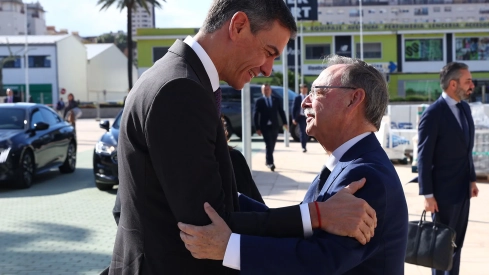
Pedro Sánchez will travel this Friday to Ceuta to direct on the ground the response to the worst migratory crisis experienced by the autonomous city since May 2021. The president will arrive accompanied by the Minister of Interior, Fernando Grande-Marlaska, after thousands of people crossed the border during Thursday and at least 18 migrants died while trying to reach the Spanish coast by swimming.
The city spent the night with the Army mobilized, security forces reinforced, and reception resources completely saturated. The death toll remains provisional and comes from police sources. The initial hypotheses suggest that the victims died from asphyxiation by immersion in the vicinity of the southern breakwater of Tarajal, while identification and search efforts continue.
The massive entry began around the Tarajal breakwater and ended up overwhelming the deployment at the border. Hundreds of people bypassed the barrier by sea and others managed to cross controls before dispersing to different parts of the city. TVE estimated the number of entries during the day at between 2,000 and 3,000, although authorities have not yet offered a consolidated official figure.
This movement came after a week in which Ceuta had already recorded around 1,500 arrivals. Services for minors are attending to some 700 young people and are operating well above their ordinary capacity, while more than a thousand people gathered outside the Temporary Immigrant Stay Center, prepared to house just over 500.
The pressure continued into the early morning. The National Police and Local Police reinforced their presence in the center of Ceuta and its surroundings, while numerous establishments kept their doors closed. Entries through Tarajal continued at a high pace past one in the morning, although significantly lower than that recorded during Thursday.
The visit begins in Tarajal
Sánchez will travel at 11:40 AM to the Tarajal border, where he will hold a meeting with representatives of the National Police and the Civil Guard. The president will learn there about the operation of the device activated to regain border control, attend to emergencies at sea, and prevent new disorderly entries.
At 12:00 p.m., he will go to the Assembly Palace to participate in a coordination meeting with the president of Ceuta, Juan Jesús Vivas, and the government delegate, Miguel Ángel Pérez. Also present will be the top officials of the National Police and the Civil Guard, as well as the directors of CETI and the Red Cross in the city.
Vivas demanded on Thursday the declaration of a situation of interest for National Security, a single command, the temporary closure of Tarajal, and more state resources. The request received the support of all parties represented in the Ceuta Assembly, from the PP and PSOE to Vox, MDyC, and Ceuta Ya!
The central government ruled out activating a national emergency through civil protection regulations because migratory flows do not appear among the risks contemplated by that legislation. The Ceuta Executive maintains that its request is based on the National Security Law, which allows for reinforced coordination through a royal decree approved by the President of the Government.
The Army reinforces an overwhelmed Civil Guard
La Moncloa decided to mobilize on Thursday afternoon the Army units usually deployed in Ceuta. The troops will act under the coordination of the Operations Command and will support the Civil Guard in the necessary tasks to maintain security, as already happened during the 2021 crisis.
The first military reinforcement consists of about 60 troops. The Interior Ministry has also increased the presence of the Civil Guard's Reserve and Security Group and has deployed new specialists from the Special Group for Underwater Activities. The National Police will increase to 200 the agents from intervention and prevention units assigned to citizen security.
The entry of thousands of people left patrols for several hours without the capacity to identify and orderly transfer all newcomers. Agents and emergency services concentrated their efforts on rescuing those in the water, attending to the injured, and locating missing persons.
The figure of at least 18 dead makes the day one of the most tragic experienced on this border. The victims would have tried to swim around the breakwater that separates Ceuta from Morocco, a short journey in distance, but especially dangerous due to currents, rocks, fatigue, and the absence of adequate equipment. Authorities do not rule out that the toll will increase in the coming hours.
Morocco, returns and Frontex support
Spain and Morocco agreed to strengthen surveillance and review measures aimed at managing those who entered irregularly. The Interior Ministry assured that both countries will work to hand them over "as soon as possible," although each case will have to respect legal guarantees, the right to asylum, and the specific protection of minors.
Grande-Marlaska held conversations throughout the day with his Moroccan counterpart, Abdelouafi Laftit, while José Manuel Albares remained in contact with the Minister of Foreign Affairs, Nasser Bourita. The Spanish Government maintains that Rabat is collaborating and attributes the massive arrival to trafficking networks that would be using the latest Supreme Court ruling to encourage new crossings.
The judicial resolution prevents the automatic application of border rejection to people intercepted at sea when they go around the breakwater. The special procedure is reserved for those who try to overcome the physical containment elements, so arrivals by swimming require identification and the corresponding individual processing.
The pressure had not disappeared on the other side of the border either. During Thursday afternoon, thousands of young people continued to arrive in Fnideq, the Moroccan town of Castillejos, and formed a column several kilometers long in the direction of Ceuta. Moroccan security forces tried to contain the crowd and moved some of those gathered to other areas of the country.
The crisis spread during the night to Melilla. The Government Delegation ordered the closure of the Beni Enzar border, the only operational crossing between the autonomous city and Morocco, after hundreds of people tried to enter en masse. Authorities asked the population to avoid traveling to the perimeter to facilitate the work of the security forces.
I conveyed to Minister Grande-Marlaska the EU’s readiness to increase support to Spain, including through Frontex, to control the situation. We are also following up with the Moroccan authorities to ensure all necessary efforts are made to prevent these dangerous journeys.
— Magnus Brunner (@magnusbrunner) July 30, 2026
The European Commission has offered financial, technical, and operational support through Frontex. The Commissioner for Home Affairs and Migration, Magnus Brunner, informed Marlaska that Brussels is closely monitoring the situation and maintaining contacts with Morocco to prevent new dangerous crossings.
The visit will also leave a delicate political photograph. The PP accuses the Executive of having reacted late and demands the activation of the National Security Law. The far-right Vox uses the arrival to speak of an "invasion" and link migration with crime, while Sumar demands that the response preserve asylum and the protection of minors. Podemos has even called for Marlaska's resignation.
Sánchez and Juan Jesús Vivas will appear together after the coordination meeting. The meeting should specify the new resources for the border and reception, the scope of the military deployment, and the measures agreed with Morocco to face the coming hours.
Add ElConstitucional.es as a preferred Google source for free.
Stay informed about all the latest breaking news with the best information. Against disinformation, for democracy and social rights.
