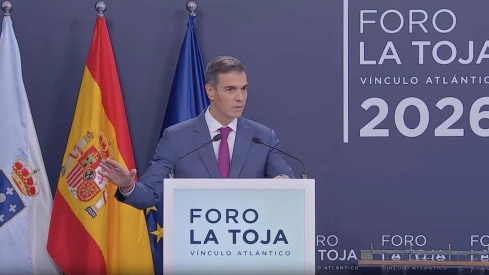
The President of the Government, Pedro Sánchez, questioned this Thursday Donald Trump's commitment to leave the regulation of artificial intelligence in the hands of the technology companies themselves. "It is a mistake to put the care of the henhouse in the hands of the fox," he warned during the inauguration of the 'La Toja-Atlantic Link Forum', where he defended public controls and legal responsibilities for those who use algorithms against democratic coexistence.
Sánchez demanded "legal obligations, public scrutiny, governmental supervision" and the assumption of "responsibilities, even criminal" when large platforms manipulate their systems for purposes that threaten democracy. His intervention placed the power of the so-called "techno-oligarchs" among the main challenges for institutions that must retain the capacity to protect citizens against global companies.
The speech took place in O Grove, Pontevedra, before King Felipe VI, former Prime Ministers Felipe González and Mariano Rajoy, and the President of the Xunta, Alfonso Rueda.
A few hours before the vote on the two housing decrees, Sánchez also conveyed to that platform a request to Congress to validate them and set aside "partisan confrontations".
Criminal responsibilities against the power of algorithms
The head of the Executive defended an artificial intelligence with a humanist vocation, subject to democratic authorities. "I believe that progress has never consisted of giving up rules, it has consisted of building rules that are up to the moment each society lives," he stated. His approach requires that technological development be accompanied by obligations that can be audited, with consequences for those who fail to comply with them.
In support of this position, he championed the Spanish Agency for the Supervision of Artificial Intelligence and the IA360 Plan, presented on September 21. This roadmap foresees actions over twelve months to extend the use of technology in the economy and public services, strengthen Spanish capabilities, and advance an agreement with social agents on its responsible deployment.
He has also mentioned the bill currently being processed to prohibit the use of social media for minors under 16 years of age. Sánchez has linked this initiative with the demand for accountability from large platforms, whose services affect both the protection of minors and the information citizens receive.
The president has warned that these powers have acquired a "planetary scale", making the response of each State insufficient. Hence his call for a Europe with greater capacity for action and a more ambitious budget, capable of financing security, technological autonomy, and adaptation to the climate emergency. This defense of European cooperation included a reproach to the PP for blocking the treaty of friendship with France in the Senate. "What national foreign policy interest or idea of Europe is being defended when it is decided to overturn a treaty of friendship with France?", he asked.
La sociedad necesita reglas justas y quiere certezas. Saber que no estará sola.
— Pedro Sánchez (@sanchezcastejon) October 1, 2026
Para eso sirven las instituciones. Para eso sirven Europa y el sistema multilateral.
Y ese es el orden que merece la pena construir. pic.twitter.com/ILFCnrU4KQ
Under the forum's motto, 'A world in disorder', Sánchez has linked technological deregulation with the weakening of international law, the use of tariffs as a pressure instrument, and the economic consequences of wars. He has called for social shields to protect families and businesses against rising energy costs and has defended renewables with another of the phrases from his speech. "Against Ormuz, sun, water, and wind".
Housing arrives in Congress as a matter of humanity
The protection of those with less capacity to defend themselves has led the discourse to the housing emergency, which Sánchez has pointed out as one of the country's greatest difficulties. The president has defended the agreements reached on Tuesday within the coalition government and through parliamentary dialogue, in response to the mobilizations that followed the eviction of Maricarmen, 87 years old.
"We have to guarantee access to housing and what I ask of Congress and also of the groups is a broad vision to validate the decrees," he demanded. He then urged the parties to overcome their differences. "Let's put aside ideology and partisan confrontations to focus on a matter that is purely human."
Esta semana hemos aprobado importantes medidas para proteger a la gente, para garantizar el derecho a la vivienda.
— Pedro Sánchez (@sanchezcastejon) October 1, 2026
Pido al Congreso altura de miras y sentido de Estado para convalidar los decretos en la sesión de mañana.
Pido que la humanidad se imponga a la ideología. pic.twitter.com/aJXcUnuyR0
The call comes with two separate votes and distinct perspectives. The first decree brings together the bulk of the protection measures, including actions against evictions and restrictions on housing purchases by investment funds. The second includes the automatic renewal of rental contracts, one of the central demands of the tenant movement.
Podemos confirmed its support for both texts this Thursday, after meeting with the Confederation of Tenants' Unions. The PNV will support the first and reject the second, while Junts has called its executive committee tonight to decide the vote. The position of the separatists and that of Coalición Canaria remain decisive for the validation of the main package.
The rejection by the five PNV deputies leaves the automatic renewal decree without a majority, even if Junts were to support it, given the positions announced by the groups. The Basque nationalists argue that it would harm small landlords and reduce the rental supply. The separation of the norms allows Congress to vote on the rest of the protections without their approval depending on that measure. Both texts will be submitted for validation this Friday, October 2.
