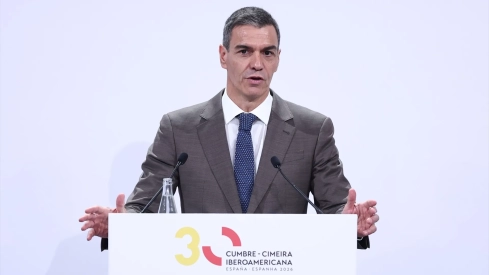
Pedro Sánchez has avoided fueling a new confrontation with Javier Milei at the end of the XXX Ibero-American Summit, held in Madrid. Asked about the speech in which the Argentine president equated socialism with fascism, the head of the Spanish Executive defended respect among leaders and made his position clear. "Insult is not part of my way of understanding or doing politics," he stated.
The response came after both had a brief and cold greeting at the beginning of Thursday's plenary session. It was their first face-to-face encounter after a succession of public attacks by the Argentine president against Sánchez, whom two weeks ago he called an "unpresentable dictator" during a visit to Madrid.
Far from engaging in an exchange of disqualifications, Sánchez thanked Milei and the rest of the leaders for the effort of traveling to Spain to participate in the summit. "Presidents are here to unite, particularly when we are at multilateral summits," he said at the subsequent press conference, where he advocated for cooperation between countries with different political positions.
The closing of the event left a joint declaration, although with reservations from Argentina and other countries in some of its sections. Buenos Aires distanced itself from the point that rejects certain coercive measures contrary to international law and also from several agreements on artificial intelligence, academic mobility, and care.
Milei again attacks socialism before Sánchez
The tension between the two presidents was one of the focuses of attention at the summit, after Milei's repeated attacks against the head of the Spanish Government and his family. The Argentine president did not attend the inaugural ceremony at the Teatro Real on Wednesday nor the dinner offered by the kings at the Palacio Real, although he did meet in Madrid with the leader of the far-right Vox, Santiago Abascal.
This Thursday, Milei participated in the plenary held at the Galería de las Colecciones Reales. There he again attacked socialism and equated it with fascism before Sánchez, although on this occasion he did not direct a personal insult to the Spanish president during his speech.
At the end of the summit, Sánchez avoided commenting in detail on the Argentine's words and also did not clarify whether they had exchanged any conversation beyond the protocol greeting. He did defend that it is possible to maintain respect "even having different ideas" and insisted on the importance of dialogue spaces in an international moment marked by conflicts and divisions.
The President of the Government considered the summit a "success" due to the progress made and emphasized the usefulness of the agreements for citizens. His intervention followed the line he already conveyed during the inauguration, when he called for strengthening ties between Latin America, the Caribbean, and Europe and defended cooperation against those who erect barriers.
Argentina distances itself from several agreements
The final declaration includes the rejection of "coercion" and measures contrary to international law and the United Nations Charter that hinder the capacity of States to meet their development needs. Argentina, Colombia, Costa Rica, and Paraguay have placed on record that they distance themselves from that specific section.
Differences have also reached some of the initiatives that Spain aspired to promote in Madrid. Argentina has not joined the Ibero-American Artificial Intelligence Alliance, the Academic Mobility Charter, or the Care and Support Charter. Paraguay has also disassociated itself from the point on the artificial intelligence alliance and has expressed reservations about the language related to gender equality.
The disagreement on these sections has not prevented a final declaration from moving forward. The Ibero-American Secretary General, Andrés Allamand, downplayed the reservations and defended that there is consensus on the core of the text, even if some governments wanted to reflect their differences.
Among the agreements reached is the creation of an Ibero-American Network for Disaster Risk Reduction and Civil Protection, supported by the 22 countries. The initiative seeks to improve prevention and shared response to emergencies, with early warning mechanisms and cooperation.
The summit has also addressed student mobility and cooperation in care. The academic charter aims to facilitate exchanges, double degrees, and postgraduate studies between institutions in the region, while the care charter is proposed as a voluntary tool to guide support policies.
Sánchez, on the other hand, downplayed the absence of leaders such as Brazilian Luiz Inácio Lula da Silva and Mexican Claudia Sheinbaum. Although their countries were represented, neither of them traveled to Madrid. The Spanish president defended that all delegations participated and thanked the effort of those who did attend the meeting.
