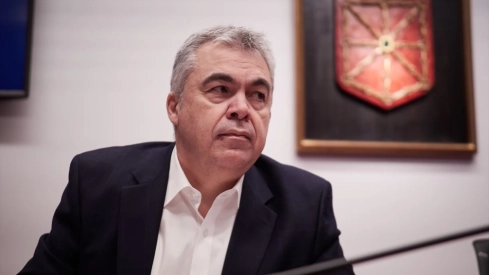
Santos CerdánSantos Cerdán has chosen a book to reappear publicly a year after his provisional imprisonment. The former Secretary of Organization of the PSOE publishes ‘The Fall. Power, Narrative and Destruction in the Era of Political Impeachment’, a self-published work distributed on Amazon in which he presents himself as a victim of political persecution, vindicates his role in the majorities that supported Pedro Sánchez, and denounces the damage of media trials before a sentence.
The book arrives with investigations still open. Cerdán is named in the case derived from the Koldo case, where the Central Operative Unit (UCO) of the Civil Guard attributes to him a relevant role in an alleged plot of public contracts and commissions. He also appears linked to the 'Leire Díez case', which investigates alleged maneuvers to discredit agents, prosecutors, and judges related to procedures affecting the socialist environment. He denies everything and places his fall in another terrain: that of the narrative, public exposure, and suspicion turned into social condemnation.
“In politics, when you make yourself uncomfortable enough, you stop being useful,” Cerdán writes. “You become a problem, and problems are not managed. They are eliminated.” This phrase summarizes much of the book's tone. The former socialist leader maintains that his case is part of a broader dynamic in which the criminal route can become a tool for political attrition. He cites precedents such as Lula da Silva, António Costa, or Podemos, and accuses the system of activating machinery where “facts cease to matter.”
Cerdán offers few concrete explanations about the causes that have marked his departure from the PSOE. He does not elaborate on the role of Koldo García, avoids going into depth on José Luis Ábalos and barely addresses the plot attributed to Leire Díez. The work focuses more on his personal experience, on political downfall, and on the defense of the presumption of innocence than on responding point by point to the evidence handled by investigators.
Puigdemont, Sánchez and the resignation
One of the most politically charged passages is in the photo with Carles Puigdemont in Brussels, during the 2023 investiture negotiations. Cerdán assures that that image marked a before and after. “For me, it was the beginning of everything that would come later,” he writes. According to his account, until then he had been an organic, discreet figure, in charge of opening channels with the PNV, EH Bildu, and Junts to make possible agreements that seemed blocked.
The former socialist number three defines himself as an “architect of impossible majorities” and claims his role in the 2018 no-confidence motion, in the formation of María Chivite's Government of Navarra, and in the parliamentary pacts that sustained Sánchez. He also recounts that the channel with Junts started before the 2023 general elections and that he resorted to the PNV to organize a first meeting with Jordi Turull in Bilbao.
Cerdán also corrects the narrative that circulated after his fall. He assures that Sánchez did not ask for his resignation at La Moncloa. “I want to make it clear, no one asked me to resign,” he states. According to his version, he went to the president's office with the decision made and left his positions convinced that it was the only way to defend himself.
The account clashes with the political version that the PSOE has used for months to defend its reaction to corruption cases: immediately removing leaders implicated in investigations. Cerdán does not directly attack Sánchez, but he does hint at the subsequent solitude. He speaks of feeling “abandoned and battered” after the party's lawyer stopped representing him and the civil liability insurance refused to assume his defense.
Soto del Real and the leaked photo
The book dedicates several pages to his time in Soto del Real prison, where he remained for 142 days, from June 30 to November 19, 2025. “The first night in the cell is not an experience. It's a slap in the face,” he writes about his arrival at module 13. He says he had no cellmate, that only his wife, his sister, his brother-in-law, and his lawyers visited him, and that calls cost 2.20 euros each.
He also recounts the episode of the photographs taken inside prison and published by a digital media outlet. According to Cerdán, an inmate warned him that up to 50,000 euros were being offered for an image of him in prison. Days later, the photos were published. The former leader assures that the inmates who took them were sent to isolation cells.
His release from prison also appears narrated in a personal tone. Cerdán recounts that he learned on television that he was being released and that he then walked out among cameras and journalists. "The cell door had opened, but the story had not ended," he writes.
'The Fall' thus functions as a public defense of the former strongman of Ferraz, more focused on reputational damage and the role of the media than on the judicial content of the case files. Cerdán tries to establish his narrative before the courts speak, amid a full judicial and political offensive against the PSOE after Ábalos, Leire Díez, and the investigations that continue to encircle the old socialist apparatus.
