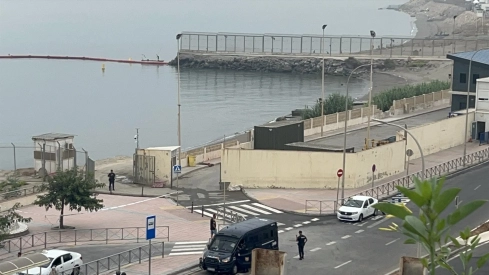
The extensive security deployment by Spain and Morocco due to the fear of a new attempt of massive entry into Ceuta has prevented a collective crossing from Moroccan territory. The alert had been activated after calls circulated on social media in recent weeks to try to reach the autonomous cities this Saturday, August 15. Given this scenario, Spain has reinforced border surveillance in Ceuta and Melilla, while Rabat has multiplied controls and personnel in the vicinity of both territories.
In Ceuta, the Spanish deployment currently totals 880 national police officers and 714 civil guards, in addition to 45 agents from the Prevention and Reaction Unit and another 20 personnel from the Central Foreigners and Borders Brigade. This contingent is joined by riot units, divers, boats and aerial assets, as well as nearly 2,000 military personnel available for support tasks. Surveillance extends to the terrestrial perimeter, beaches, breakwaters and waters near the city, where a maritime barrier of about 500 meters has also been installed in Tarajal. The Spanish deployment is coordinated with Morocco, whose control of movements in its territory is key to preventing large groups from simultaneously reaching the border.
The Moroccan action has intensified especially in Fnideq, a town located next to Ceuta. Hundreds of police, gendarmes, members of the Auxiliary Forces and riot units have taken positions at the accesses and areas near the border, with vehicle controls, road surveillance and patrols in wooded areas. Barbed wire and metal barriers have also been installed, while riot vehicles and Royal Navy boats remain deployed in the coastal area.
Charges against migrants by the Moroccan Police
This Saturday, Moroccan security forces charged against groups of migrants trying to advance towards Ceuta in a mountainous area located about three kilometers from the border. The agents used tear gas and batons and had the support of helicopters, drones and police dogs to disperse the groups. So far, 148 people have been intercepted: 128 from sub-Saharan African countries and another 20 of Moroccan nationality.
Rabat's operation has also included actions against those who, according to authorities, would be promoting the calls through social media. In recent days, the General Directorate of National Security has arrested 61 people accused of inciting or promoting irregular migration. These actions are in addition to the restrictions imposed on the ground on Spanish media outlets that were covering the operation.
Journalists forced to leave the town
A local official from the Moroccan Ministry of Interior, Youssef Hajji, ordered EFE and TVE journalists dispatched to Fnideq on Saturday to leave the town while reporting on the situation at the border. The EFE correspondent witnessed the official relaying the same instruction to the TVE team and, according to the agency, warned them that their accreditations and professional equipment could be confiscated if they did not leave Castillejos.
EFE has requested explanations from the Moroccan Ministry of Interior, although it has not yet received a response. The Director of Communication of the Ministry of Youth, Culture and Communication, for his part, has assured that he is trying to clarify what happened. Meanwhile, the reinforcement of the border continues on both sides, with the aim of preventing a repeat of the massive entry recorded at the end of July.
