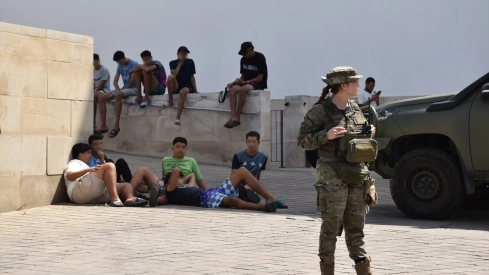
The Government has concentrated in Ceuta and Melilla an extraordinary security deployment in response to the calls disseminated during recent weeks to attempt to cross the borders this Saturday, August 15. The authorship and real scope of the calls remain uncertain, although the precedent of July 30 and 31 has led the Interior Ministry to prepare for all scenarios and to reinforce coordination with Morocco.
The operation covers the terrestrial perimeters, beaches, breakwaters, and waters near the two autonomous cities. Air surveillance and monitoring of movements detected on the other side of the border have also been increased. The immediate objective is to prevent large groups from simultaneously approaching Ceuta or Melilla and once again overwhelming the deployed devices.
Ceuta has 880 national police officers and 714 civil guards, nearly 500 more personnel than before the massive entry at the end of July. They are joined by another 45 agents from the Prevention and Reaction Unit to reinforce citizen security and 20 members of the Central Foreigners and Borders Brigade, responsible for expediting international protection files and return procedures.
Among the mobilized units are riot squads, citizen security agents, divers from the Special Group for Underwater Activities, boats, and aerial assets. The maritime deployment includes the vessel 'Duque de Ahumada', while a helicopter maintains surveillance over the coast and the most sensitive points of the perimeter.
The General Command of Ceuta also keeps nearly 2,000 military personnel available for support tasks. Permits have been restricted to guarantee the presence of units in case of any incident. A maritime barrier of about 500 meters has been installed at the Tarajal breakwater, reinforcing containment on the route used by thousands of people at the end of July.
Melilla has also raised its level of vigilance. The Interior Ministry has sent three groups from the Civil Guard's Reserve and Security Group and fifty agents from the Police Intervention Unit. The patrol boat 'Río Segura' remains in the city with a crew of 25 people, and a helicopter transferred from Malaga completes the control by land, sea, and air.
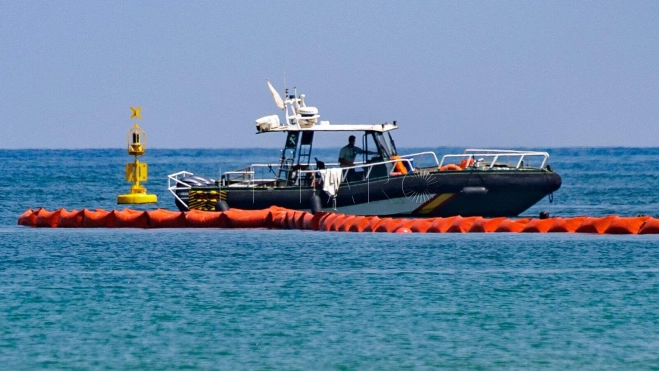
The Civil Guard has placed a provisional floating barrier in the South Dock and has closed the last 140 meters of an area that was previously delimited by a breakwater with construction fences. The Interior Ministry maintains that these elements allow agents' actions to adapt to the recent Supreme Court doctrine on border rejections by sea.
Intelligence services are closely monitoring movements in Nador and Mount Gurugú, where different security sources have located groups of people from other Moroccan cities. The possible shift of pressure towards Melilla is part of the contemplated scenarios, although so far no institution has confirmed a concentration capable of sustaining a coordinated attempt of great magnitude.
The president of Melilla, Juan José Imbroda, has called for calm and has argued that the city's situation is different from that experienced in Ceuta. The local government recognizes, however, that the increase in arrivals has led to an over-occupation of the La Purísima juvenile center, whose facilities and staff have had to be reinforced.
Morocco tries to cut off movements before the border
The Spanish deployment relies on Morocco's actions, whose ability to intercept displacements before they reach the perimeters is decisive. Rabat has mobilized hundreds of police, gendarmes, members of the Auxiliary Forces, riot units, and military personnel at the accesses to Ceuta and Melilla.
Fnideq, the Moroccan town located next to Ceuta, remains under numerous controls. The police and Gendarmerie check vehicles on the road from Tangier, monitor collective transport, and patrol wooded areas commonly used as refuge. The beach closest to the autonomous city has been partially closed, and access to the coastal road is restricted.
In the vicinity of the border crossing, fences, metal barriers, and new concertina wire have been installed. There are also riot vehicles equipped with water cannons, while Royal Navy boats patrol off the coast. Dozens of buses remain ready to transport intercepted individuals to the interior of Morocco.
Vigilance extends to Nador, Beni Enzar and the accesses to Melilla. Moroccan authorities have announced arrests and judicial proceedings against several people suspected of spreading messages aimed at organizing the crossings. The spokesperson for the Ministry of Interior, Rachid El Khalfi, assures that "all necessary measures" have been adopted and has asked to disregard calls that he considers "suspicious and misleading".
Rabat simultaneously demands shared responsibility and asks Spain to accelerate the resolution of open cases, especially those related to Moroccan minors. The Spanish Government maintains that any family reunification must be studied individually and respect the best interest of the minor.
Institutions combat hoaxes about August 15
The security operation is accompanied by an institutional campaign aimed at dismantling false information circulating on Facebook, Instagram, TikTok and closed WhatsApp groups. Among the messages disseminated are references to a supposed opening of the border, the delivery of Spanish documentation or automatic transfer to the Peninsula.
The Spanish Embassy in Morocco has published a direct warning reminding that entering Ceuta or Melilla irregularly does not grant the right to remain in Spain nor does it allow access to the rest of Europe. "All information to the contrary is false," the diplomatic representation warned.
Información verificada:
— Embajada de España en Marruecos (@EmbEspanaRabat) August 11, 2026
Entrar irregularmente en Ceuta o Melilla no da derecho a permanecer en España ni a acceder al resto de Europa.
Toda información en sentido contrario es FALSA.
The European Commission has strengthened coordination with Meta and TikTok, whose teams and fact-checkers work 24 hours a day to detect content related to human trafficking, incitement to violence, and the spread of false information. Brussels maintains daily contact with the platforms and believes that the mechanism has allowed for a reduction in the visibility of some messages.
Institutional warnings seek to dismantle the promise of an automatic route to the Peninsula. Applications for international protection must be examined individually, and minors arriving without family members are protected by Spanish legislation and international child protection conventions.
The Government also faces the consequences of the entry registered at the end of July. The Interior Ministry estimates that about 5,000 people still remain in Ceuta and puts the number of identified minors at 1,898. The Ceuta executive handles higher estimates, and its president, Juan Jesús Vivas, has demanded more resources, a new legal framework, and greater speed in administrative resolutions.
From this Sunday, August 16, a technical team from the Ministry of Youth and Childhood will be permanently installed in Ceuta to accelerate the identification of minors, study possible family reunifications, and prepare referrals to other communities. The Government has announced an extraordinary allocation of 25 million euros to reinforce their care, which will be addressed at the next Sectoral Conference on Childhood and Adolescence.
The Minister of Inclusion, Social Security, and Migration, Elma Saiz, will travel to Ceuta on Monday to meet with Vivas and learn about the humanitarian operation deployed. In Melilla, the regional government has purchased 100 beds, 100 fireproof mattresses, and 80 bed bases for La Purísima, in addition to incorporating educators, educational assistants, and cleaning staff.
During the first hours of Saturday, the deployed units maintain reinforced shifts in both perimeters, while information services follow the evolution of digital calls and movements detected in Fnideq, Nador, and the surroundings of Gurugú.
