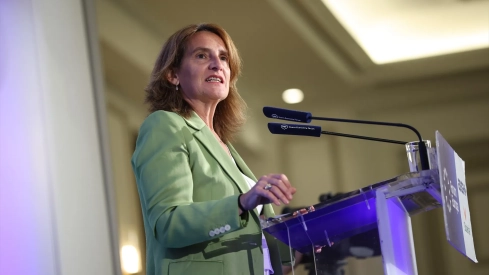
Teresa Ribera has questioned this Monday whether the entry of nearly 80,000 migrants into Ceuta during July 30 and 31 occurred completely spontaneously. The executive vice-president of the European Commission considers it difficult to explain a mobilization of such dimensions without some degree of organization.
"What happened in Ceuta we will gradually learn and discover, and I believe we must be prudent in this regard," she stated during an informative breakfast at 'Fórum Europa'. She then clearly expressed her doubts. "It is very difficult to think that 80,000 people agree on their own at a certain moment," she pointed out.
Ribera avoided directly accusing the Moroccan government and also did not answer whether Brussels should demand explanations from Rabat for the actions of its security forces. She did point to a possible instrumentalization of migratory movements to achieve political or diplomatic objectives.
The doubts about what happened at the border
The European leader recalled that Ceuta and Melilla constitute the two only land borders between the European Union and Africa. She also mentioned the crises caused in the east of the continent by the use of migrants as a tool of pressure from Russia and Belarus, a threat against which Brussels began to prepare specific response mechanisms.
Ribera's words come after the Government published 40 reports, alerts, and intelligence communications about the crisis. The documentation shows that the National Intelligence Center warned both Spanish authorities and Moroccan services on July 29 that several groups were spreading plans to cross the border on social media. The detected communities gathered around 180,000 followers.
The documents also record an insufficient response from Moroccan forces during the decisive hours. Pedro Sánchez has maintained, despite these unknowns, that Spain lacks solid evidence to affirm that Rabat organized the entry. Morocco rejects any responsibility and attributes what happened to messages spread on social media, the actions of traffickers, and the confusion generated by a Spanish judicial resolution.
A common response from the European Union
Ribera has demanded that the EU improve its capacity to react quickly to episodes of these characteristics. "Europe never wins when it responds divided to a problem," she warned, before advocating for greater coordination among member states and the strengthening of European border surveillance and support systems.
The vice president used a statistic to explain the magnitude of the episode. Frontex recorded just over 74,000 irregular entries into the European Union during the first eight months of 2026, while nearly 80,000 people arrived in Ceuta in just two days. A good part of the latter do not appear in the agency's figures because they subsequently returned to Morocco.
The European response, Ribera argued, must maintain respect for rules and people. The community leader called for special attention to the minors who crossed the border and rejected that urgency should serve to lower their guarantees. "Respect when we talk about minors is also important to remember in the management of this crisis," she concluded.
Add ElConstitucional.es as a preferred Google source for free.
Stay informed about all the latest breaking news with the best information. Against disinformation, for democracy and social rights.
