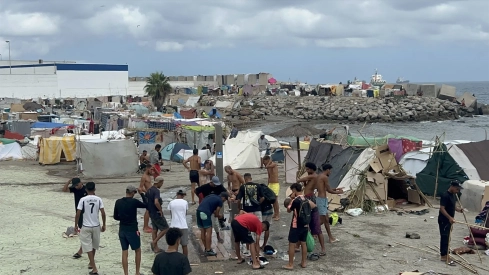
The Spanish response to the Ceuta crisis combines two demands that political debate usually presents as opposing. A large majority calls for more control at the borders of Ceuta and Melilla, while an even larger percentage considers it essential to maintain understanding with Morocco to guarantee its security.
These are the main conclusions of the September Barometer of the Center for Sociological Research, the first study published after the massive entry of migrants recorded at the end of July. The survey was conducted through 4,042 telephone interviews carried out between September 1 and 4, with a margin of error of 1.6%. 97.1% of participants claim to be informed about what happened.
More security and a pragmatic relationship with Rabat
82.2% of respondents believe it is necessary to reinforce Spanish borders to prevent new massive entries into Ceuta and Melilla. Rejection of this measure is reduced to 13.3%, while the rest acknowledge that they lack sufficient information or avoid answering.
This support for border control coexists with an even clearer commitment to cooperation. 86.3% attach much or considerable importance to understanding between Spain and Morocco to secure the borders. 10.1% give it little or no relevance.
Support decreases slightly when the CIS asks about a policy of "friendship and good neighborliness," although it still reaches 73.6% of the population. The difference between both responses draws a relationship based mainly on pragmatism. Citizens see it as necessary to maintain channels with Rabat, especially for its role in migration control, although a part maintains reservations about a bilateral relationship that has gone through successive crises.
The position on sovereignty also appears clear. 77.1% consider Ceuta and Melilla to be as Spanish territories as any other on the peninsula. 14.3% understand that the cities present an ambiguous and special situation that should be addressed through agreements with Morocco. For the majority, collaboration with Rabat can be strengthened without opening any debate about the Spanishness of both territories.
Almost unanimous support for greater European involvement
The most shared demand is directed towards Brussels. 89.4% want the European Union to collaborate more with Spain in managing the situation in Ceuta, compared to 7.2% who consider the community response sufficient. The data offers broad social support for the strategy of moving the crisis to the European sphere and treating the Ceuta border as part of the Union's external border.
The barometer also reveals a strong perception of international interference. 67.7% believe that there are countries, leaders, or global actors interested in causing problems between Spain and Morocco. Within that group, 49.1% mention the United States or American sectors, 38.1% point to Morocco or a part of its society, and 35.4% indicate Israel.
Donald Trump is expressly cited by 33.4% of those who perceive these maneuvers, followed by Benjamin Netanyahu, with 15.2%. Russia gathers 10.8% of mentions, the European Union itself 10.1%, and Giorgia Meloni 6.1%. These percentages allow for multiple responses and are calculated only on those who believe that external actors are generating tension. Mentions of the United States and Trump, or those referring to Israel and Netanyahu, cannot be added as if they represented distinct groups.
The formulation of the questionnaire requires interpreting this block with caution. The CIS directly asks if there are actors trying to create "problems or misunderstandings", but leaves out an assessment of the management carried out by the Government of Pedro Sánchez and also does not request attributing responsibility for the massive entry. The results allow measuring preferences on borders, diplomacy, and European support, but do not offer direct approval or rejection of the Executive's actions.
The crisis maintains enormous public notoriety, although its weight decreases when citizens spontaneously respond about the country's main problems. Concern about immigration has dropped from 23.4% to 19.7%, while the specific category on Morocco and the borders of Ceuta and Melilla barely appears in 4.8% of responses. Housing continues to dominate the citizen agenda with 37.5%, followed by the economic situation, with 21.6%.
Add ElConstitucional.es as a preferred Google source for free.
Stay informed about all the latest breaking news with the best information. Against disinformation, for democracy and social rights.
