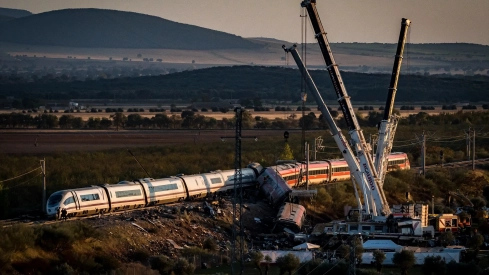
The Urda railway accident continues to raise questions about the decisions that were made from the Atocha control center during the minutes leading up to the crash. Communications between the AVE driver and the control center workers show that the driver reported a failure in the security system that indicated the track was occupied. Despite this warning, he received permission to continue circulating.
The conversation is key to reconstructing what happened on October 28, when the AVE hit the Iryo train from behind, which remained stopped. Now, investigators are analyzing the orders that were given, the warnings each convoy received, and the functioning of the security systems.
The driver warned that there was a train on the track, but Atocha gave him permission to continue
The first communication occurred after the LZB security system, responsible for controlling train speed and helping to prevent accidents, failed. The driver communicated to the control center: "I got a partial block 000 failure". With this message, he was warning that the system detected an obstacle ahead, which in this case was the Iryo train stopped on the track. The control center worker even repeated the information to confirm that he had understood it: "You told me you have a stop point and zero target, right?". The driver replied yes.
The expression "zero target" means that the train must stop completely, as the system indicates that the section of track ahead is occupied. Once stopped, the driver can only resume travel under special safety conditions and advancing with great caution, which is known as "sight driving". Despite this, Atocha authorized the AVE to continue at normal speed, without applying that limitation.
The difference between the indications received by the two trains is another key to understanding what happened. While the AVE system indicated a "target 0", the Iryo train received an indication of "target 40". This means that the Iryo system allowed it to circulate at a maximum of 40 kilometers per hour, although the convoy remained stopped and its driver had communicated this situation to the control center.
The change of a traffic light from red to green left the AVE without another warning signal
The Minister of Transport, Óscar Puente, explained that there was another safety element that could have alerted the AVE driver that he had a train in front of him: a traffic light that was red. This signal could have served as a warning for the driver to reduce speed or stop the convoy before reaching the Iryo. However, from the Atocha control center, the Urda traffic light was changed to green to allow the Iryo train to resume circulation, although it ultimately could not move.
By changing that signal, the previous traffic light, located at a greater distance, also turned green. In this way, the safety system stopped showing a stop signal that could have served as a warning for the AVE. The first technical report on the accident places the collision between the AVE and the Iryo at a speed of between 160 and 200 kilometers per hour. The impact occurred around 8:53 a.m., when the Renfe train hit the Iryo convoy from behind, which remained stopped.
Investigators are analyzing communications between the drivers and the control center, records of safety systems, and the circumstances that prevented the Iryo from resuming its journey. For now, several questions remain open: why did the LZB system fail, why did Atocha authorize the AVE to circulate without reducing speed, and why was it not detected that the Iryo train remained stopped on the track.
