The housing crisis already occupied a central place in the concerns of Spaniards before Maricarmen's eviction filled the Puerta del Sol. 86.6% of those surveyed by the Center for Sociological Research (CIS) believe that access to decent housing is not guaranteed for everyone, according to the study on the Welfare State published this Wednesday.
The figure brings together two distinct responses. 68.4% consider that this right is only guaranteed for some people and another 18.2% think that no one has it assured. Barely 11.9% believe that everyone can access decent and adequate housing. The study was prepared with more than 6,000 interviews between September 10 and 17, before the eviction of the 87-year-old woman that triggered protests and encampments throughout the country.
The comparison with the previous survey shows that the perception of inequality has worsened. In 2024, 82.3% considered that access to housing was not guaranteed for everyone. Now it is 4.3 points more. Then, 15.7% believed that the right was within reach of anyone; today 11.9% affirm it.
Buying the first home seems increasingly difficult
Pessimism intensifies when the CIS asks about the future. 65.9% believe that accessing a first home will worsen, 17.2% think it will remain the same, and only 14.3% expect an improvement. Overall, 83.1% do not trust that buying their first home will be easier in the coming years. In 2024, those who predicted a worsening were 58.5%.
The answer is supported by prices. The National Institute of Statistics (INE) registered an interannual increase of 12.2% in free housing in the second quarter of 2026. In second-hand homes, which concentrate a good part of sales, the increase reached 12.9%. These are data from operations carried out, different from the opinions collected by the CIS, but they help to understand why the prospect of buying is moving away.
The Bank of Spain provides another measure of that distance. According to its latest annual report, the average price of a home in 2024 was equivalent to 6.8 years of net income for households that were not yet owners. The figure rose to 9.7 years in the city of Madrid and 10 in Malaga. For many households, the problem begins long before applying for a mortgage, with the savings needed for the down payment and purchase expenses.
The discomfort also crosses very different electorates. The published cross-sections of the study show broad majorities among voters of PSOE, Vox, Sumar, Junts, and PNV who believe that the right to housing is not equally fulfilled. This political extension explains why the discussion already goes beyond the usual differences between parties on rent, property, or the construction of new homes.
From the survey to Friday's vote
Article 47 of the Constitution recognizes the right to enjoy decent and adequate housing and entrusts public authorities with promoting the conditions to make it effective. The survey asks about the perception of that access, so its percentages do not measure how many people lack housing nor do they allow for evaluating the measures approved this week. The responses were collected before Tuesday's Council of Ministers.
The Government published this Wednesday in the Official State Gazette the first of its two housing decrees. It will come into force on Thursday and includes, among other measures, protection against certain evictions of vulnerable people until 2030, the regulation of seasonal and room rentals, and the possibility of requesting an extraordinary extension of up to two years for certain contracts that are close to expiring. The second text addresses the automatic renewal of rentals and faces a more uncertain vote. Both will need validation from Congress.
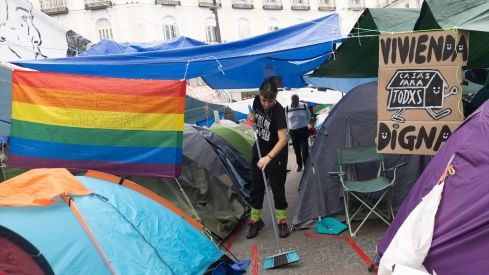
The Sol encampment has maintained the protest after the approval of the decrees and demands solutions that provide stability to tenants and curb price increases. The CIS had collected this discontent days before the first tents were set up. On Friday, deputies will vote separately on the two government responses to a problem that 86.6% of respondents already saw as far from resolved.
