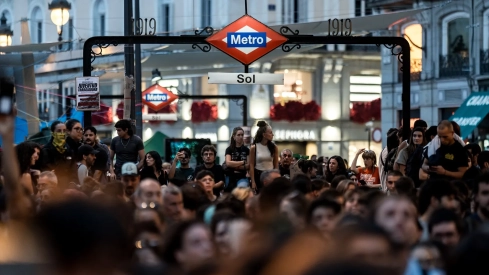
The Council of Ministers approved two housing decrees this Tuesday and, as night fell, the tents were still in Puerta del Sol. Thousands of people gathered in the Madrid square after the call from the Tenants' Union to protect the encampment against threats spread by far-right groups. Many later returned to their homes; hundreds of protesters remained there to spend the fourth night.
The protest had begun on Saturday, after the eviction of 87-year-old Maricarmen Abascal. She has accepted an agreement to return to her home, but her case has led to a mobilization that is already spreading to other cities. In the assembly held this Tuesday in Sol, the union asked to maintain the encampment at least until Friday, urged union organizations to work towards a general strike, and called for people to take to the streets again during the weekend.
The approval of the decrees is a step forward that the collectives attribute to citizen pressure. They are also concerned that the Government has distributed the measures in two texts that must separately pass the Congress vote. That is why they want to read the full wording before assessing the extent of the announced protections.
Two housing decrees pending support in Congress
The first brings together most of the package. It includes the extension until 2030 of protection against evictions of vulnerable households, a two-year extension for current rental contracts that end before December 31, 2028, measures on seasonal and room rentals, and restrictions on speculative housing purchases until 2028. It also incorporates tax incentives and actions to promote public housing. The specific scope of several measures, including the restriction on speculative purchases, must be verified in the official text.
The second decree contains the automatic renewal of rental contracts, with exceptions for certain cases of owner necessity. It was the last major hurdle in a negotiation that PSOE and Sumar extended until Tuesday noon. Minister Pablo Bustinduy admitted that Sumar wanted to include that measure along with the rest and that he also does not share some tax breaks or the agreed temporary limits. Even so, he defended the agreement and asked the parliamentary groups to validate it.
The publication of both texts in the BOE is scheduled for this Wednesday. Their wording will allow checking since when each measure is in force. The Government has requested an extraordinary plenary session to vote on them on Friday, but is still looking for the necessary support. Junts and Podemos have not clarified their vote. Míriam Nogueras' party demands more protection for small owners and keeps negotiations open; Podemos criticizes the division of the package. The separation leaves the decree on automatic renewal particularly exposed, which generates more resistance among potential parliamentary partners.
The distance between administrations was also evident in the special on housing broadcast last night by RTVE. The Madrid councilor Jorge Rodrigo maintained that the decrees had "finished off" the rental market. Minister Isabel Rodríguez responded that, if the Community of Madrid left its powers in the hands of the central Government, she would convene another Council of Ministers to freeze rents in the region. Rodríguez also acknowledged that she must be prudent about the outcome of Friday's vote.
#DecretoMaricarmenRTVE | Isabel Rodríguez, ministra de Vivienda, se dirige al consejero de Vivienda de la CAM: "Deje esas competencias en manos del Gobierno de España y mañana mismo convocamos otro Consejo de Ministros para congelar el alquiler en la Comunidad de Madrid". pic.twitter.com/RV65Z1v3Lu
— RTVE Noticias (@rtvenoticias) September 29, 2026
Sol resists amidst far-right threats of violence and Ayuso's ultimatum
The assembly at Puerta del Sol had made clear in the afternoon its decision to continue. "This goes beyond Maricarmen or a decree," said the protesters. Their spokesperson Valeria Racu asked to know the fine print of the rules and recalled that behind many evictions there are years of increases, burofaxes, and uncertainty that rarely appear in images of a judicial launch.
Hours later, far-right messages changed the rhythm of the square. Daniel Esteve, head of Desokupa, hinted on social media that there would be a "party" during the night, while Pedro Chaparro, from the neo-Nazi group Democracia Nacional, encouraged to "kick out" the campers.
The Tenants' Union then called to surround and protect the tents. Thousands of people responded to the call. An episode of tension was recorded on Calle del Arenal when two young people carrying flags tried to access Sol and ended up leaving with police presence. The collective assault that the organizers feared did not occur.
Cientos de personas han acudido a defender la acampada por la vivienda en la Puerta del Sol ante la amenaza de grupos de extrema derecha.
— Olmo Calvo (@OlmoCalvo) September 29, 2026
29/09/2026 pic.twitter.com/VpRLy83kkQ
To that threat is added that of the Government of Isabel Díaz Ayuso, which has given the Government Delegation 48 hours to remove the camp and has warned of possible legal actions. Mayor José Luis Martínez-Almeida has also demanded its eviction. The Delegation, for its part, has defended the right to assembly and has indicated that the Police will continue to ensure security in the square. The dispute comes as those sleeping there prepare new mobilizations and await the Congress vote.
The social outcry for housing extends from Barcelona to Andalusia and Bilbao
Barcelona joined the encampments this Tuesday. About 150 people gathered in Plaça Catalunya, set up about twenty tents and decided in assembly to continue through the night. The initiative brings together activists from different groups and comes after the protest called on Monday by the Sindicat de Llogateres on the occasion of Pedro Sánchez's visit to the city.
🔴 Comença l'acampada per un habitatge digne per a tothom a Barcelona. Desenes de tendes i al voltant d'un centenar de persones acampen a la plaça de Catalunya per reclamar mesures a l'altura de la greu situació al país. pic.twitter.com/eEAMKUDHck
— David Melero 📸 📽 ✏ 🔴 (@davidmelero__) September 29, 2026
In Andalusia, Seville, Malaga, and Cadiz agreed to maintain their encampments after learning of the government's agreement. The tents remain in the Setas de la Encarnación, in Malaga's Plaza de la Constitución, and in Cadiz's Plaza del Palillero. In Cordoba, however, the encampment was lifted on Tuesday, and the organizers have announced a demonstration for Sunday. Almeria gathered about 300 people at the Puerta de Purchena. These are different decisions made in each square, although they share the demand for lasting measures against evictions and rising rents.
The esplanade of the Arriaga Theater in Bilbao also hosted tents since Monday night. Its participants are preparing more mobilizations, while in Donostia about 200 people gathered on Tuesday without proposing an encampment. In Palma, the assembly in Plaza de España decided to maintain the camp as an organizing place. Late on Tuesday, more than 300 people participated in an assembly in Las Palmas de Gran Canaria that agreed to camp in front of the Government Delegation.
Tents had also been set up in Murcia, Santander, and Santiago de Compostela, although the situation of each protest has evolved differently; in Santiago, the Police evicted the interior of the intermodal station where they had initially been located. Ourense, León, and Zamora are among the cities that have hosted concentrations. The new calls from the Tenants' Union for all of Spain, scheduled for the weekend, will take the mobilization beyond the squares where the tents remain today.
Add ElConstitucional.es as a preferred Google source for free.
Stay informed about all the latest breaking news with the best information. Against disinformation, for democracy and social rights.
