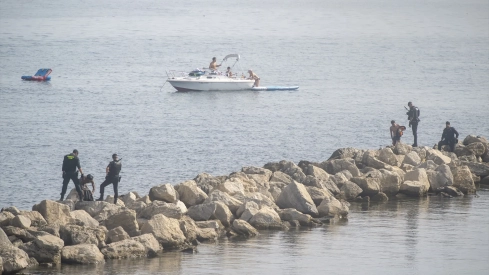
The Civil Guard confirmed during the first hours of the massive entry into Ceuta a radical change in Morocco's actions. The authorities of the neighboring country had collaborated in migratory containment until July 29, but the situation was very different the next morning. "Passivity is detected, and they are allowing the arrival of candidates towards the border area," the Armed Institute noted while thousands of people tried to reach Spanish territory.
The conclusion appears in one of the 40 documents declassified and published this Wednesday by the Government, a decision that allows reconstructing the information available before and during the crisis. The report was prepared on July 30 by the Operations Section of the General Staff of the Deputy Operational Directorate and updated at 6:15 p.m., when Ceuta had been receiving arrivals by land and sea for a good part of the day.
The Civil Guard had already warned of the "passivity" of the Moroccan forces in an initial analysis carried out at 1:20 p.m. According to the official chronology, the situation became overwhelmed around noon, and numerous people began to cross the border breakwater without finding a sufficient response on the other side of the border.
At 1:40 p.m., a certain recovery of Moroccan police activity was observed, although this reaction took time to translate into a reduction in arrivals. Twenty minutes later, a videoconference was established with the Ministry of Interior to coordinate the Spanish response. The estimates then spoke of 10,000 people who had already entered and another 6,000 concentrated in Morocco.
The document described the events as "extremely serious", warned of a humanitarian crisis, and acknowledged that ordinary resources had been overwhelmed. It also considered the deployment of the Armed Forces appropriate and linked part of the migratory pressure to the lack of containment mechanisms after the recent Supreme Court ruling on entries by swimming. To this scenario was added Morocco's attitude during the decisive hours.
From prior collaboration to the passivity of July 30
Reports show that Moroccan behavior had been different during the previous days. In the week of July 20 to 26, 279 swimming entries were recorded in Ceuta and Melilla, 195 more than during the preceding week, but the Royal Navy increased its interceptions from 947 to 1,429. The Civil Guard itself assessed that this collaboration had contributed to curbing arrivals in Spain.
The previous evolution reflected a sustained increase in pressure. The Armed Institute had already warned on July 8 of a possible "pull effect" after the ruling that prevented applying border rejection to those intercepted entering by swimming. The note proposed reinforcing the Ceuta Maritime Service, expanding underwater personnel in Melilla, and improving coastal surveillance and early detection systems. The Supreme Court had confirmed the legal limits of returns in these cases that same day.
Those alerts anticipated an increase in entries by sea, but no Civil Guard document ever foresaw an avalanche of the magnitude recorded on July 30. The information released by the Executive puts the number of entries during that first day at 49,000, within a crisis that ended up leaving more than 70,000 crossings into Ceuta. The Government maintains that previous warnings also did not allow knowing that scale.
The Civil Guard's Information Headquarters examined five possible explanations for Morocco's inability to contain the flow. The hypothesis considered most probable was overflow and operational surprise. It then placed the withdrawal of personnel to cover the Throne Day events and a possible change of attitude to avoid images of repression during a particularly significant date.
The report also contemplated the participation of some external actor and, lastly, a possible connivance of the Moroccan authorities as retaliation for Pedro Sánchez's visit to Algeria or for the Supreme Court's ruling. That political explanation remained the least probable of the five analyzed.
The Civil Guard considered it difficult to think, due to the existing power structure in Morocco, that an event of such dimensions could develop completely outside the knowledge of the regime. Even so, their final assessment ruled out as probable that the massive crossing had been deliberately consented to or encouraged from Rabat, a conclusion that coincides with the absence of solid evidence pointed out by the Prime Minister. Sánchez acknowledged that Moroccan forces allowed the crossings during the critical hours, although he left open the doubt between passivity and operational incapacity.
Early on July 31, the Civil Guard was confident that the end of the Throne Day celebrations would return Moroccan forces to a "proactive" attitude and reduce the border flow that the previous day had left 49,000 entries in Ceuta.
