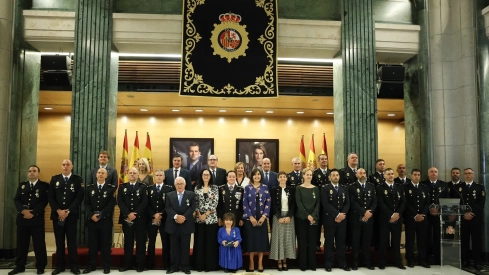
The Congress of Deputies has removed the portraits of three presidents of the Francoist Cortes that still remained in the gallery of the Lower House. The decision puts an end to the presence of these images in one of the main spaces of political representation of Spanish democracy and responds to a demand that left-wing parties and memorialist associations had been raising for years.
The paintings correspond to Esteban de Bilbao y Eguía, president of the Cortes between 1943 and 1965; Antonio Iturmendi Bañales, who held the position between 1965 and 1969, and Alejandro Rodríguez de Valcárcel y Nebreda, who did so between 1969 and 1975. The three led the Cortes during the dictatorship of Francisco Franco, a regime that eliminated democratic freedoms and persecuted its opponents.
The removal was carried out after the agreement adopted on October 13 by the Bureau of the Permanent Deputation of the Congress. The initiative was promoted by Sumar and had the support of the PSOE, while the PP abstained. The measure seeks to comply with the Democratic Memory Law and remove from the gallery the portraits of those who were part of the institutions that supported the dictatorship.
Armengol defends the removal of the Francoist portraits
The president of the Congress, Francina Armengol, has celebrated the decision and has defended that the House must recognize the victims of the dictatorship and contribute to repairing the injustices they suffered.
In a message published on her X account, Armengol pointed out that the removal demonstrates the Congress's commitment to democratic memory. She also defended that the measure allows recognizing the victims and repairing an injustice that has lasted too long.
Demostramos el compromiso del Congreso de los Diputados con la memoria democrática, reconociendo a las víctimas de la dictadura y contribuyendo a reparar una injusticia que ha durado demasiado tiempo.
— Francina Armengol (@F_Armengol) October 26, 2026
Así hemos cumplido el acuerdo de la Mesa del Congreso para retirar de la… pic.twitter.com/kNmAn7c74l
The decision represents a change from the position the PSOE had maintained in previous debates. In 2023, the socialists voted along with the PP and Vox against an initiative by EH Bildu that asked to remove these portraits and that of Manuel Fraga, former Francoist minister and one of the drafters of the Constitution. On that occasion, the parties opposed to the proposal argued that the gallery was not included in the scope of application of the Democratic Memory Law.
The removal of the paintings is not a recent request. PNV deputy Iñaki Anasagasti already raised the issue in the nineties. Since then, different political formations and historical memory associations have demanded that the portraits of the leaders of the Francoist Cortes stop occupying a space in the Congress.
The Congress will honor the victims of Francoist repression
The removal of the portraits coincides with the acts of remembrance for the victims of Francoism. The Congress will hold a tribute on the occasion of the Day of Remembrance and Homage to the Victims of the Military Coup, the Civil War and the Dictatorship, which is commemorated every October 31. This year, the event will especially remember those known as 'Las rapadas de Fuendejalón', a group of 39 women from this town in Zaragoza who were taken from their homes in 1936, shaved and paraded through the streets as a form of punishment and humiliation during the Francoist repression.
Homage will also be paid to María Domínguez, republican mayor of Fuendejalón, who was shot by Francoist troops. The ceremony will include a conversation between historians María Rosón Villena and Sescún Marías Cadenas and will end with the performance of the puppet show 'Melón pelado'.
With the removal of the portraits and the tribute to the victims, the Congress addresses the presence of symbols linked to the dictatorship in its institutional spaces and remembers those who suffered Francoist repression. The decision comes after decades of claims and reopens the debate on how democratic institutions should represent Spain's dictatorial past.
