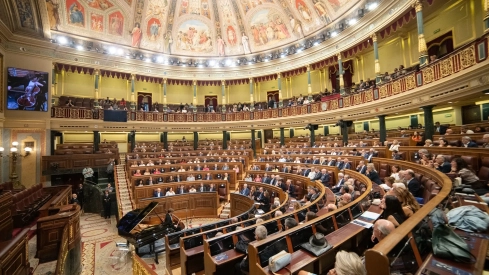
Congress will hold this Wednesday the tribute to the victims of Francoism, with the portraits of presidents of the Francoist Cortes already taken down, on the Day of Remembrance and Tribute to the Victims of the Military Coup, the Civil War and the Dictatorship, which is commemorated every October 31, after a postponement due to the train accident in Urda (Toledo).
The President of Congress, Francina Armengol, will preside over the ceremony at five in the afternoon in the Salón de Pasos Perdidos, where she will deliver a speech to give way to a discussion between the historians and researchers María Rosón Villena and Sescún Marías Cadenas.
“The shaved women” focus the event, while the parliamentary Government removes Francoist symbols
The tribute will focus on “The shaved women” of Fuendejalón (Zaragoza), an episode of Francoist repression in which 39 women were taken from their homes, shaved, and paraded through the streets as punishment and humiliation for their condition, ideology, or family and political ties.
Also, María Domínguez, republican mayor of Fuendejalón, shot by Francoist troops, will be remembered, and the event will conclude with a theatrical piece with puppets titled Melón pelado, by ButacaZero, written by Esther Fernández Carrodeguas and directed by Xavier Castiñeira.
The Congress Bureau removes three portraits and the PSOE opens the way for new arrangements in democracy
The novelty of this edition is that the commemoration will take place with the portraits of the presidents of the Francoist Cortes already removed from the gallery of the Congress Palace: Esteban de Bilbao y Eguía (1943-1965), Antonio Iturmendi Bañales (1965-1969) and Alejandro Rodríguez de Valcárcel y Nebreda (1969-1975).
However, Torcuato Fernández Miranda is excluded for being one of the architects of the dissolution of these Francoist Cortes and of the political reform that led to the Transition.
The agreement was adopted last day 13 in the Congress Bureau, with the support of the PSOE and Sumar and the abstention of the PP.
The removal was requested since the nineties by the PNV deputy Iñaki Anasagasti, and later it was also demanded by Bildu and left-wing formations. In 2023, Bildu forced a vote to remove these portraits and those of Manuel Fraga, but the initiative was rejected by PSOE, PP and Vox, who stressed that the Congress portrait gallery was not affected by the Memory Law because it was not a public space and because it did not include military personnel and ministers involved in the repression, who would be those cited by the legislation.
The PSOE accepts the withdrawal after decades of claims
With the Cortes dissolved, the PSOE has now accepted the request promoted by Esther Gil de Reboleño, representative of Sumar in the Permanent Deputation Bureau, with the aim of complying with the Democratic Memory Law and leaving Congress “free of Francoist symbols”.
In addition, the Association for the Recovery of Historical Memory (ARMH) recently addressed the President of Congress to demand the removal of these portraits, even hinting at the possibility of initiating legal actions for non-compliance with the Memory Law.
With the paintings removed, according to the Chamber, the placement of the portraits of the President of Congress Meritxell Batet, of Francina Armengol herself, and of subsequent presidents elected in a democratic period will be facilitated later.
Contact