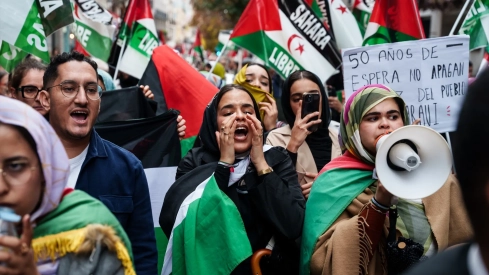
Half a century after the Spanish withdrawal from Western Sahara, Congress took one of the most important steps this Thursday to repair the consequences that departure left on thousands of families. The Justice Committee has approved the law that will allow Sahrawi people born in the territory before September 29, 1977, and their direct descendants, to access Spanish nationality.
The opinion received 19 favorable votes from the PSOE, Sumar, and the Government's usual partners. PP and Junts added 15 abstentions, and the far-right Vox was left alone in rejection, with three votes against.
The vote clears much of the political path of a norm that has remained paralyzed for more than a year. It will still have to be ratified by the Plenary of Congress, presumably in September, and then continue its processing in the Senate. The support gathered this Thursday allows anticipating a sufficient majority to complete both steps.
A right that thousands of families could not exercise
The future law stems from a very specific historical circumstance. After Spain's withdrawal, Sahrawis formally had a period to opt for Spanish nationality, but many of them were already living under the occupation of Morocco and Mauritania or had embarked on the path of exile.
When that period ended, on September 29, 1977, the Spanish Administration had abandoned the territory and the procedure was practically inaccessible. The Supreme Court itself has subsequently recognized the real difficulties that prevented many people from exercising that option.
The law now enables the acquisition of nationality by naturalization, even if the applicant lacks legal residence in Spain. Sumar estimates that around 80,000 people could directly benefit, a figure that would increase by incorporating their children.
First-degree descendants will have five years to apply after their father or mother is registered in the Spanish Civil Registry. The recognition will thus reach families separated between the Tindouf camps, Western Sahara, and different host countries.
The documents that will serve to prove origin
The beneficiary status can be proven with an old Spanish ID card, even if expired, the registration receipt in the census prepared by the United Nations for the Sahara referendum, a legalized birth certificate, the family book, or documents issued by the Spanish Administration.
The Commission has expanded the valid proofs to include schooling certificates, retirement pensions, driving licenses, medical documents, and any other administrative paper showing birth in the former colony before the established date. The documents will be evaluated together to prevent the loss or disappearance of a single file from closing the procedure. This is a relevant provision after five decades of displacement, war, and exile, during which numerous families have lost part of their documentation.
The PSOE has refused to directly accept certificates issued by the Polisario Front, as this organization lacks Spanish recognition as an administrative authority. The final wording therefore relies on Spanish documents, legalized certificates, and the United Nations census.
The application will be free and can be submitted within three years after its entry into force, with the possibility of extending the period for another year. Justice will have twelve months to resolve each file, and the rule will begin to apply four months after appearing in the BOE.
Two years of residence instead of ten
The reform also introduces a permanent change in the Civil Code. Sahrawis legally residing in Spain will be able to apply for nationality after two years, compared to the ten years generally required until now. They will be equated with nationals from Ibero-American countries, Portugal, the Philippines, and Equatorial Guinea, as well as people of Sephardic origin. With this change, Congress recognizes the historical link created during decades of Spanish administration.
Enrique Santiago, IU spokesperson in the Sumar group, has argued that the State is recovering a right that was interrupted with the failed decolonization. ERC, EH Bildu, and PNV have also supported the measure, although they have warned that nationality only covers a part of Spanish responsibility.
Their spokespersons have demanded to maintain support for the right to self-determination and the pending referendum. Western Sahara continues to be included by the United Nations among the territories pending decolonization and its people legally retain the right to decide their future.
The PP stops blocking and Vox takes the debate to immigration
The change in the PP's position has considerably broadened support for the opinion. The popular party supported the consideration of the law in February 2025, voted against the report of the presentation in June, and this Thursday they have finally opted for abstention to allow it to continue advancing.
María Jesús Moro has defended that her group shares the objective of facilitating nationality for Sahrawis, although she maintains reservations about the legal technique and documentary guarantees. She also recalled that the first advance of the initiative would have been impossible without the votes of the PP.
Junts has also chosen abstention. Josep Pagès has described the measure as a matter of historical reparation and humanitarian responsibility, although he has criticized that the PSOE has now recovered a norm kept for months in the parliamentary 'fridge'.
The far-right Vox has been the only force that has voted against it. Carlos Flores Juberías has framed the reform in his discourse against immigration and has warned that it could encourage Sahrawis to cross the Strait, despite the direct historical link that the law requires to prove to access nationality.
Morocco is once again present in the debate
The processing has once again shown the delicate relationship between the Sahrawi cause and Spanish policy towards Morocco. In 2022, Pedro Sánchez supported the Moroccan autonomy proposal as the "most serious, realistic and credible" basis for resolving the conflict, a shift that broke the position maintained for decades and opened a diplomatic crisis with Algeria.
The future nationality does not alter that external position nor does it imply Spanish recognition of the Sahrawi Arab Democratic Republic. It does recover a historical responsibility that makes Rabat uncomfortable, by expressly recognizing the existence of a people linked to the former Spanish administration and pending to exercise their self-determination.
The PSOE tried during the processing to replace in the preamble the references to "Saharawi people" with formulas such as "Saharawi population". Its partners rejected these changes and maintained the original expression, consistent with the language used by the United Nations and the Court of Justice of the European Union.
European justice has reiterated that Western Sahara has a separate and distinct status from Morocco and that the Saharawi people are the holders of their right to self-determination. This doctrine has also led to the annulment of trade agreements applied to the territory without its consent.
A claim sustained by civil society
Solidarity associations and Saharawi collectives have been demanding for years that Spain recognize this link. CEAS-Sáhara promoted campaigns to unblock the initiative and recently denounced the exclusion of stateless Saharawi people from the extraordinary regularization procedure.
The measure takes on special importance in the refugee camps located in Tindouf. Oxfam has estimated before the United Nations that some 173,600 people continue to live there, largely dependent on humanitarian aid that faces recurrent funding difficulties.
For these groups, nationality offers legal security, access to rights, and a path of protection for families who retain Spanish documents from the colonial era. Its approval will neither resolve the territorial conflict nor replace the pending self-determination process.
The opinion is now prepared for debate and voting in the Plenary Session of Congress during the session period that begins in September. If it obtains the expected support, it will pass to the Senate through the urgent procedure. The deadlines to apply for nationality will only begin to run after its definitive approval, its publication in the BOE, and the four months set for its entry into force.
Add ElConstitucional.es as a preferred Google source for free.
Stay informed about all the latest breaking news with the best information. Against disinformation, for democracy and social rights.
