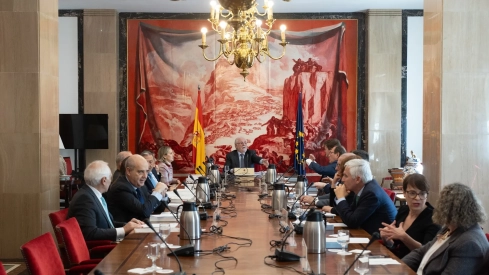
The Central Electoral Board complied this Monday with the Supreme Court's order regarding the census of beneficiaries of the so-called 'grandchildren's law', but it did so with an unusual division and leaving internal record of serious legal reservations. After almost two hours of meeting, the body activated the review of registrations in the foreign census while a good part of its members questioned that thousands of Spaniards could be provisionally deprived of their vote without having been heard.
The fracture was reflected in two votes. The JEC rejected by seven votes to six to file an appeal against the Supreme Court's order. The majority in favor of complying with it considered that such a challenge had little chance of succeeding and could generate greater legal uncertainty.
A second vote ended with eight votes to five. In it, the decision to strictly execute what was ordered prevailed, without adding interpretations or evaluating the court's criteria. The approved agreement barely occupies one page and states that the mandate must "be complied with in its terms".
That contained text hides a much more tense deliberation. According to sources present at the meeting, a large majority of the members consider that the Supreme Court has overstepped its bounds by affecting a fundamental right through a precautionary resolution that has not allowed the affected persons to appear or make allegations.
A compliance full of reservations
The discomfort within the Board goes beyond the division between its progressive and conservative sectors. Magistrates, professors, and jurists of the body have questioned the proportionality of a measure that temporarily removes from the census citizens whose Spanish nationality remains fully valid.
Some members have warned that a restriction of these characteristics should be adopted after hearing those affected and having a precise delimitation of its scope. Among the expressions uttered during the meeting are very harsh criticisms of the order and reproaches to the Supreme Court for not having measured the practical and legal consequences of its decision.
The Administrative Litigation Chamber itself was divided on the precautionary measure. The order was approved by five magistrates against one after several hours of deliberation. Magistrate Alicia Millán issued a dissenting opinion, considering that the alleged risk regarding the cleanliness of future electoral processes was not sufficiently proven and that the adopted response was disproportionate.
The dispute began last July, when the Electoral Board received several requests to intervene in the application of the additional provision of the Democratic Memory Law, which facilitates nationality for descendants of exiled Spaniards. The JEC then refused to halt the registrations, understanding that it lacked the competence to judge the validity of a law or the instructions issued to develop it.
The far-right Vox and Iustitia Europa appealed that decision, and the Supreme Court partially granted their requests. As 'ElConstitucional.es' reported, the court suspended the electoral effects of certain registrations in the Census of Absent Residents until it issues a ruling on the merits of the case.
The Government has expressed its disagreement with the measure. The Minister of Justice, Félix Bolaños, has called it legally "very debatable" and has asked the Supreme Court to resolve it quickly, if possible before the next general elections. The PSOE has also claimed that "the vote is sacred" and accuses Vox of attacking the rights of Spanish residents abroad.
A review that threatens to overwhelm consulates
The so-called 'grandchildren's law' is part of the Democratic Memory Law of 2022. The provision allows people born abroad whose parents or grandparents were Spanish by origin and had lost or renounced that nationality as a result of exile to opt for Spanish nationality.
An instruction approved a few days later established the presumption of exile for those who left Spain between July 18, 1936, and December 31, 1955. These descendants had to prove their relatives' departure from the country, although they were exempt from individually demonstrating that it occurred for political, ideological, religious, or sexual orientation and identity-related reasons.
The Supreme Court has now ordered these files to be separated from those in which exile was documented. Beneficiaries included in this latter group will retain their electoral rights. Registrations processed through the presumption established in 2022 will be suspended until there is a definitive ruling or consulates certify that they meet the conditions required by the court.
The decision affects the right to vote and does not revoke Spanish nationality. The exact number of people who will be removed from the census is also not yet known, as this number will depend precisely on the review that is now beginning.
Government data indicate that, as of May 31, 333,696 people naturalized through this route were already registered in the census, while another 238,065 had applied to do so. The Supreme Court has also used the increase of 408,262 voters registered in the CERA from the 2023 general elections to July 2026, a figure provided by Iustitia Europa that does not necessarily equate to the final number of affected individuals.
The Board has transferred the proceedings to the Electoral Census Office and the Directorate General for Spaniards Abroad and Consular Affairs. Consular registries must review the files and issue certificates proving which applicants descend from people who genuinely suffered exile under the terms set out by law.
The representative of the National Institute of Statistics, present at the meeting with voice but without vote, has warned that some requirements may need months or even years of work. The individual review will require personnel, documentation, and resources that many already saturated consulates will hardly be able to provide within the established deadlines.
The Supreme Court has given fifteen days to complete several reports on the foreign census and the criteria used to assign each voter a municipality. Afterwards, the JEC will have another ten days to approve an instruction. While this complex administrative operation begins, thousands of Spanish citizens will remain awaiting a ruling that will determine whether they can recover the exercise of a right directly linked to the nationality that the State already recognized them.
Add ElConstitucional.es as a preferred Google source for free.
Stay informed about all the latest breaking news with the best information. Against disinformation, for democracy and social rights.
