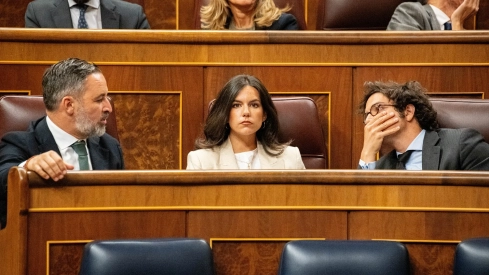
The far-right Vox announced this Wednesday its top candidates for the general elections on November 29 with a particularly significant decision in Tarragona. Its candidate will be Jordi de la Fuente, former leader of the neo-Nazi party Movimiento Social Republicano (MSR) and current general secretary of Solidaridad, the union linked to the formation. In Valencia, Carlos Flores Juberías, convicted of psychologically abusing his ex-wife, will continue, although he drops from the first to the third position.
The changes in the candidacies coexist with the continuity of most of the deputies and the rise of people with responsibilities in the organization. Abascal had already reserved the second position for Madrid for Montse Lluís, negotiator of the regional agreements with the PP, and the third for the Vox leader in Ceuta, Juan Sergio Redondo. Javier Ortega Smith, former general secretary of the party, disappears from the lists, while Jorge Campos returns to Balearic regional politics and Lourdes Méndez Monasterio abandons political activity.
Among those who benefit are Carlos Hernández Quero, who will head Málaga, and Samuel Vázquez, candidate for Ávila, spokespersons for Housing and Security and Immigration, respectively. Both represent two of the issues that Vox tries to connect in its campaign. Quero has blamed immigration for the deterioration of young people's access to a home and Vázquez has publicly defended "repatriation, deportation and remigration" as a response to security problems.
Flores drops to third place, but remains on the list
The permanence of Carlos Flores in the Valencian candidacy keeps among the aspirants to Congress a politician with a firm conviction for gender violence against his ex-partner. In September 2002, the Provincial Court of Valencia confirmed a sentence of one year in prison for habitual psychological violence and 21 counts of coercion, insults, and vexations. The resolution also established compensation of 6,000 euros and a prohibition from approaching his ex-wife for three years.
When that sentence became publicly known again in 2022, after his designation as a candidate for the Generalitat, Flores placed the events in the context of his marital separation and downplayed their political relevance. Vox maintained him then and includes him again now, although it gives the first place to Ignacio Gil Lázaro and places Ana Bellver in the second. The descent has concrete electoral consequences. In Valencia, the party obtained two deputies in 2023, so Flores needs the candidacy to gain representation to keep his seat.
Also continues José María Sánchez García, third for Alicante, known for his confrontations in Congress. In September 2021, he called socialist deputy Laura Berja "witch" while an initiative to penalize harassment outside abortion clinics was being debated. Last April 14, he was again expelled from the plenary session after going up to the rostrum and confronting a lawyer and the Vice President of the Chamber, Alfonso Rodríguez Gómez de Celis. His electoral continuity comes after both episodes.
From a neo-Nazi past to anti-immigrant discourse
The incorporation of Jordi de la Fuente at the head of Tarragona gives a new electoral projection to a leader from far-right organizations prior to Vox. Before joining Abascal's party, he was part of the Movimiento Social Republicano and Plataforma per Catalunya, a party that made opposition to immigration its main banner. In the MSR, he held leadership responsibilities and was a candidate for the presidency of the Generalitat in 2010.
The Vox leadership already defended that trajectory when De la Fuente ascended to the head of Solidaridad in March 2025. His national spokesperson, José Antonio Fúster, responded to questions about his neo-Nazi ties by speaking of a "very, very remote" and "prehistoric" past, while conveying the party's confidence in him. Now, the party offers him to lead a candidacy for Congress in a province where it was left without representation in the last general elections.
In Girona appears Ignasi Mulleras, another candidate with a long trajectory in the far right. He was a councilman for Plataforma per Catalunya in Olot and previously appeared on candidacies for Juntas Españolas, Alternativa Demócrata Nacional, and Plataforma España 2000. The BOE (Official State Gazette) lists his name in the 25th position on the Alternativa Demócrata Nacional list for the 1994 European elections, a coalition that preceded the creation of Democracia Nacional.
For Almería, Rocío de Meer repeats, one of the party's harshest voices against immigration. In a parliamentary intervention in August 2020, she used the expression "multicultural dung heaps" when asking if Spaniards would allow their neighborhoods to end up like certain areas of Brussels and Paris. In that speech, she also cited El Puche, El Raval, and Lavapiés to attack multiculturalism. The controversy over those words has not prevented her continuity at the head of the list.
Small provinces decide how much the far-right Vox can grow
Abascal presents these candidacies with polling expectations much higher than their 2023 results. The Sigma Dos survey for 'El Mundo', published on October 19 and conducted with 3,007 telephone and internet interviews between the 1st and 14th, attributes to Vox 19.5% of the votes and between 65 and 68 deputies. This would be between 32 and 35 more than the 33 obtained on 23J and would exceed the 52 from November 2019, their best result in a general election.
The October CIS barometer, published on the 14th, offers a different scenario for the Parliament as a whole, with the PSOE ahead of the PP, but also places Vox above its result from the last elections, with 17.1% compared to 12.4% on 23J. The extent of that growth and its translation into seats remain open. In the Sigma Dos estimate, the PP would get between 132 and 137 deputies and would need Abascal's support to gather an absolute majority.
Part of the possible advance is played out in constituencies where Vox did not obtain representation. Ávila, Huesca, and Teruel each distribute three deputies, a figure that makes it especially difficult to enter when two candidacies concentrate a good part of the support. In 2023, Guadalajara was the only three-seat province where Vox managed to get one. The party keeps Ángel López Maraver there and seeks to expand that map with Vázquez in Ávila, Ester Blanco in Huesca, and Daniel Alda in Teruel.
Galicia constitutes another of its bets. The official candidacy published by Vox places Manuel Fuentes at the head of A Coruña, where the party gathered 34,410 votes in 2023 and was left out of Congress. Abascal himself recognized this Wednesday that he has a "thorn in his side" with the community and has assured that he aspires to get a deputy for that province. Its eight seats were then distributed among PP, PSOE, Sumar and BNG.
Growth in large constituencies will also determine who gets in and who stays out. Madrid contributed five deputies to Vox in 2023 and Malaga, two, while Valencia and Alicante elected two each. These last two results explain why the third place of Flores and Sánchez García depends on a provincial improvement, even if the party rises in Spain as a whole. The deadline to present candidacies ends on Monday, October 26, the day Abascal has scheduled an event to present his candidates in Talavera de la Reina.
