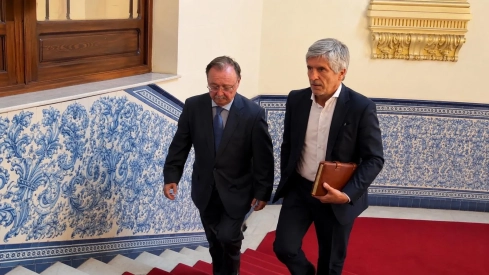
The Government closed on Thursday with three open fronts around the Ceuta crisis. Interior reinforced the device to accelerate the files of the people who remain in the city, the Ministry of Childhood set a date for the debate on the resources allocated to minors and the clash with the Popular Party over the appearances of the ministers moved again to the Senate.
Fernando Grande-Marlaska acknowledged during his second visit to Ceuta that around 5,000 migrants still remain, among them 1,898 identified minors. The minister announced the arrival of 45 police officers from a Prevention and Reaction Unit and another 20 immigration officials, in charge of reinforcing security and streamlining the procedures for return, international protection and identification.
The head of Interior assured that those who are in an irregular situation will be returned "as soon as possible" and sent a message to those who may consider new entries. "None of them will stay in Ceuta, none will go to the Peninsula and none will be regularized," he affirmed, although he safeguarded cases of special vulnerability protected by Spanish and international legislation. Marlaska avoided, however, setting a calendar for returns.
Vivas demands an urgent response and raises the figure to 9,000 people
The explanations from Interior were insufficient for the president of Ceuta, Juan Jesús Vivas, who conveyed to Marlaska that the city continues to be in a situation of "maximum risk" for coexistence, security and the functioning of public services. "Every day that passes is worse," he warned after a meeting in which he again demanded more police and civil guards, the presence of Frontex in Tarajal and health reinforcements.
Vivas estimates that there are still about 9,000 people, compared to the 5,000 counted by Interior. His estimate is based on the 4,500 meals distributed daily in Tarajal, the 3,000 delivered by social organizations and the increase in minors taken in. This is an indirect calculation that may include overlaps and people who use different resources.
The president of Ceuta demanded the urgent return of those who entered on July 30 and summarized his position with a blunt phrase. "No regularization, no asylum, no transfer to the Peninsula," he maintained. He also proposed rejecting from the outset applications for international protection submitted in Ceuta, a possibility that would require legal changes and that must respect the right of each person to have their petition studied individually, as set out in the Asylum Law.
Childhood prepares the first referrals of minors
The second axis of the response will arrive this weekend. The Ministry of Youth and Childhood will deploy a permanent technical team in Ceuta starting Sunday, August 16 to accelerate the identification of minors, study each case, and prepare referrals to reception resources on the Peninsula. Girls, children under 13, and those in a situation of greater vulnerability will have priority.
The Sectoral Conference on Childhood will meet on August 27 to decide on the distribution of the 25 million euros committed by the Government to care for minors who arrived in Ceuta. The amount seeks to alleviate overwhelmed protection services and finance their reception in other autonomous communities. The distribution of these resources will be put to a vote.
The communities governed by the PP participated in the technical meeting held on Thursday, although they refused to include a specific point on the situation of minors and their reception outside Ceuta on the agenda for the 27th. They argued that they need reliable figures and detailed planning. Minister Sira Rego will raise it again at the beginning of the Sectoral Conference. Aragon, Castilla y León, and Extremadura, where the far-right Vox manages childhood competencies, were not even represented.
The Senate keeps the pulse open for appearances
The management of Ceuta will continue to pit the Government and the PP against each other in the Cortes. Marlaska did not attend the Senate's Interior Committee on Wednesday and Margarita Robles asked this Thursday to postpone her appearance until September, initially scheduled for August 18, arguing that she needed more time to prepare it "with a minimum of rigor and detail." The popular party accused Pedro Sánchez of preventing the minister from rendering accounts in the Upper House.
The Executive has chosen to explain its actions in Congress, where Robles will appear on the 25th, Félix Bolaños on the 27th, and Marlaska and José Manuel Albares on the 28th. The disagreement is now focused on the chosen chamber and date, while the PP maintains that the ministers must also attend the calls of the Senate, where it holds an absolute majority.
The President of the Upper House, Pedro Rollán, will take the political pulse to the city itself this Friday. He will meet at 11:45 AM with Juan Jesús Vivas in the Assembly Palace, hold a meeting with political representatives, and tour different points of Ceuta before addressing the media. The visit comes amid the dispute over the Government's parliamentary explanations.
