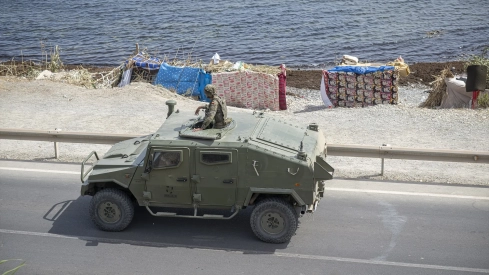
The Government faces this Thursday a new phase of its plan to alleviate the situation in Ceuta almost three weeks after the massive entry recorded on July 30 and 31. The action combines the transfer of some 500 migrant girls to the Peninsula, the opening of temporary spaces for another 1,500 people, new economic allocations and the reinforcement of police and judicial services.
The economic support linked to the emergency reaches at least 37 million euros, although it comes from different allocations. The Executive enabled 25 extraordinary millions to attend to minors, which are added to the 5.5 million assigned to Ceuta during the Sectoral Conference on Childhood in July. It has also allocated 6.5 million to Cruz Roja to reinforce humanitarian, health and social assistance.
The protection of minors has become the most urgent task. The Ministry of Youth and Childhood and the Ceuta Government are working together to get some 500 girls and adolescents off the streets, temporarily house them in adequate facilities and then prepare their transfer to different resources on the Peninsula.
500 girls and 1,500 places to relieve the emergency
The first phase of the operation has already begun within Ceuta. The minors are being relocated to six spaces, including a warehouse that has started operating, two others pending conditioning, a hall with 120 places and two residential buildings with capacity for another 150 people.
Almost a hundred girls have already moved to these facilities, a movement prior to the transfer to the Peninsula. The final figure of 500 is still provisional and will depend on the identification of the minors, their family situation and the protection needs detected by the teams working on the ground.
The formula being studied by Childhood would allow the use of resources managed by specialized organizations without necessarily handing over guardianship to the autonomous communities. Ceuta would maintain that legal responsibility while the entities would assume the daily care of the minors in the Peninsula. The plan also contemplates foster care and the relocations foreseen in the mandatory solidarity system.
The Government thus hopes to circumvent the anticipated rejection by several autonomous communities governed by the PP and offer a quick solution for the most vulnerable profiles. Technicians estimate that the complete operation could last one or two months, provided that the facilities and protection procedures advance at the planned pace.
Sira Rego this Wednesday set the legal limits for any possible return to Morocco. "Talking about deporting children is an outrage, no matter where it comes from," the minister responded after Alberto Núñez Feijóo called for the return of all migrants, including minors.
The Minister for Children recalled that each possible repatriation requires an individual file, the intervention of the Public Prosecutor's Office, a hearing for the minor, and verification that family reunification or their handover to Moroccan social services offers guarantees. Some children lack located relatives, and others have fled situations of violence or abuse.
The facility for girls is in addition to the creation of 1,500 temporary reception places announced by the spokesperson minister, Elma Saiz. The spaces will be set up in the Embolsamiento car park, the Hípica, the old football field of the cavalry barracks, and El Guano, land ceded by the Autonomous City or belonging to the State. The operation will have the priority support of the Red Cross, which has already provided more than 4,000 socio-health assistance services.
More agents and judicial reinforcements
The Ministry of Interior has deployed 20 police officers specialized in immigration to Ceuta to expedite identification and administrative procedures. Another 45 National Police agents have joined them. The operation also has about 770 Civil Guards, nearly 200 more than at the beginning of the crisis.
The objective is to accelerate the return files of adults who do not have the right to remain in Spain, reinforce border surveillance, and maintain security in the streets. Elma Saiz insisted this Wednesday that Spain will comply with the Immigration Law, international law, and European regulations. "Spain will not renounce international law," the spokesperson affirmed.
The Administration of Justice is also reinforcing its presence in the city. The department led by Félix Bolaños has incorporated a manager and two procedural processors into the Ceuta Area Prosecutor's Office, has authorized the participation of five lawyers in the specialized legal aid shift, and has allowed three substitute prosecutors to support the open procedures during these weeks.
The Ministry assures that it has economic coverage to process more reinforcements when it receives the formal request from the General Council of the Judiciary. The governing body of judges considers two additional magistrates necessary, one for the on-call service and another for the court in charge of violence against women and sexual offenses.
Brussels maintains open contacts with the Spanish authorities, although the Government has not yet submitted a formal request for urgent financial aid. The European Commission has offered the resources of Frontex, Europol, and the Asylum Agency and will transmit the conclusions of the technical mission sent to Ceuta to the Member States.
Feijóo takes the clash of appearances to the Supreme Court
Alberto Núñez Feijóo hardened his position this Wednesday during an appearance with Juan Jesús Vivas in Ceuta. The president of the PP described the massive entry as an "invasion," demanded a single command, and called for the return of all people who crossed the border irregularly.
"Neither adults nor minors. All must return," said Feijóo, who refused to create what he defined as a "perverse precedent" by granting rights to those who participated in an irregular entry. This formulation provoked an immediate response from Infancia, which recalled that Spanish legislation prevents ordering the collective return of minors.
The PSOE accused the popular leader of traveling to Ceuta to "add fuel to the tension" and "campaign using institutions." Ferraz maintained that the PP had joined the "wave of hoaxes and fear" through speeches that fuel rejection of migrants. The socialist Organization Secretary, Rebeca Torró, accused Feijóo of only seeking "the photo" with a "tin patriotism."
The Minister of Equality, Ana Redondo, defended the coordinated work with administrations and social organizations against the PP's criticism for her absence in Ceuta. "Make noise, we continue working," she responded after the popular party announced they would request her censure in the Senate.
Óscar Puente had days earlier attributed the hardening of Vivas's discourse to the influence of the PP's national leadership. The minister acknowledged that the authorities were unable to stop the entry when it was overwhelmed, although he rejected that Morocco had organized the crossing and defended maintaining cooperation with the neighboring country.
The political struggle will also have a judicial and parliamentary course. Feijóo announced that the PP will go to the Supreme Court to determine if the ministers could refuse to appear in the Senate, arguing that they will offer their explanations in Congress. The rejected summonses affected Fernando Grande-Marlaska, José Manuel Albares, and Margarita Robles.
The Executive maintains that appearances in both chambers would have caused duplications and has already set its calendar in Congress. Robles will appear on August 25, Bolaños will do so on the 27th, and Marlaska and Albares will attend on the 28th. The PP will also bring to the first plenary session of September the censures of these three ministers, Mónica García and Ana Redondo, initiatives that will go ahead thanks to their absolute majority in the Senate, although they have no legal effects on the continuity of the members of the Government
