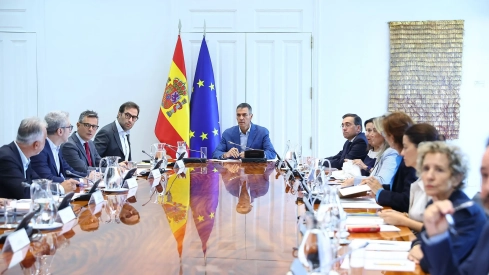
The Government will open this Tuesday the new political course with the response to the Ceuta crisis at the center of its first Council of Ministers after the summer. Pedro Sánchez will preside over a meeting in which the approval of an extraordinary package of up to 168 million euros is planned to reactivate the economy of the autonomous city, protect employment and reinforce public services subjected to strong pressure since the massive entry of migrants on July 30.
The amount is approximately 8% of Ceuta's gross domestic product and will expand the special plan that, according to Executive data, has already mobilized around 180 million between 2023 and 2026. Sánchez advanced the new measures this Monday during his interview on 'Hoy por Hoy', on 'Cadena SER', after a month in which the Government's actions have been mainly focused on the border, reception and the security device.
The Council will also approve in a second round the new Framework Statute for health personnel, which will update a regulation in force since 2003 and will then be sent to Congress. The reform will reach the table amidst conflict with medical unions, who maintain their criticism of the text and are studying new mobilizations during September.
A 168 million shield for employment and services in Ceuta
The economic response will combine direct aid to small and medium-sized enterprises and self-employed workers with new labor measures to prevent layoffs and closures. These include a reinforced regime of temporary employment regulation files due to force majeure, known as ERTE, for companies affected by the crisis. These files will allow a 100% exemption from business contributions to Social Security. Included workers will be able to access unemployment benefits without meeting the minimum contribution period and without consuming the rights accumulated up to that moment.
The Executive will also raise the hiring bonuses in Ceuta and Melilla from 50% to 75%. The measure seeks to reduce labor costs, facilitate new hires and restore confidence in two economies heavily conditioned by their border situation and by the increased cost of transporting people and goods.
The package will include an extraordinary grant of 21.5 million to reinforce public services and finance the operation of the desalination plants in both autonomous cities. In the case of Ceuta, provisions will also be made for cleaning and waste collection in peripheral areas, citizen security, traffic regulation, and the fight against import fraud.
The Ceuta and Melilla administrations will have fifteen days to request these resources, and the Treasury will have one month to resolve the requests. The amounts granted must be executed during 2026.
Eight hundred transfers and more protection for minors and women
The Council will be held after nearly 800 migrants were transferred this Monday from different points in Ceuta to the resources enabled by the administrations. Among them are mothers with their children, accompanied minors, and adults who remained on the street or in provisional facilities.
One of the most important movements allowed nearly 250 women and girls to be taken from a sports center in the Príncipe neighborhood to the new La Hípica facility, prepared with 320 places and permanent surveillance. The transfer took place before the start of the school year and with the priority of reducing women's exposure to possible aggressions.
Ángel Víctor Torres, Minister of Territorial Policy and head of the single command deployed by the Government, explained on 'Al Rojo Vivo', on laSexta, that the operation developed "not without difficulties." The Executive already has more than 3,000 temporary places and is working with the forecast of reaching 6,000 in the coming days.
The identification of the sheltered individuals will be the next step. To expedite the files, 60 National Police officers and eleven other workers assigned to asylum procedures have arrived. Torres defended that the exact number of people still in Ceuta can be known when all are registered and housed in controlled spaces.
The minister stated on 'Espejo Público', on Antena 3, that most adults will not be entitled to international protection and will have to return to their country through procedures adjusted to the law. He also assured that more than 200 people have been expelled after committing crimes and promised an "absolutely uncompromising" response to those who disrupt the city's security.
Field work continues in a still delicate environment. The National Police had to fire warning shots into the air and carry out charges in Loma Colmenar this Monday after hundreds of migrants tried to access the enabled facility. The incident forced the temporary closure of the University Hospital road. Hours later, Torres reported that the distribution of food by the Red Cross had been able to resume normally.
From the Government of Ceuta, Juan Jesús Vivas again questioned the state's actions in an interview on 'Espejo Público' and described the management as "unthinkable, inexplicable and unacceptable". The president of Ceuta pointed to "indolence", "irresponsibility" or the fear of inconveniencing Morocco. Torres avoided entering the confrontation and assured that he would work with "absolute loyalty" towards the city.
Attention to minors constitutes another priority front. The Minister of Youth and Children, Sira Rego, reported this Monday in Congress that 1,478 children and adolescents are already within the protection system and estimated that there are around 1,200 left to identify. Her department proposes the urgent transfer to the Peninsula of 500 especially vulnerable girls, a measure that is still awaiting authorization from the Ceuta Executive.
Of the 760 girls located, 233 are under thirteen years old and some have fled sexual violence, forced marriages, ill-treatment or street situations. Rego recalled that there are some 2,000 places available in the state system and defended that the files of each minor can continue to be processed from other territories while a possible family reunification is studied.
Spain had sent nearly 600 files to Morocco before July 30 to check the conditions of these possible returns. The minister assured that the response from the Moroccan authorities has so far been "silence". The transfers will be joined by the 25 million approved to support the care, accommodation and accompaniment of minors.
Equality will also reinforce its presence with a multidisciplinary unit specialized in violence against women and girls. Ana Redondo announced in Congress that it will be composed of professionals in psychology, social work, legal advice, migration, childhood, and international protection. The Prosecutor's Office has raised to 23 the sexual assaults registered since the beginning of the crisis, five of them rapes, with nine minor victims between 14 and 17 years old.
Félix Bolaños, Minister of Justice, has also authorized the incorporation of a second judge to reinforce and alleviate the workload of the Ceuta courts. Sánchez will appear this Thursday in Congress to report on all the management and defend an action based, as he said on Monday, on "certain data and facts."
The Popular Party maintains its doubts about Morocco's role and demands more speed from the Executive, while Sumar has asked to transfer minors and vulnerable people to the Peninsula and has reproached Sánchez for the absence of direct criticism of Rabat.
The Framework Statute arrives in Congress with the medical pulse open
Apart from Ceuta, the Council of Ministers will approve the definitive text of the new Framework Statute for health personnel before sending it to Congress. The norm was agreed by Health with UGT, Comisiones Obreras, CSIF, and SATSE, although medical organizations maintain their open confrontation with Mónica García's department.
The project will reduce mandatory shifts from 24 to 17 hours, will set a maximum working week of 45 hours, and will establish competitive examinations every two years. It also introduces new limits on temporary employment, conciliation measures, and a professional classification adapted to the training and responsibilities of each category.
Medical unions demand their own statute and negotiation framework, a differentiated classification, and the implementation of a 35-hour work week. Conversations have been paralyzed since before the summer, and the State Confederation of Medical Unions will analyze this Friday whether to activate the indefinite strike announced for September.
The Ministry of Health maintains that a good part of the salary and on-call organization demands depend on the autonomous communities. During the summer, agreements have been reached in territories such as Euskadi, Galicia, Asturias, the Valencian Community, and Andalusia, although all autonomous communities, including those governed by the PSOE, have asked the Ministry to reopen negotiations on the text.
