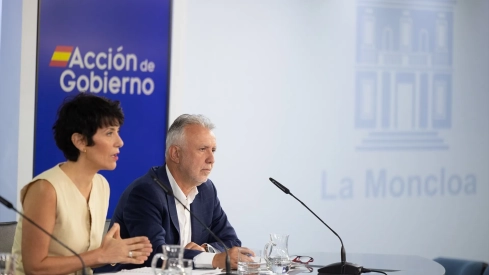
The Government has taken, 26 days after the start of the crisis, a new step to address the migratory situation in Ceuta after the massive entry of people from Morocco at the end of July. After the extraordinary meeting of the National Security Council, chaired by Pedro Sánchez, the Council of Ministers has declared the “situation of interest for national security” in the autonomous city and has approved the creation of a single command that will be led by the Minister of Territorial Policy and Democratic Memory, Ángel Víctor Torres.
The new functional authority aims to concentrate the coordination of the response among the different administrations and organizations involved. Torres will lead a specialized committee in which eleven ministries, the Government Delegation in Ceuta, the autonomous Executive chaired by Juan Jesús Vivas, the National Intelligence Center (CNI) and the Department of National Security will participate.
As explained by the spokeswoman minister, Elma Saiz, this is a new stage to ensure that actions are carried out “in a coordinated and effective manner”. The minister, who has already requested to appear before the National Security Commission of Congress, plans to travel to Ceuta this Tuesday to hold working meetings.
The second phase in crisis management
Torres has now focused on the second phase of crisis management, after, according to his data, between 90% and 95% of the more than 70,000 people who entered Ceuta on July 30 and 31 returned to Morocco within 24 to 48 hours. The minister described this first action as “successful and effective”, but pointed out that the Executive must now address the situation of those who remained in Spanish territory. For this new stage, he has established as a priority the “return and repatriation of the largest number of people”, both adults and minors, always within the legal framework and with respect for their rights.
Along with the single command, the Council of Ministers has approved two other important texts related to migration policy. These are the preliminary drafts of a new Asylum Law and a reform of the Organic Law on the rights and freedoms of foreigners in Spain and their social integration. As Saiz explained, both projects seek to update the Spanish legal system and adapt it to the European Pact on Migration and Asylum, which came into force last June. The Minister of Interior, Fernando Grande-Marlaska, has indicated that this adaptation constitutes the common objective of the two legislative initiatives.
Minister Robles' appearance
The Minister of Defense, Margarita Robles, has inaugurated the appearances of the Executive's ministers to explain her ministry's actions regarding the massive entry of people into Ceuta between July 30 and 31. In this context, Robles has conveyed the work of the Armed Forces and about the National Intelligence Center (CNI).
The Minister of Defense, Margarita Robles, began her speech by remembering the people who have lost their lives during the migratory crisis and stressed that it is a situation with an important human dimension. She pointed out that "almost 100 people" have died, although she admitted that the exact number of fatalities is not yet known. In this context, she defended that Spain must act in accordance with legality and, especially, respecting human rights. She also considered it necessary to move towards a common, comprehensive and coordinated migration policy within the European Union, while apologizing to those who may feel abandoned.
In a message addressed to the citizens of Ceuta, Robles assured that the Government shares their concern and that "their anguish is our anguish", insisting that they will not be alone. The minister explained that the Executive is working with the European Union to reinforce the border and has emphatically claimed the Spanishness of the two autonomous cities: "Ceuta and Melilla are Spain. They are very Spanish and represent the best of Spain". In this regard, she warned that the Government will not allow these values to be threatened and stated that "any aggression against Ceuta and Melilla is an aggression against all of Spain".
On the other hand, the minister wanted to recognize and value the work carried out during the crisis by the State Security Forces and Corps, especially the Civil Guard and the National Police. She also highlighted the “great work” done by the Armed Forces and the National Intelligence Center (CNI) during the situation.
"The CNI monitors the situation with 25 agents from multiple perspectives such as mafias, the rise of jihadist terrorism, or irregular immigration. The duty of secrecy is a guarantee for their actions, although sometimes it is an obstacle to informing. The CNI carried out the work required of them and provided the necessary information," the minister conveyed.
The Minister of Defense, Margarita Robles, explained that on the afternoon of July 30, the Government Delegation in Ceuta requested the collaboration of the Armed Forces to support the State Security Forces and Corps in view of the situation that was occurring in the autonomous city. As she detailed, after this request, the Chief of Staff of the Defense (JEMAD) established the guidelines for the available capabilities of the Armed Forces to contribute to the tasks of presence, surveillance, and deterrence.
Robles pointed out that, based on these instructions, the operational commands of the different Armies and the Navy received the order to attend to the requests of the Ministry of Interior and provide the necessary means. The minister specified that this action was carried out following the usual chain of command of the Armed Forces, through the established procedures to coordinate their intervention and provide support to the security forces.
The Minister of Defense, Margarita Robles, has distanced herself somewhat, throughout the crisis, from the discourse maintained by the Government during the migratory crisis, especially regarding the relationship with Morocco. While the Executive has insisted on defining the neighboring country as a “reliable partner”, Robles has maintained a more forceful discourse by defending the territorial integrity of Spain and repeating on several occasions that “Ceuta and Melilla are not to be touched”.
The Government's agenda in Congress
The ministers of the Government of Spain who have collaborated in managing the massive entry of migrant people into Ceuta through the border with Morocco between July 30 and 31, have scheduled their self-requested appearances in the Congress of Deputies for this week, where they will provide explanations about the actions of their ministries in managing the crisis that the autonomous city is experiencing.
In this regard, this Tuesday, the Minister of Defense, Margarita Robles, was the first to carry out her intervention in the Lower House on the work of the Armed Forces and the National Intelligence Center (CNI). This appearance will be followed by those of the Minister of the Presidency, Félix Bolaños, and the Minister of Health, Mónica García (on Thursday 27); those of the Minister of Foreign Affairs, José Manuel Albares, the Minister of Interior, Fernando Grande-Marlaska, and the Minister of Migrations, Elma Saiz (on Friday 28) and, finally, those of the Minister of Youth and Childhood, Sira Rego, and the Minister of Equality, Ana Redondo (on Monday 31).
