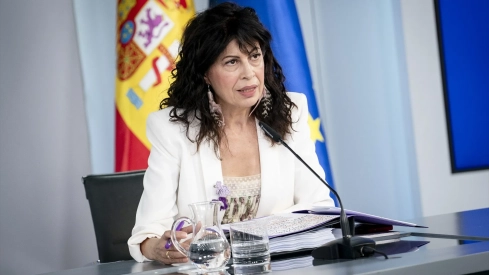
The Council of Ministers approved this Tuesday the Organic Law Project on measures regarding vicarious violence, a pioneering norm with which Spain will for the first time provide an integral response to aggressors who use children, relatives, or close people to cause pain to a woman.
The text will now reach Congress after nine months of negotiations between the ministries of Equality, Justice, and Youth and Childhood. The definitive version introduces important changes compared to the first draft presented in September 2025. Vicarious violence will become an aggravating factor due to gender, abusers convicted of serious crimes will automatically lose parental authority, and judges will be obliged to listen to minors before deciding on their guardianship, custody, or visitation regime.
"We are facing a pioneering law at a European level that comes to provide a response to all victims and their families," defended the Minister of Equality, Ana Redondo, after the government meeting. The project modifies ten norms, including the Penal Code, the Civil Code, the Law against Gender Violence, child protection legislation, and procedural laws.
El Gobierno aprueba el Proyecto de Ley Orgánica de medidas en materia de violencia vicaria.
— La Moncloa (@desdelamoncloa) July 14, 2026
“La violencia vicaria es violencia de género.
Así se ha entendido en este proyecto de ley y así se va a desarrollar”, la ministra de @IgualdadGob, @_anaredondo_ pic.twitter.com/GX0oLqDktH
Vicarious violence will be a gender aggravating factor
The new definition will be incorporated into the Law on Comprehensive Protection Measures against Gender Violence. Vicarious violence will be considered that exercised by a partner or ex-partner on other people with the purpose of causing pain or suffering to a woman.
Protection will cover sons and daughters, grandchildren and other descendants, minors or adults with disabilities subject to guardianship or custody, close minor relatives, fathers, mothers, brothers and sisters. It will also extend to the woman's current partner, even when both live in different homes.
The legal key will be in the aggressor's intention. The harm is directed against an interposed person, but seeks to punish, control, or emotionally destroy the woman. Threats, aggressions, detentions, the instrumentalization of visits, and the most serious crimes may be included when this purpose is proven.
The first preliminary draft contemplated creating an autonomous crime against moral integrity. The final agreement replaces that figure with a specific gender aggravating circumstance, which will allow to toughen the penalty corresponding to the crime committed directly against the victim used by the aggressor.
The change responds to warnings from feminist associations, jurists, and advisory bodies. The initial crime could open the door to interpretations unrelated to sexist violence and facilitate complaints against protective mothers by their own aggressors. The new wording expressly links the conduct with gender violence and keeps intact the penalties for murder, injuries, sexual assault, threats, or any other offense committed.
"Vicarious violence is gender violence. This has been understood in this project and this is how it will be developed," Redondo stressed.
Automatic loss of parental authority
One of the most relevant changes affects men convicted by a final judgment for serious crimes against their children or against the woman with whom they maintain or maintained a relationship. The loss of parental authority will be automatic, without the need to open another procedure afterwards to decide whether the aggressor retains their parental rights.
The measure may be applied in cases of serious crimes against life, physical or psychological integrity, freedom, and sexual freedom. The recovery of parental authority will be linked to the cancellation of criminal records, once the sentence has been served and the legally established deadlines have passed.
When there is still no final judgment, but there are well-founded indications of violence or an open criminal process, the judge may attribute the exercise of parental authority exclusively to the other parent. The interest and safety of the minor must guide any decision.
"An abuser can never be a good father," the Minister of Equality has defended. The Government seeks to correct situations in which a criminal conviction for gender violence barely produced consequences in civil proceedings and allowed the aggressor to retain decision-making capacity over their children.
Shared custody will be excluded when it may harm the physical, psychological, or emotional health of minors. Judges must specifically justify any visitation or communication regime granted to a parent investigated for domestic or gender violence.
Minors will have the right to be heard
The future law requires listening to children and adolescents before making decisions about their custody, cohabitation, or contact with their parents. The hearing must adapt to their age, maturity, and personal circumstances and may be conducted with the assistance of specialists.
When direct listening is impossible or contrary to their interest, the judge must explain the reasons. The minor's opinion will then be known through representatives without conflicting interests, professionals, or people of special trust capable of conveying it objectively.
Exposure to vicarious violence will be expressly recognized as a risk indicator for childhood. Social services, courts, and administrations will be able to activate protection measures before violence reaches its most serious manifestations.
Civil proceedings on parental authority will also be processed through oral trial to reduce deadlines. The objective is to prevent an urgent decision on a minor's safety from remaining blocked for months while a parallel criminal case progresses.
The new formulation includes part of the claims made by Youth and Childhood, which even distanced itself from the first draft. The department led by Sira Rego demanded greater guarantees regarding child listening, visits, and the possibility that a violent parent could continue to maintain areas of control over their children.
A legal response to the José Bretón case
The reform of the Penal Code also incorporates an accessory penalty to prevent the convicted person from publishing or disseminating messages, photographs, images, stories, or any other content directly related to the crime.
The forecast arises after the controversy over El odio (Hate), the book built around the testimony of José Bretón, convicted of murdering his children Ruth and José to cause the greatest possible suffering to their mother, Ruth Ortiz. The publication was withdrawn before reaching bookstores after the family's rejection and a broad social mobilization.
The law will allow closing that path of revictimization and preventing the aggressor from turning the crime into a public narrative that prolongs the harm of those who survived. "Society accompanied the victim in the face of the book's publication. Now we want the law to accompany society in that reproach," Redondo explained.
The mother of a child murdered by vicarious violence may also request the change of surnames of the deceased minor and of the rest of the common children who are still minors. The measure seeks to eliminate the permanence of the nominal link with the aggressor.
The Social Security reform will also prevent the perpetrator of a homicide from generating or benefiting from death and survival benefits linked to their victim. The text will also reinforce the training of judges, prosecutors, and other legal operators in vicarious violence, gender perspective, childhood, and disability.
A broader statistic to know all victims
Since the beginning of official records in 2013, 68 children have been murdered in contexts of gender violence against their mothers. Three of these crimes have occurred during 2026.
The current statistic is essentially limited to minor sons and daughters. The new law will expand the count to incorporate, in a differentiated way, other people murdered as instrumental victims, including descendants, minor family members, dependent people with disabilities, ascendants, siblings, and partners of the woman.
The Government wants to thus know the real dimension of a violence that goes far beyond murders. Assaults, constant threats, the use of visits, and the manipulation of children are part of a dynamic of control that can continue for years after separation.
The bill will now be sent to Congress, where it will need an absolute majority due to its organic nature. Parliamentary groups may present amendments on the definition, visits, protection of minors, and the scope of people recognized as victims.
The 016 offers information, legal advice, and psychosocial care 24 hours a day. It also attends via WhatsApp at 600 000 016, through the email 016-online@igualdad.gob.es and through the chat of the Government Delegation against Gender Violence. In case of an immediate emergency, call 112.
