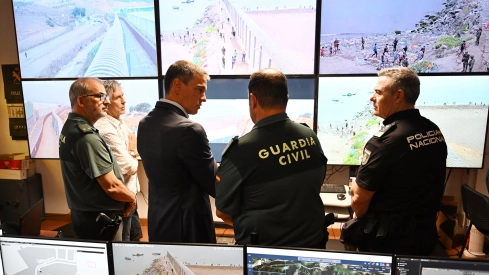
The Government arrives this Tuesday at the extraordinary meeting of Interior Ministers of the European Union determined to preserve cooperation with Morocco. Moncloa closed on Monday practically maintaining the same explanation as Rabat regarding the massive entry into Ceuta, attributed to disinformation spread on social media, human trafficking mafias, and a false interpretation of the latest Supreme Court ruling.
José Manuel Albares described what happened as a “very unusual” event that still needs to be investigated, but avoided holding the Moroccan government responsible. The Minister of Foreign Affairs stressed that Rabat offered its collaboration “from the first moment” to contain arrivals and facilitate the return of the vast majority of those who crossed the border.
The version coincides with the statement released on Sunday by the Moroccan Ministry of Interior. Moroccan authorities also placed the origin of the crisis in messages that presented the Supreme Court ruling as a supposed opening of Spanish borders and defined themselves as a “reliable and responsible” partner.
This account leaves an essential question pending. Tens of thousands of people were able to gather and advance towards Ceuta while Moroccan surveillance was reduced to disappearing at some points along the border. Reports from ‘El País’ and Cadena SER, based on intelligence service sources, suggest that Rabat did not initially plan the avalanche, although it eventually allowed it and facilitated some crossings.
The Minister of Defense, Margarita Robles, adopted a more demanding tone than Albares. She demanded a “thorough” investigation from Morocco and warned that whoever had consented to or tolerated the entry would have to assume responsibility. She also insisted that Spanish sovereignty over Ceuta and Melilla “is not to be touched.”
The figures show the dimension of the tragedy, although administrations still maintain different balances. The Government of Ceuta counts 88 bodies recovered in Spanish territory, compared to the 72 reported by the Government Delegation. Morocco acknowledges another eleven deaths on its side of the border. Thousands of people also remain in Ceuta and reception resources for adults and minors continue to be overwhelmed.
Do you want us to continue investigating the topics that others keep silent about? We want to be free and independent, but we need your help. Any contribution helps us to move forward. Thank you very much for being there.
The Government denies an alert of that magnitude
The previous action of the National Intelligence Center opened another front within the Executive on Monday. 'Cadena SER' published that the CNI had sent several warnings to the Interior during the previous weeks about the real risk of a massive entry from Morocco, although without anticipating the exact moment or the number of people who would participate.
The Ministry of Interior denied having received those warnings and the Government spokeswoman, Elma Saiz, later clarified the official position. "There was no report that warned of the magnitude of the figures that had to be responded to," she assured. Moncloa therefore denies that Intelligence anticipated a crisis of this dimension, although the published information maintains that there were general warnings about the increased risk.
Robles avoided discrediting the service dependent on her department and thanked the work carried out by the CNI, the Armed Forces Intelligence Center and the information services of the Police and the Civil Guard. The Government of Ceuta also assures that it alerted the State to the rapid deterioration of the situation and that on July 16 it requested floating barriers to reinforce the Tarajal breakwater.
The controversy increased late on Monday. 'El País' published that Moncloa dismissed the head of communication of the National Security Department after its official page reported the entry of 49,000 people into Ceuta. The alert was withdrawn shortly after and, according to the newspaper, the dismissal was communicated on Friday while the official was on vacation.
Vivas breaks the reliable partner narrative
Juan Jesús Vivas has expressed the toughest position against Rabat from Ceuta. The president of the autonomous city maintains that Morocco has shown that "it is not reliable" and that the population experienced the massive entry as an "attack" and a violation of Spanish territorial integrity.
Vivas believes that the avalanche was at least favored or allowed by the Moroccan authorities and demands a strong response from Spain and the European Union. He also demands permanent means to prevent the border from depending on Rabat's will and the immediate processing of return files for those who remain in the city.
The national leadership of the PP has avoided going so far in its criticism of Morocco. Alberto Núñez Feijóo and Miguel Tellado have concentrated their attacks on Pedro Sánchez's Executive, whom they accuse of lack of foresight, weakness, and a delayed response. Tellado defended this Monday a "solid" relationship with Rabat based on reciprocity, transparency, and mutual respect.
The 'populares' have launched a parliamentary offensive with questions in Congress and requests for documentation in the Senate. The PP demands the previous reports, entry statistics, instructions issued after the Supreme Court ruling, action protocols, and the extraordinary cost of the emergency. It also calls for reforming the Immigration Law to extend border rejection to maritime entries in Ceuta and Melilla.
The crisis in Ceuta reaches Brussels this Tuesday
EU Interior Ministers meet this Tuesday by videoconference starting at 10:00 a.m. The call is informal and will focus on the evolution of the Ceuta crisis, the protection of external borders, and coordination among member states.
Spain will demand solidarity from its partners after the criticism and measures announced by several European governments. Albares accused the Italian Executive on Monday of amplifying false information about the risk to the Schengen area and recalled that the vast majority of people who entered remain in Ceuta or have returned to Morocco, without massive displacements towards the Peninsula or other European countries.
Ursula von der Leyen has acknowledged the speed of the Spanish response and has also praised Moroccan cooperation. The President of the Commission proposes strengthening early warning systems, improving border management, and increasing technical and financial assistance to Morocco.
The meeting will offer the first common debate of the Twenty-Seven after the crisis. Fernando Grande-Marlaska will have to explain the Spanish actions to his counterparts while in Madrid it is still pending to know what warnings the Interior Ministry received before tens of thousands of people reached the Ceuta border.
Add ElConstitucional.es as a preferred Google source for free.
Stay informed about all the latest breaking news with the best information. Against disinformation, for democracy and social rights.
