The Government will bring this Tuesday to the Council of Ministers its first battery of measures to assist people and territories affected by large fires. The response will include the declaration of the affected areas as zones seriously damaged by a civil protection emergency and an extraordinary benefit for workers who cannot attend their jobs.
The Executive will also approve the creation of a Scientific Panel for Action against Climate Change. The meeting comes with more than 100,000 people evacuated or confined between Madrid, Ávila, Toledo, and Castellón and after the fire has burned more than 172,000 hectares across Spain since the beginning of the year.
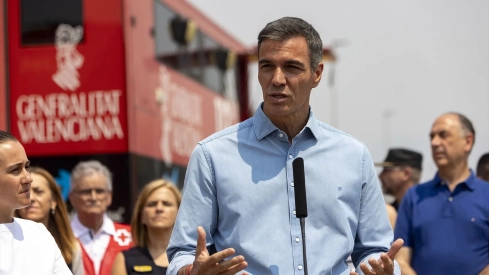
Pedro Sánchez advanced a good part of the measures this Monday. In the morning, he presented the National Network of Climate Shelters in Madrid and in the afternoon he traveled to the command post of the La Vall d'Uixó fire. From Castellón, he assured that there are still "difficult hours" ahead and again called for a State pact against the climate emergency.
The declaration opens up aid for those affected
The Council of Ministers will declare the damaged areas as zones seriously affected by a civil protection emergency, the official name for the former disaster zone. Sánchez initially announced the measure during his Sunday visit to the Navaluenga command post, in Ávila, and reconfirmed it this Monday from Castellón.
The agreement must delimit the included municipalities. Madrid, Ávila, and Toledo have already been expressly cited by the Government, while the definitive extension will be included in the text approved this Tuesday. The declaration will allow moving from immediate response to the repair of homes, businesses, farms, and infrastructures.
The National Civil Protection System Law contemplates aid for damages suffered in habitual residences and essential goods, compensation to city councils for their emergency actions, and subsidies for industrial, commercial, and service establishments. It also allows addressing the damages suffered by farmers, ranchers, and forest owners.
The package may also include credit lines from the Official Credit Institute, tax reductions, and exemptions from taxes such as IBI or Economic Activities Tax for affected properties and businesses. Self-employed individuals and companies can also access moratoriums on their Social Security contributions when they prove damages.
The amounts will still depend on the evaluation carried out on the ground. The fires remain active in several areas, and technicians will not be able to finalize a definitive assessment until the extinction progresses. The declaration approved this Tuesday will establish the legal framework to process the aid and specify it later.
A benefit for those who cannot work
The Ministry of Labor has prepared a specific measure for employees who have been displaced from their homes, lost their housing, or cannot travel to their workplace. The new extraordinary benefit will cover salary and contributions as long as the circumstances preventing work persist.
The protection will also extend to those whose workplace is operational but cannot reach it due to road closures, transport suspension, or interruption of basic services. The goal is to prevent evacuated residents from having to choose between attending to a family emergency and going to work.
The State will assume 100% of the salary and contributions during that period, so companies do not have to bear a cost caused by a catastrophe unrelated to their activity. The measure was negotiated over the weekend with unions, employers' associations, and officials from the affected communities.
The decree will also extend by five days the leave for workers who have lost a family member as a result of the fires. The benefit will currently cover the present emergencies, although Yolanda Díaz's department intended to permanently incorporate it into legislation to respond to future climate catastrophes.
Labor regulations already recognize leaves of up to four days when a person cannot go to work due to mobility restrictions or serious risks derived from a catastrophe. The new benefit addresses different situations, such as loss of housing or prolonged evacuation, which had left numerous affected individuals without sufficiently clear economic coverage.
Climate shelters and scientific advice
Sánchez accompanied the immediate measures with an adaptation agenda in the face of rising temperatures. The president announced ten million euros to create new climate shelters, including educational centers, and another nine million destined for green infrastructures and urban renaturalization projects.
The network aims to offer safe public spaces during extreme heat episodes. The General State Administration already has 180 shelters that open every summer between May 15 and September 30. The map prepared by Ecological Transition brings together around 1,100 facilities distributed throughout the country.
"We want to guarantee that age, economic resources, or the lack of green areas are not a barrier to the climate crisis," Sánchez defended. The Government also announced in June 200 million euros from the National Energy Efficiency Fund to improve the air conditioning and rehabilitation of schools.
The Council of Ministers will also approve the creation of the Scientific Panel for Action against Climate Change. The new body will be made up of researchers and will have the functions of anticipating risks, evaluating public policies, and transferring recommendations to the Executive.
"In the face of an emergency of this magnitude, data, evidence, and science are useful," the president affirmed during the presentation of the network. La Moncloa links both measures to the State Pact against the Climate Emergency proposed by Sánchez in September 2025.
More than 172,000 hectares burned
The measures come after one of the most serious weeks recorded in Spain since comparable data exists. Fires have burned 172,396 hectares between January 1 and July 27, six times more than the 29,817 recorded during the same period in 2025, according to the latest balance collected by Europa Press.
The fronts of Madrid and Ávila have at times formed a single large fire. The first estimates place the affected hectares in the Sierra Oeste of Madrid at around 25,000 and those burned in the province of Ávila at nearly 50,000. Toledo also remains within the national interest emergency declared by the Interior.
In Castellón, the La Vall d'Uixó fire has forced the evacuation of more than 16,000 people from municipalities close to the Serra d'Espadà. The fire had ravaged around 7,200 hectares and reached a perimeter of 67 kilometers as of the close of this Monday.
The Minister of the Interior, Fernando Grande-Marlaska, stated that there is "control over the emergency," although he acknowledged that the teams are advancing "slowly" due to the weather. Close to 3,000 professionals and around a thousand ground and air resources are working in the most complicated sectors of Madrid and Ávila.
The Interior Ministry maintains the suspension of harvesting with agricultural machinery in Madrid, Ávila, and Toledo while the national emergency continues. The order seeks to prevent new outbreaks during days marked by dry terrain, high temperatures, and very low humidity.
Sánchez insists on the State pact
The president again called this Monday for the support of parties, social agents, and administrations for the pact against the climate emergency. "This is indeed a national priority," Sánchez defended, asking to reinforce prevention, improve coordination, and accelerate reconstruction after each catastrophe.
The PP has avoided completely closing the door to negotiation, although it demands that the Government take as a starting point the 50 measures presented by Alberto Núñez Feijóo after the 2025 fires. Cuca Gamarra avoided confirming whether the popular party members will sit at the future table and demanded that the agreement include economic resources and concrete actions on the territory.
Other popular leaders have hardened their discourse. Parliamentary spokesperson Ester Muñoz accused the Executive of using climate change as a "mantra", while Isabel Díaz Ayuso rejected that all fires are attributed to the climate emergency.
The third vice-president, Sara Aagesen, responded that prevention and forest management mainly correspond to the autonomous communities and asked them to execute their plans throughout the year. She also criticized the governments shared with the far-right Vox, which she accuses of questioning scientific evidence and weakening environmental policies.
The heatwave complicates the operation
The Council of Ministers will meet on the last day before weather conditions worsen again. AEMET has activated a special warning for a heatwave that will begin this Wednesday, July 29, and will last, at least, until Sunday, August 2.
The risk of fire will reach extreme values due to high temperatures, the southerly wind, and the generalized drop in humidity. Thermometers could exceed 40 degrees in the Ebro valley, the northeastern depressions, and a large part of the interior of the southern half of the peninsula.
Marlaska defined this Tuesday as a decisive day to stabilize the main fronts before this deterioration. Operations will continue in Madrid, Ávila, Toledo, and Castellón while the Council of Ministers approves the first measures for those affected. The Ministry of Interior will meet with the autonomous communities on Wednesday to review the emergency and coordinate the next actions.
Add ElConstitucional.es as a preferred Google source for free.
Stay informed about all the latest breaking news with the best information. Against disinformation, for democracy and social rights.
