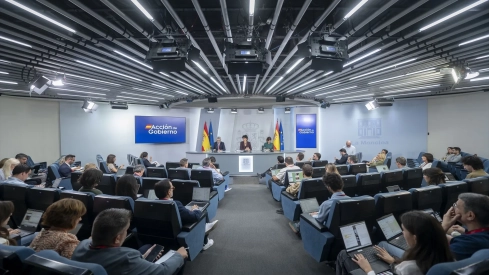
The Council of Ministers approved this Tuesday the IV Strategic Plan for the Effective Equality of Women and Men, a roadmap with more than 750 measures until 2029 that, in principle, should remain in force after the general elections on November 29. The document incorporates for the first time specific actions on political violence against women and on SLAPP demands, long and costly judicial procedures that seek to intimidate or wear down those involved in matters of public interest.
From the Ministry of Equality, which has prepared the plan, they maintain that both phenomena constitute a threat to democratic participation. Political violence can limit the exercise of political rights and the presence of women in decision-making spaces; SLAPPs, for their part, jeopardize fundamental rights of journalists, activists, human rights defenders, researchers, political representatives and other women who participate in public life.
An observatory to measure attacks and a line of aid to stop them
Among the concrete measures is the creation of an Observatory of Digital Misogyny and Political Violence, aimed at collecting and analyzing attacks in the online environment. Equality also foresees a specific line of subsidies for prevention, awareness and research projects in this area, according to ministry sources.
The rest of the block on political violence functions, for now, as a working basis: promoting research and data analysis, strengthening prevention and protection in physical and digital spaces, and launching campaigns and educational actions aimed at public institutions, media and civil society. The plan also proposes strengthening collaboration with public and private, national and international agents.
Judicial pressure against women in public life enters the official agenda
In parallel, the plan incorporates anti-SLAPP measures with training on the use of these lawsuits as tools of coercion and violence, in addition to promoting studies that serve to update protection protocols. The ministry emphasizes that, although these litigations can be directed against anyone, women who participate in the public space often face them in a broader context of harassment, bullying and violence, especially in digital environments.
The decision comes at a time of growth of both phenomena. A UIP report warned in February of the expansion of political violence in a context of polarization, social and economic pressure, amplification of anger on networks and less confidence in institutions. According to that survey, 76% of female parliamentarians said they had suffered violence, compared to 68% of men, and they are disproportionately affected by gender and sexual violence online.
UNESCO, in an analysis published last year on violence against women journalists, also noted that in five years the proportion of professionals who link digital attacks with episodes of abuse, harassment or aggression outside the internet doubled: from 20% in 2020 to 42% in 2022. And the latest report from the Coalition Against SLAPP Lawsuits in Europe, together with the Daphne Caruana Galizia Foundation, identified 1,303 cases between 2010 and 2024, with 167 new lawsuits in 2024 alone.
This context explains the European regulatory shift. The EU approved the anti-SLAPP directive in 2024, and Spain transposed it in the Action Plan for Democracy of that same year. Meanwhile, in the country several complaints have been filed against communicators and journalists for matters related to sexist and sexual violence, among them the one filed against Paloma Palenciano in 2021, archived in 2022, and those opened against Cristina Fallarás, still ongoing.
Complaints have also been registered, such as that of YouTuber Sergio Candanedo against communicator and artist Yolanda Domínguez for calling him a "machista troll" and saying that he was "violent with women"; in that case, the Constitutional Court ended up ruling in favor of Domínguez's freedom of expression. Likewise, elDiario.es and other media have been the subject of complaints for their publication of testimonies of sexual violence against Julio Iglesias, a procedure in which, among other issues, imprisonment is requested.
</
Contact