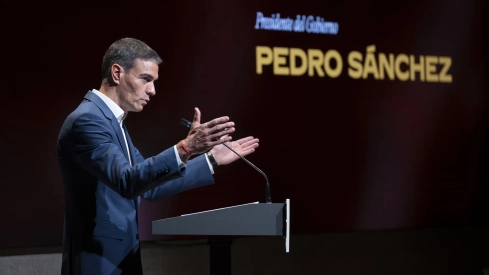
The Government has decided to place immigration at the center of its political agenda in the midst of a full offensive by the right and the far-right against the extraordinary regularization of migrant people. The deadline to apply for it ended this Tuesday, June 30, with more than 1.2 million applications on the table, well above initial forecasts, and Pedro Sánchez took advantage of the day to present the new Integration and Citizenship Plan.
The measure affects people who were already in Spain before January 1, 2026, or who had applied for international protection before that date. It is not a new entry or an automatic concession without requirements. The royal decree requires proof of residence in Spain, no criminal record, and no threat to public order, public safety, or public health. The initial authorization allows for residence and work for one year.
Sánchez defended regularization as a way to bring hundreds of thousands of people who already live in the country out of the underground economy. The president spoke of managing migration in a “fair, orderly, and intelligent” manner and linked the measure to employment, demography, and the sustainability of the welfare state. The event was also attended by Second Vice President Yolanda Díaz, along with several ministers, unions, and employers.

The plan presented by the Executive starts with 500 million euros in its first year, 16 measures, and a new State Agency for Human Mobility. It includes strengthening public services, training, employment in sectors with labor shortages, and coexistence rules. The campaign chosen by Inclusion summarizes Moncloa's political approach with a clear slogan: “Where do they come from? They come from building a country.”
From fear to data
The Government's response comes after several days in which PP and Vox have tried to mix immigrant regularization, the Grandchildren Law, and external voting. Feijóo has spoken of “electoral engineering” and the far-right Vox has raised the tone with its usual recipe of suspicions about the democratic system. The problem with this discourse is that administrative regularization does not grant Spanish nationality or allow voting in general elections.
The Vice President Carlos Cuerpo defended in the morning on 'La Hora de La 1' on TVE that the process allows more than a million people to be taken "out of the realm of the invisible" and linked it to two effects: social justice and economic progress. He also responded to the opposition's electoral accusation with a simple phrase: "Nobody knows who immigrants are going to vote for."
The economic argument is not minor. The Government maintains that immigration has contributed significantly to recent growth and that Spain needs an active population to fill vacancies in sectors such as care, hospitality, agriculture, construction, and services. The discussion, therefore, is not just about papers, but about more contributions, contracts, labor rights, and the country's real capacity to sustain our economy.
The Supreme Court opens a European unknown
The regularization now enters a more delicate administrative and judicial phase. The Supreme Court is considering raising a preliminary question before the Court of Justice of the European Union to clarify whether some aspects of the royal decree fit with community law. The doubt arises from the appeals filed by the governments of Aragon and the Valencian Community, both from the PP.
That movement does not by itself suspend the process. The Supreme Court has transferred the matter to the parties for them to comment before deciding whether to elevate the consultation to Luxembourg. The European Commission, for its part, had already defended that this type of regularization can be compatible with the European framework if processed with guarantees and has avoided commenting now on the Spanish court's decision.
The political battle will continue. The PP continues to try to load the debate onto the ground of control and electoral impact. Meanwhile, the far-right Vox takes it in its populist drift to identity fear. The Government, on the other hand, wants to turn the closing of the deadline into the beginning of a new stage: files, permits, integration, and employment. For thousands of people who until now worked, cared, paid rents, and sustained neighborhoods without papers, the change begins in something as basic as ceasing to be invisible.
