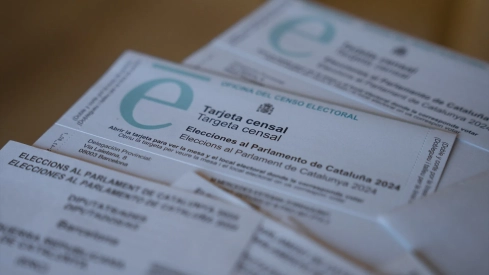
The Supreme Court has decided to provisionally suspend new registrations in the Electoral Census of Absent Residents (CERA) for those who have acquired nationality under the so-called grandchildren's law—except in cases where it is proven that the new electors are descendants of Spanish exiles—at the request of appeals from Iustitia Europa and Vox. In this regard, the Central Electoral Board (JEC) will meet this Monday to study the requirement.
The precautionary measure will be in force during successive electoral processes until the high court issues a ruling and is part of the appeals filed by Iustitia Europa and Vox against the agreement adopted by the Central Electoral Board (JEC) on July 16. The Administrative Litigation Chamber of the Supreme Court has upheld the precautionary measures proposed by both parties and conditions the recognition of electoral rights on the ability to demonstrate the status of a descendant of exiles.
To verify which registrations meet these requirements, the Supreme Court orders the JEC to request a detailed report from the Electoral Census Office. The document must differentiate between census registrations that have occurred directly due to the exile cases contemplated in the 'grandchildren's law' and those that have been authorized based on the interpretation subsequently established through an instruction.
Furthermore, the court demands that the Electoral Board urge the Census Office to complete another report that it had already requested on July 16 regarding the application of this regulation and the postal vote of absent residents. It must also draw up an instruction that establishes specific criteria for determining the municipality in which the electoral registration should be made.
In the event that these documents are not yet completed, the Supreme Court establishes that the JEC must set a maximum period of 15 days for the Census Office to prepare and deliver them. Once received, the Electoral Board will have a maximum of ten days to approve them.
The so-called 'grandchildren's law' was incorporated into the Democratic Memory Law approved in October 2022 and opened up the possibility for children and grandchildren of Spanish origin to obtain Spanish nationality. Among the contemplated cases is that of those who can prove that their father, mother, grandfather, or grandmother were Spanish and had to go into exile for political, ideological, religious, or sexual orientation-related reasons.
Subsequently, an instruction broadened the interpretation of these cases by establishing that the condition of exile would be "presumed" in the case of Spaniards who left Spain between 1936 and 1955. It is precisely on the application of this criterion that the Supreme Court now demands information to determine which registrations in the CERA can maintain their electoral effects.
