Housing concentrates the political debate on the way to the general elections of November 29. The death of Maricarmen Abascal, the mobilizations in the streets and the call for a general strike have placed access to a home among the main demands to the parties. The pre-campaign confronts the Government and the PP on how to protect tenants and expand the offer, while thousands of people demand measures that arrive before the next eviction or the next rent increase.
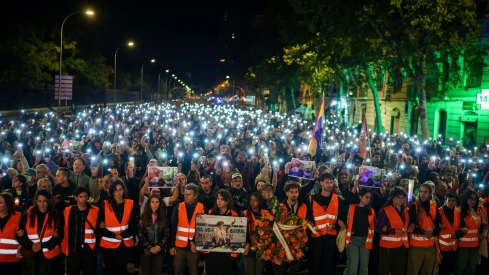
Madrid once again expressed this discomfort on Thursday with a march in memory of Maricarmen that gathered 20,000 people, according to the provisional figure from the Government Delegation. The mobilization covered the path from Puerta del Sol to the home from which she was evicted on September 23. "We do not tolerate one more eviction" was one of the slogans of a farewell that combined mourning with the demand for accountability.
The pressure has two upcoming dates. On October 16, the Permanent Deputation will vote on the Executive's new decrees. On November 11, unions call for a general strike for housing and wages. Between both dates, the parties must explain what they offer to a population whose discomfort came from before. The CIS published on Thursday reflects broad support for public intervention, with interviews conducted in June, before Maricarmen's eviction and the early election.
The mourning for the death of Maricarmen and the general strike in her honor
Maricarmen died on Wednesday at the age of 87 in the Gregorio Marañón hospital, where she had been admitted since the day of her eviction. She had lived for seven decades at number 46 Alcalde Sainz de Baranda, in the Retiro district of Madrid. The agreement reached for her to return did not become effective before her death, after years of procedures and several eviction attempts.
Thursday's march brought photographs, candles and a wreath from the Tenants' Union to that portal. Attendees alternated silence with slogans against evictions and speculation. The head of the march reached the house to applause, while flowers and mementos were placed in front of the building. The tribute joined those held in other cities and the vigil that had turned Sol into a place of farewell.
The mobilization will make the leap to workplaces with the general strike of November 11, agreed upon by the Confederation of Tenants' Unions, CCOO, UGT, and other organizations. The 24-hour strike will be held 18 days before the elections, with demands that unite affordable rents, measures against speculation, and sufficient wages to face the cost of living.
Its promoters direct the demands to all administrations and also to business organizations. Pepe Álvarez, general secretary of UGT, has specified that "there is no single recipient of the protest", while Unai Sordo, leader of CCOO, has insisted that no administration is left out. This approach extends the pressure beyond the vote on the decrees and forces a discussion of regional powers, municipal decisions, and wage negotiation.
The duel also left a strong institutional division. The Senate, the Madrid Assembly, and the City Council of the capital refused to hold the minutes of silence requested by the left, which maintained its tributes outside official acts. In Cibeles, Almeida accused PSOE and Más Madrid of acting as "vultures" and "scavengers". The PP's refusal was not uniform, as it did accompany the tributes in Les Corts Valencianes and in a commission of the Andalusian Parliament.
The Government's housing decrees are voted on again
Pedro Sánchez faces the pre-campaign with a new attempt to recover the measures that Congress rejected on October 2. PP, the far-right Vox, Junts, and UPN voted against the main package; the second text also faced rejection from the PNV and Coalición Canaria. The Council of Ministers re-approved both norms on Tuesday, with changes, and their continuity must now be resolved in the Permanent Deputation.
The main decree came into force on Thursday, although it contains measures with different application deadlines. It includes protection against evictions of vulnerable people without housing alternatives and extraordinary extensions of up to two years for certain rentals, subject to requirements and exceptions. It also regulates seasonal and room rentals and modifies tax incentives to promote affordable housing.
Another measure limits until the end of 2030 certain home purchases by funds and large holders at prices below 70% of their market value. The package also incorporates 10,000 million euros for an ICO loan line aimed at first homes, with up to 50,000 euros interest-free to cover part of the down payment. These are loans that must be repaid, under the conditions of the program, as 'ElConstitucional.es' already explained.
The second decree seeks to give more continuity to contracts through successive renewals and establishes compensation when the owner decides not to renew them, with exceptions such as the need to recover the house for personal or family use. The BOE sets its entry into force for November 15. It must first pass a parliamentary vote, for which the Government still does not have a guaranteed majority.
The PNV maintains its support for the main text and its rejection of the second. This difference will be decisive in the session scheduled for October 16, before a body that assumes the corresponding parliamentary functions while the Cortes are dissolved. The vote will allow verifying which measures survive the blockade that precipitated the early election, before the parties enter the official campaign.
The CIS represents the housing crisis in Spain
The Housing Barometer released on Thursday helps measure the extent of the problem. 86.9% of respondents are very or quite concerned and 76.3% consider state intervention necessary to guarantee access to a home. In addition, 91.4% ask for more public housing to be built. The survey was conducted between June 22 and 30, so its responses reflect a concern prior to the mobilizations of these weeks.
Citizen support extends to measures of different kinds. 95.4% support lowering taxes to buy a first home, 85.7% demand greater guarantees against defaults, and 84.3% want to bring developable land to the market. This set of responses demands proposals capable of addressing both those who fear losing their rental and those who seek to buy or rent a home.
The PP's alternative focuses on expanding supply, reducing red tape, and strengthening the legal security of owners. Feijóo promises to promote one million homes in a legislature, through a new Land Law, public-private collaboration, guarantees, and tax aid. Among his proposals is to reduce VAT to 4% to facilitate young people buying their first home. The popular party maintains that the Government's measures harm the rental market.
Feijóo accused the PSOE on Thursday of attempting an "emotional manipulation" with housing and warned that "it will not fly", without expressly mentioning Maricarmen in his speech before the National Executive Board. The PP attributes the crisis to Sánchez's years of management, while the Executive points to popular rejection of its decrees. The discussion also confronts the deadlines for each response, between building new homes and protecting those whose contract is about to expire.
From the Government, Félix Bolaños assured on Thursday that he shares the reasons for the strike, linked to affordable housing and higher wages. He also acknowledged that the unions consider what has been done insufficient. This demand also affects the left that is negotiating its candidacy for 29N, where Colau places housing among her priorities and Belarra demands to stop speculation as a condition for another agreement with the PSOE.
Tributes will continue this Friday. The Confederation of Tenants' Unions, together with CCOO and UGT, has called for a minute of silence at 12:00 in workplaces and study centers throughout the country in memory of Maricarmen.
