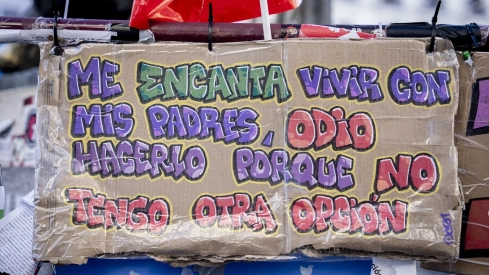
Housing arrives at the general elections on November 29 with a discomfort that was already widespread before the encampments and the early election. 87% of Spaniards are very or quite concerned about the housing situation and 76.3% believe that the State should intervene in the market as much as necessary to guarantee access to a home, according to the Housing Barometer published this Thursday by the Center for Sociological Research (CIS).
The study is based on 6,019 interviews conducted between June 22 and 30. Their responses precede the eviction and death of Maricarmen Abascal, the Government's housing decrees, and the election call. That date matters: the CIS shows that the concern already existed when the protest had not yet filled the Puerta del Sol. 41.6% of respondents then stated that the crisis personally affected them.
A broad agreement, with different measures
The demand for public action has several facets. 91.4% want administrations to build more public housing and 79% believe that the constitutional right to housing should be prioritized over its consideration as a market good. Recovering public housing sold to private companies (83.1%), creating a state housing company (76.3%), and limiting tourist apartments (75.6%) also receive high support.
But support for intervention does not equate to a blank check for any proposal. The measure with the most support in the entire questionnaire is lowering taxes on the purchase of a first home, with 95.4%. Giving more guarantees to owners against possible defaults convinces 85.7% and bringing developable land to the market, 84.3%. These are responses that force parties to talk about tenant protection as well as purchase, legal security, and construction.
Other measures also gather clear majorities. 70.6% support freezing rents for two years and 72% raising taxes on those who own ten or more homes. The limit appears when asking about expropriations: 49.9% support expropriating land to build public housing, while the expropriation of empty flats obtains 40% support and 54.3% rejection. The consensus on the existence of the problem is much greater than the agreement on all its solutions.
There a central dispute of the campaign opens. The PSOE and the left can point to support for public housing and limits on the market; the PP can rely on tax cuts, land, and guarantees to owners. No single bloc alone gathers all the preferences collected by the barometer. To convince those who live the problem, the proposals will have to explain what homes will arrive, to whom, and in what timeframe.
Wanting to buy and not being able to leave home
The preference for ownership remains overwhelming. 93.5% say they would like to live in their own home, although 55% currently reside in a property they own and 24.1% live in rented accommodation. Among those who wish to buy but do not plan to do so soon, 80.7% indicate that they lack money for the down payment and 71.3% that their income is not enough for mortgage payments.
The blockage also appears before thinking about a mortgage. Among those who live with family or in a shared room and do not plan to move to an independent home during the next year, 84.9% say that rent is too expensive for their income and 85.6% point to the purchase price. 77% lack money for the down payment or deposit. The barometer thus describes a daily difficulty: there are people who want to form their own home and cannot even afford the first payment.
The consequences go beyond postponing a move. 18.5% have received family help to pay rent or mortgage in the last five years; 14.7% have moved away from family or friends for economic reasons and 11.8% have had to return to their family home or share a flat because they could not afford their own. In addition, almost a quarter have lived in a house with extreme cold or heat. The crisis affects the price, but also where and how one lives.
The Government seeks support for its decrees
The Ministry of Housing considers that the CIS endorses its commitment to expand the public housing stock and intervene in the market. The first of the two decrees that the Government approved again on Tuesday comes into force this Thursday, although it must pass the vote in the Permanent Deputation of the Congress. It includes protection against certain evictions of vulnerable people, extraordinary extensions of rental contracts, and financing to facilitate the purchase of a first home.
The support for each CIS question, however, does not measure the approval of those specific decrees: the interviews were conducted three months before they were approved. Their viability now depends on parliamentary votes. The PNV has announced its support for the first text and its rejection of the second, which proposes converting certain rental contracts into indefinite ones.
There will also be a fight over who should answer to the voters. Only 36.1% identify autonomous communities as the administration with the most powers in housing, while 44.5% would prefer the State to have more capacity to improve access. The central government will have to defend its measures; the regional executives, their decisions on land, protected housing, and the application of available tools.
The barometer includes a voting question, although it does not offer an estimate of seats for 29N. In direct intention, the PSOE obtains 20%, the PP 14.8%, and Vox 9.2%, with 21.9% undecided. These are responses collected in June, before the early election and the mobilizations that have brought housing to the center of the pre-campaign.
