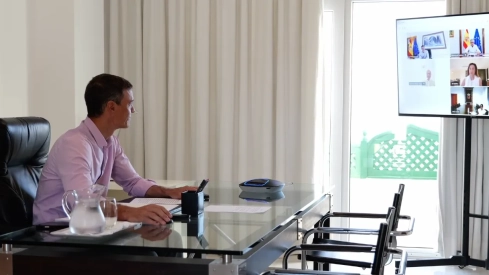
The President of the Government, Pedro Sánchez, led a coordination meeting by videoconference on Friday to analyze the evolution of the migratory crisis in Ceuta and define the next steps of the Executive's response. Several members of the Government participated in the meeting, including the Minister of Defense, Margarita Robles; the Minister of Interior, Fernando Grande-Marlaska; the Minister of Territorial Policy and Democratic Memory, Ángel Víctor Torres; the Minister of Inclusion, Social Security and Migrations, Elma Saiz; the Minister of Youth and Childhood, Sira Rego, and the Secretary of State for Foreign and Global Affairs, Diego Martínez.
During the meeting, the Executive evaluated the current situation in the autonomous city and the development of the actions deployed since the beginning of the crisis. Likewise, new initiatives aimed at reinforcing assistance to migrants who remain in Ceuta and at guaranteeing the security and well-being of the population were addressed.
The Government has reaffirmed its commitment to mobilize all necessary State resources with the aim of accelerating the return to normality in the autonomous city and minimizing the consequences derived from the massive arrival of people registered in recent days.
In addition, the Executive requested the appearance, at its own request and in an extraordinary period, of four ministers in the Congress of Deputies to report on the management of the crisis by the end of August. The interventions of Robles on the 25th, Bolaños on the 27th, Marlaska and Albares on the 28th are planned.
Economic aid allocated
After the Government allocated an extraordinary allocation of 25 million euros to assist unaccompanied minors in Ceuta after the migratory crisis, the Ministry of Inclusion, Social Security and Migrations has made a transfer of 6.5 million euros to the city to "reinforce" aid and reception with the aim of "guaranteeing socio-health care" for the people in the Temporary Immigrant Stay Center (CETI).
The Ministry of Inclusion has reported that the actions launched to reinforce the reception system have allowed an increase of 72 places in the capacity of the CETI of Ceuta. In addition, the department led by Elma Saiz has indicated that it has coordinated with the Red Cross the socio-health assistance to migrants who remain both on the beach and in the vicinity of the CETI, where food kits are also being distributed.
On the other hand, the minister participates this Thursday by videoconference in a coordination meeting of the humanitarian assistance device organized by the Government Delegation in Ceuta, in which the Secretary of State for Migration, Pilar Cancela, also intervenes.
The Ministry has reiterated that they are following the evolution of the situation "very closely" and that they have been "in permanent contact and coordination from the very first moment" with the Government of the Autonomous City, the Government Delegation in Ceuta, the Ministry of Interior and the rest of the administrations involved, with the aim of "providing an adequate, coordinated and effective humanitarian response to this extraordinary situation".
The PP's offensive in the Senate
Political pressure on the Government over the management of the migratory crisis in Ceuta continues to increase. After the Popular Party demanded this Thursday in Congress the urgent convocation of the Permanent Deputation to demand the appearance of several ministers and the President of the Government, Pedro Sánchez, a coordination meeting of the Executive has been called for this Friday. Likewise, the Government has announced that ministers Margarita Robles, Félix Bolaños, Fernando Grande-Marlaska and José Manuel Albares will appear at their own request in Congress at the end of August.
In response, the 'populares' have decided to bring forward those explanations and have summoned the same ministers to the Senate next week to account for the Executive's actions in the face of the massive arrival of migrants to the autonomous city. The appearances are scheduled for August 12, 13 and 17.
Spain's warning to Italy
The Government of Spain has responded to the Government of Italy for its initiative regarding the migratory crisis in Ceuta after the massive entry of people into Spanish territory. In this regard, they have urged the country of Giorgia Meloni to carry out, in two days, this Sunday, the suspension of the 'Schengen area', otherwise, the Executive assures, "Spain will be forced to adopt proportional measures to protect the interests and dignity of its citizens."
Spain has demanded that "controls be ended and Spaniards be treated like the rest of European citizens" which have affected, since August 1, "the mobility of thousands of passengers and generated legal uncertainty."
Similarly, they have stated that these restrictions have been carried out "without prior notice, unilaterally and with spurious arguments that do not conform to either the Schengen Borders Code or the truth," calling the Meloni Government's action "unjust, contrary to the interests of the EU and discriminatory."
Furthermore, they have reminded Italy, one of the countries with the most irregular migrant crossings, that practically all the people who entered Spanish territory, "have already returned to Morocco."
From the executive of the ultra leader, Giorgia Meloni, they have rejected the Spanish ultimatum: "Italy does not accept ultimatums or impositions from abroad on matters of national security and border control," the prime minister's office said in a statement. Thus, Italy will maintain extraordinary controls at least until August 15. Meloni's refusal keeps the conflict open until Sunday. The Spanish Government will then have to decide whether to activate the announced proportional measures while Italy extends the controls, at least, until six days after the deadline set by Madrid expires.
Add ElConstitucional.es as a preferred Google source for free.
Stay informed about all the latest breaking news with the best information. Against disinformation, for democracy and social rights.

