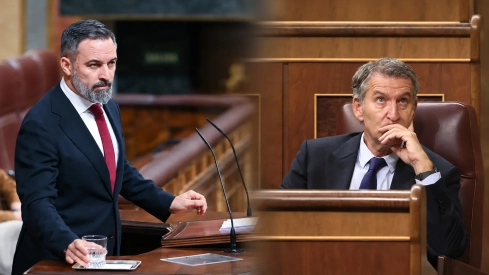
Alberto Núñez Feijóo's PP and the far-right Vox have closed this Monday an agreement to coordinate their candidacies for the Senate in the November 29 elections. The popular party withdraws from Girona, Tarragona, and Gipuzkoa and agrees to incorporate candidates proposed by Santiago Abascal's party under its own acronym in other territories. The pact affects 23 provinces and seeks to concentrate the right-wing vote against the alliance of progressive forces.
The understanding allows the far-right Vox to seek representation through PP candidacies where it withdraws its own. Feijóo thus offers the far-right space on its lists and a shared negotiation on the institutional power that both parties aspire to achieve. Its general secretary, Miguel Tellado, has presented the collaboration as "very good news for Spain" and has attributed "sense of state" to both formations.
"No one is diluted, no one gives up their own acronym," Tellado said. The content of the agreement establishes, however, that the PP cedes to Vox the choice of part of its Senate aspirants. The candidates proposed by the far-right will appear as "independents," a denomination that will allow them to be included in the popular candidacy even if their designation comes from Abascal's party.
Feijóo has endorsed the pact on his social networks, where he has promised to act with "broad-mindedness and responsibility." "The furious reaction of those who want to prevent it shows that we are on the right track," the president of the PP wrote after the announcement.
Hay una mayoría de españoles que quiere cambio. Y haremos todo lo que esperan de nosotros. Vamos a lograrlo con altura de miras y responsabilidad.
— Alberto Núñez Feijóo (@NunezFeijoo) October 26, 2026
La reacción rabiosa de quienes quieren impedirlo demuestra que vamos en el camino adecuado.
The distribution of candidacies
Vox renounces to present its own candidacy in Las Palmas, Santa Cruz de Tenerife, Cádiz, Valencia, Castellón and Balearic Islands. In return, the PP incorporates aspirants proposed by the far-right, placed in the second or third position of their candidacies. The withdrawal allows reducing the competition between both parties while Abascal retains the possibility of obtaining senators through the popular party's acronym.
The distribution has a particularity in the archipelagos, where the electoral district is the island. In Gran Canaria, Tenerife and Mallorca, which elect three senators each, the agreed formula combines two PP candidates and one proposed by Vox. In the islands that elect a single representative, the far-right withdraws. In addition, in the three largest islands, each elector can mark a maximum of two names, an important detail to understand how they should coordinate their support.
For its part, the PP stops running in Girona, Tarragona and Gipuzkoa, without an equivalent incorporation of popular candidates in Vox's lists. Feijóo agrees to withdraw from territories where his representation options were reduced. The exchange allows Abascal to get candidates within the popular lists in exchange for a concession from the PP that has a limited electoral cost.
The third part of the agreement affects another 14 provinces, where Vox will present a single candidate. These are Seville, Huelva, Asturias, Badajoz, Álava, Navarra, Cáceres, Huesca, Zaragoza, Alicante, Granada, Cuenca, Pontevedra and Jaén. In all of them, the PP will maintain its three aspirants. Tellado has explained that Vox voters will be able to mark their candidate and, in addition, two popular ones.
🔴 URGENTE SENADO | Actualización tras escuchar la comparecencia del Secretario General del PP, Miguel Tellado:
— VOX 🇪🇸 (@vox_es) October 26, 2026
Celebramos que haya un punto de encuentro para evitar el asalto de la extrema izquierda al Senado, donde el Partido Popular retirará las candidaturas de Gerona,… https://t.co/lD9VefWAq3
The strategy takes advantage of the fact that the vote for the Senate allows combining candidates from different parties. In peninsular provinces, four senators are elected, and each voter can indicate up to three names. The usual distribution of three seats for the first force and one for the second can change if support is distributed differently. PP and Vox try to take advantage of this possibility to add more representatives between them and dispute the remaining seats with the left-wing parties.
The result will depend on how many votes each candidate receives. Coordination can improve their options, but no distribution is guaranteed by the pact, and appearing in second or third place does not guarantee a seat either. In the Senate, the most voted candidates are elected, unlike the closed lists of the Congress.
The Constitutional Court, on the horizon
The agreement responds to the Senate of Progress coalition, promoted by the PSOE, the Frente Amplio and other territorial forces to reduce the fragmentation of the left-wing vote. The far-right has described this electoral alliance as an attempt to "assault institutions". Its general secretary, Ignacio Garriga, has justified the rapprochement with the PP by the shared will to "expel Sánchez's criminal organization from all institutions." With this language, he presents as a threat a coalition that will run in the elections, while negotiating his own electoral coordination with the popular party.
For the PP, the ambition is to maintain control of the Upper House and reach a three-fifths majority with Vox. This threshold has consequences that go beyond the approval of parliamentary initiatives. The Senate proposes four of the twelve magistrates of the Constitutional Court and needs this reinforced majority to elect them.
If both parties gather enough support, they could agree on these four names without needing the votes of the PSOE, among the candidates presented by the autonomous assemblies and following the foreseen procedure. The renewal could alter the balance of the court in charge of ruling on the constitutionality of laws. The pact therefore grants the far-right a possible negotiation capacity over these appointments.
The same majority allows the Senate to elect ten of the twenty members of the General Council of the Judiciary when their renewal is due. The other ten are elected by the Congress. Therefore, the result of the Upper House will condition a relevant part of institutional appointments, with Vox as the PP's interlocutor to gather the necessary votes.
The announced understanding also does not guarantee the far-right its own parliamentary group, for whose constitution at least ten senators are needed. Tellado has avoided committing to additional compensation to ensure that objective. The names of the candidates proposed by Vox must be specified in the candidacies that both parties have until midnight this Monday to register.
