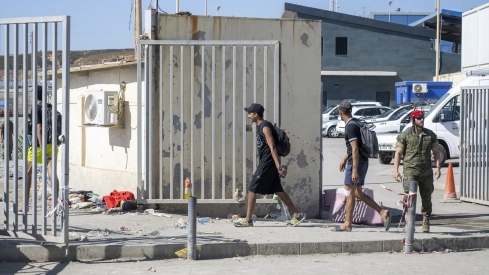
The State Attorney General's Office has directly pointed to Morocco and Algeria for the difficulties both countries pose in executing judicial expulsions of their citizens from Spain. Its annual report, corresponding to 2025 and published this Thursday, describes "extremely restrictive" consular collaboration that ends up frustrating a large part of the repatriations agreed upon by the courts.
The document identifies the lack of documentation and limited cooperation from consulates as the main obstacle to making these measures effective. It also mentions other problems, such as the collapse of some judicial bodies or the impossibility of locating the convicted person, although it attributes the biggest bottleneck to the response from the countries of origin.
In the case of Morocco, authorities only accept the return when the convicted person has an original and valid passport, a difficult requirement to meet because many convicts deliberately hide this document. Without confirmation from the consulate or a valid identification, the order issued by the judge remains blocked and the Spanish State loses the possibility of executing it.
Algeria's attitude is even more closed. The Attorney General's report states that the country "practically does not document expulsions" and that, in some Spanish provinces, this route has come to be considered "materially unfeasible." The prosecutor's offices of Seville, the Balearic Islands, Valencia, Murcia, and Zaragoza are among those that have warned of these persistent obstacles.
The publication of the report also comes at a particularly delicate moment for relations with Rabat. The declassified documents on the massive entry into Ceuta already described a not very proactive and late Moroccan response during the crisis of July 30 and 31, when more than 70,000 people crossed into the autonomous city.
The report refers to 2025 and, therefore, predates what happened in Ceuta. Its content shows, however, that the difficulties with Morocco came long before the last border crisis. Spain needs Rabat's cooperation to control departures from its territory and also to accept the return of those who have a judicial expulsion order. The official documents known this week show failures at both ends.
Requests increased by almost 20% in one year
During 2025, the Prosecutor's Office requested on 5,551 occasions to substitute prison sentences exceeding one year with the expulsion of the convicted person, 19.2% more than in 2024 and 34% above the figure recorded in 2023. This possibility, regulated by article 89 of the Penal Code, is considered when there is a total lack of roots in Spain.
The Public Prosecutor's Office has also detected an increase in voluntary expulsion requests made by the convicted persons themselves, especially in Madrid, Navarra, and Catalonia. Some are even submitted when the original sentence did not contemplate that option, a situation whose legal viability is now being studied by the Attorney General's Office.
The difficulty in executing expulsions contrasts with the results obtained when there is administrative coordination. In Segovia, 14 of the 16 requested measures were authorized, and 13 were materialized. The Prosecutor's Office itself uses this data to demonstrate that the procedure works when documentation is available and consulates collaborate. The obstacles from Morocco and Algeria leave too many Spanish judicial orders unfulfilled.
Add ElConstitucional.es as a preferred Google source for free.
Stay informed about all the latest breaking news with the best information. Against disinformation, for democracy and social rights.
