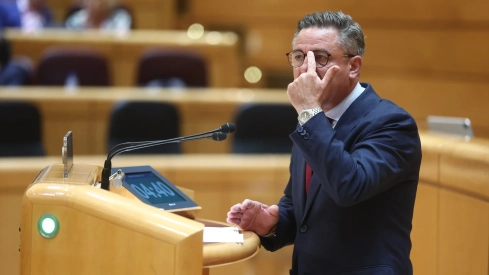
The gateway to RETA for mutual society members has passed its penultimate parliamentary procedure this Thursday, but it does so with a significant modification. The Senate has approved the reform by 164 votes in favor, one against, and 96 abstentions and has returned the text to Congress for the definitive vote. The norm will allow thousands of professionals to transfer their accumulated economic rights in alternative mutual societies to the self-employed regime of Social Security, although it excludes mutual society members who are already retired, except in cases of widow's pension.
The decision corrects the text that had emerged from Congress in June. Then, a PP amendment expanded access to the gateway and opened the door to already retired pensioners and those who had a recognized right to a pension. Now, with an absolute majority in the Senate, the popular party has again limited that scope and has reinstated the exclusion of the so-called passive members.
The issue mainly affects lawyers, solicitors, architects, engineers, and other collegiate professionals who for years contributed to private mutual societies as an alternative to RETA. Many of them have reached retirement age with very reduced benefits, in some cases of 300 or 400 euros per month, after long professional careers. This gap explains the social and political pressure that has accompanied the processing of the reform in recent months.
Who can access the gateway
The text emerging from the Senate maintains the gateway for mutual society members who are not pensioners of a public regime or their alternative mutual society. The exception remains for those who receive a widow's pension. Also eligible are active professionals with more than 15 years of contributions, therefore with the right to a contributory pension, one of the relevant differences compared to previous versions.
The reform will allow transferring the economic rights generated in the mutual society to the public system to convert them into contribution periods in RETA. Whoever meets the requirements and decides to access the gateway will be compulsorily and irreversibly integrated into Social Security.
One of the key points will be the regulation that the Government must approve within a period of three months from the entry into force of the law. This will specify much of the fine print: requirements, procedure, final calculation of transferred contributions, and exact conditions for integration into the public regime.
The PP changes in the Senate what it opened in Congress
The processing has left a striking political photograph. The PP was the party that introduced an amendment in Congress to broaden access to the pathway, also for retirees. Just a few weeks later, the PP itself has used its majority in the Senate to once again exclude this group.
The Popular Party argues that the solution must be viable and that the Government will now have the responsibility to develop a regulation that does not frustrate those affected. From the left, however, the PP has been criticized for having cut the scope of the measure and for keeping out people who are already receiving very low pensions after having contributed for decades in alternative systems.
The debate has been heated, although most groups have agreed that the reform does not resolve all cases. The PNV senator Nerea Ahedo defended that the text represents a solution for thousands of professionals against the risk of doing nothing. EH Bildu, for its part, focused on the origin of the problem and criticized the alternative model that allowed these mutual societies to function for years as a substitute for Social Security.
The calculation of years and the 1x1 formula
The Senate has also introduced changes in the way contribution periods are calculated. For mutual members over 52 years old as of December 31, 2026, the well-known 1x1 formula is maintained, which allows each full month of registration and contribution to the mutual society to be computed as a full month in the RETA for pension percentage purposes.
This improvement will also apply to periods prior to 1995, when affiliation to certain mutual societies was mandatory for some collegiate professions. This is one of the most sensitive points for veteran mutual members, because it can prevent them from being treated as if they were practically starting from scratch in Social Security.
Another issue will be the economic conversion. The text establishes that the minimum contribution base that would have corresponded in the RETA will be taken into account and that an improvement coefficient between 0.67 and 0.87 will be applied, designed to adjust for contingencies not covered by alternative mutual societies.
The reform now returns to Congress, which will have to decide whether to accept the changes introduced by the Senate or recover part of the previous text. That vote will be the definitive one before publication in the BOE. For thousands of mutualistas, the result will determine whether the gateway remains a partial exit or if Congress again widens access before closing the law.
