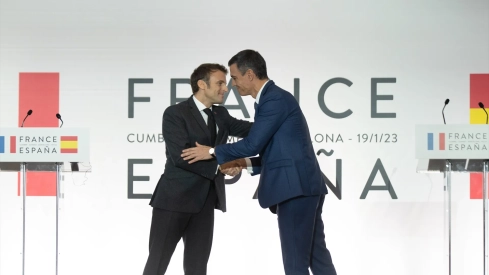
The Senate has once again blocked this Thursday the Treaty of Friendship and Cooperation between Spain and France, signed by Pedro Sánchez and Emmanuel Macron in Barcelona in January 2023. The majority of PP and the far-right Vox in the Upper House has approved referring the text to the Constitutional Court for it to rule on the clause that regulates the rotating participation of ministers from one country in meetings of the other.
The initiative has gone ahead with 146 votes in favor, those of PP and Vox, against 112 against and two abstentions. The political and legal effect is immediate: the ratification is suspended until the Constitutional Court rules, without a closed deadline to resolve.
The treaty had already been ratified by France and approved by the Congress of Deputies on June 18, after Junts and Podemos changed their position and voted in favor. If the Senate had simply rejected the text, Congress could lift the veto. The path chosen by the PP delays the agreement for the second time and leaves the bilateral relationship pending another ruling from the Constitutional Court.
The PP clings to the ministers' clause
The point questioned by the popular party is article 2.4 of the treaty. This section provides that a French minister may participate, at least once every three months and on a rotating basis, in a meeting of the Spanish Council of Ministers, and that a Spanish minister may do the same in France.
The PP maintains that this formula raises constitutional doubts because the Magna Carta establishes the composition of the Government. During the debate, popular senator Miquel Jerez defended that his group asks for “legal certainty” and that it be the Constitutional Court that clarifies whether there is a contradiction between the treaty and the Constitution.
The Government already tried to clear up that objection with an exchange of letters between the Minister of Foreign Affairs, José Manuel Albares, and his French counterpart, Jean-Noël Barrot. In these letters it is clarified that the presence of the invited minister would occur “on the margins” of the Council of Ministers, in a separate meeting and without being part of the executive session of the Government.
For the PP, this clarification is not enough because it does not literally modify the treaty. Pepa Pardo, popular Justice spokesperson, went so far as to say that the Executive “sold France a fake treaty” and defended that the Senate act as “guardian” of the Constitution and national sovereignty.
The far-right Vox accompanies the blockade and hardens its tone
Vox has voted alongside the PP, turning the debate into a question of sovereignty. Senator Ángel Pelayo has maintained that the Council of Ministers “is not a group of friends” and has rejected normalizing the periodic presence of members of foreign governments in that body.
The far-right's position aligns with its usual rejection of any formula of European integration or cooperation that could be presented as a cession of sovereignty. In this case, PP and Vox have once again ended up coinciding in the same vote and in the same practical consequence: the treaty with France remains frozen.
The groups supporting the Government have criticized this interpretation. The PSOE has accused the PP of practicing a blockade with consequences for the relationship with Paris. From the PNV, it has been argued that the treaty responds to the European spirit and that such an attitude would have made many advances in European integration impossible. Compromís has spoken of a “very serious error” and ERC has accused the popular party of dragging itself into the far-right's agenda.
Albares accuses the PP of boycotting a strategic agreement
The Minister of Foreign Affairs has reacted harshly. Albares has accused the PP of becoming an “anti-system” party by blocking the first friendship treaty between Spain and France, and has defended that the agreement is key for cross-border cooperation, economic relations, European policy, interconnections, and coordination in matters such as defense, justice, culture, transport, or energy.
The Government insists that France is not just any partner. It is Spain's main European neighbor, one of its major economic partners, and a country with a daily relationship that affects hundreds of thousands of citizens. Foreign Affairs has also reminded of the 330,000 Spaniards living in France and the million people residing in border municipalities.
The vote comes in a particularly sensitive week for Sánchez's foreign policy. The president will travel to Paris on July 14 as a guest to the official events of the French National Day, while the treaty he signed with Macron remains unenforced due to the blockade in the Senate.
The agreement also had symbolic value. France maintains similar mechanisms with Germany, Italy, or Poland, as part of a practice of reinforced cooperation among European partners. Madrid and Paris wanted to elevate their bilateral relationship to that same level after the summit held in Barcelona in 2023.
