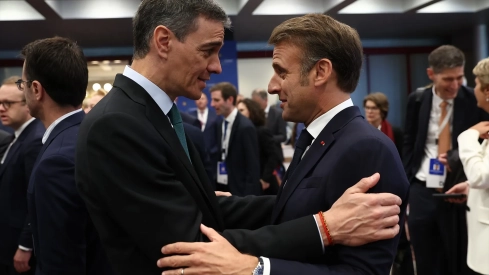
The Partido Popular once again uses its absolute majority in the Senate to block the treaty of friendship and cooperation between Spain and France, signed by Pedro Sánchez and Emmanuel Macron in Barcelona in January 2023. The agreement was already approved by Congress in June, but the popular party has activated a new consultation with the Constitutional Court that will suspend its processing in the Upper House.
The maneuver comes at an especially uncomfortable time for Moncloa. Sánchez will travel to Paris on July 14 as a guest at the parade of the French national holiday, without being able to guarantee Macron when the treaty that both governments presented as a leap in the bilateral relationship will come into force.
The Minister of Foreign Affairs, José Manuel Albares, on Monday criticized the PP and accused it of playing "a very dangerous game". He also spoke of "nonsense" and of "sabotaging the interests of Spaniards" by delaying an agreement with Spain's main neighbor and one of its most important economic partners.
The PP clings to the ministers' clause
The PP's argument focuses on a clause in the treaty that stipulates that a Spanish minister and a French minister will participate on a rotating basis in meetings of the other country at least once every three months. The popular party argues that this formula may clash with the Constitution, which sets the composition of the Government.
The Government rejects this interpretation. To clear up doubts, Albares and his French counterpart, Jean-Noël Barrot, exchanged interpretative letters in April where it was clarified that this participation would take place "on the margins" of the Council of Ministers, in a separate meeting and without being part of the executive meeting of the Government.
The PP considers this clarification insufficient because it does not modify the text of the treaty. Foreign Affairs defends just the opposite and recalls that the formula is not a European rarity. France has similar mechanisms with Germany, Italy and Poland.
France has already ratified it
The Barcelona treaty regulates bilateral cooperation in foreign policy, defense, justice, interior, culture, education, industry, agriculture, energy, transport and interconnections. It also strengthens cross-border cooperation, one of the most sensitive issues for the territories that share the Pyrenees.
France already ratified the agreement in March 2025. In Spain, the text first fell in Congress due to the rejection of PP and Vox and the abstention then of Junts and Podemos. The Government sent it back to the Lower House and it went ahead in June, after those two groups changed their position and voted in favor.
The Senate's blockade also delays high-level bilateral summits. Since the signing of the treaty in January 2023, no new meeting of that format has been held between both countries, precisely because the last one left pending an agreement that is still not in force.
The Senate plenary will vote this Thursday on the request to the Constitutional Court promoted by the PP. If it goes ahead, the treaty will again be stalled. This time, with Sánchez on his way to Paris and with the Élysée closely watching the Spanish blockade.
