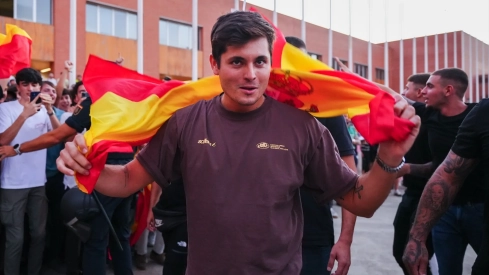
Vito Quiles voluntarily appeared this Tuesday, October 27, in a Madrid court, one day after his search, arrest, and presentation before Justice was ordered. The measure had been agreed upon after he could not be personally notified of the opening of an oral trial in a case related to an interview with a woman with an intellectual disability.
The procedure dates back to March 2024, when the ultra agitator approached Violeta, a woman with a recognized intellectual disability of 75%, during a concentration in front of the national headquarters of the Popular Party, on Génova street in Madrid. The protest demanded accountability for the management of nursing homes during the pandemic and called for the resignation of Isabel Díaz Ayuso. During the interview, Quiles asked the woman questions, whose difficulties in responding were recorded in the footage. The images were broadcast on EDA TV, Javier Negre's media outlet, and later disseminated on social media, where the affected person received derogatory comments.
The Prosecutor's Office maintains that Quiles acted "guided by the desire to denigrate" the woman because of her disability and the political ideas he attributed to her. The Public Prosecutor's Office considers that the dissemination of the interview undermined her dignity and requests two years in prison for the agitator for these acts. The case also affects Javier Negre, for whom the Prosecutor's Office requests one and a half years in prison for his participation in the dissemination of the content. The complaint was promoted by the feminist organization Libres y Combativas.
The other judicial cases and controversies surrounding the ultra, Vito Quiles
The procedure for the interview with the disabled woman is not the only legal front that Vito Quiles has faced in recent months. According to several media outlets, the agitator has accumulated various cases related to his publications on social media, his actions before public figures, and the use of private information.
One of the most recent cases refers to an official from the Ministry of Finance whom Quiles linked to María Jesús Montero and to whom he attributed a release from prison thanks to the intervention of the then minister. The worker filed a complaint considering that these statements were false and harmed his reputation. In July 2026, a judge ordered Quiles' arrest after he failed to appear for two court summons. The communicator ended up appearing before the magistrate, who revoked the order and summoned him again to testify.
He has also been involved in a legal confrontation with Begoña Gómez, wife of the Prime Minister. The Provincial Court of Madrid ordered in October to reopen the investigation into events that occurred in April at a restaurant in Las Rozas, after a court initially dismissed the complaint. The Court considers it necessary to investigate whether Quiles' conduct could constitute a crime of coercion, although it has clarified that the decision does not mean declaring that he has committed that crime.
The trial will determine if there was a crime in the dissemination of the interview
These antecedents reflect the succession of controversies and procedures that have surrounded the agitator in recent months. However, each case has a different legal situation and investigations, complaints, and requests for conviction do not equate to a conviction.
In parallel, his actions against political figures and public representatives have generated other complaints, investigations, and legal confrontations. Some of these cases remain open, while others have been dismissed or have experienced changes in their legal course. Therefore, each procedure must be analyzed independently and according to its current status.
The new case once again brings to the table the debate about the limits of journalistic activity, the dissemination of content on social networks, and the protection of people with disabilities against possible situations of public humiliation. The trial must determine whether Quiles' actions and the dissemination of the interview constitute a crime, as the Prosecutor's Office maintains.
