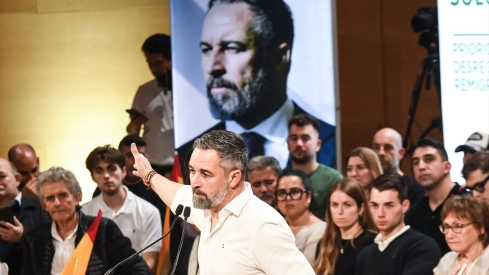
The president of Vox, Santiago Abascal, has kept the door open this Thursday to a possible challenge of the next general elections on November 29, alleging an alleged adulteration of the census for overseas voting linked to nationalizations protected by the so-called "Grandchildren's Law". Asked about this issue in an interview on 'Espejo Público', reported by Europa Press, the leader of the party avoided confirming a closed decision and stated: "I am not going to anticipate events yet".
Abascal has not ruled out that the party may adopt measures such as challenging the elections, in which 190,000 great-grandchildren naturalized by the so-called "Grandchildren's Law" and residing abroad will be able to vote. In his opinion, it is an "incongruity" and a situation "difficult to understand" that the children of those who availed themselves of this norm can exercise the right to vote, while parents who have not been able to prove that they are descendants of exiles do not have that same possibility.
The appeal before the Supreme Court is still pending
The leader of Vox has also recalled that the party already filed an appeal before the Supreme Court (TS), which remains "pending resolution". In that context, Abascal has maintained that the high court already noted "material and structural problems" to determine which descendants of Spaniards can avail themselves of the "Grandchildren's Law" and which cannot.
The president of Vox has also reiterated that "only 900" people could demonstrate that they had acquired nationality "legally". From there, he insisted on his approach: "Well, nationality must be given to the descendants of those 900 and all the others must be denied nationality and the right to vote". According to him, that is "the key" and he added that "it can be done", which is why his party has decided to appeal.
The Supreme Court's decision on the vote of the children of naturalized citizens
The statements by Santiago Abascal come after the Supreme Court announced last Monday that it will allow the children of those naturalized by the so-called "Grandchildren's Law", some 190,000 people, to vote in the elections on November 29, unlike parents who have not been able to prove that they are descendants of exiles and, therefore, can avail themselves of the law.
Thus, the TS has denied the precautionary measures requested by Vox and by Iustitia Europea to extend the suspension of the right to vote to those naturalized by the grandchildren's law and their children. However, the court does maintain the suspension of the right to vote for the 163,355 people who obtained nationality through this provision of the Democratic Memory Law, unless they have proven that they are descendants of exiles.
Contact