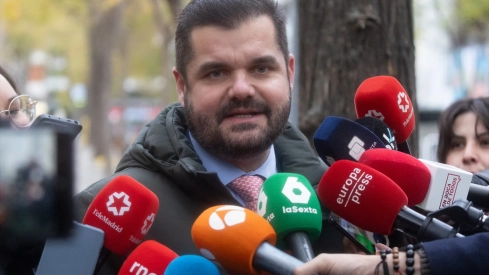
Iustitia Europa has appealed to the Supreme Court its decision not to suspend the vote of the children of those naturalized by the so-called 'grandchildren law' for the general elections on November 29, arguing that this participation could have "effects on the result" that comes out of the ballot boxes.
The brief, presented by the lawyer and president of the organization, Luis María Pardo, criticizes the order issued this Monday by the high court, which refused to extend the suspension of the vote to this group and left intact the possibility of their participation in the elections.
The Supreme Court argued that stopping this right to vote "is contrary to the requirements derived from the principles of legal certainty and electoral stability" and that, therefore, the balancing of interests should lean towards denying the precautionary measure, as it perceived a possible serious disturbance of the general interest.
The pulse shifts to the risk to the electoral result
Pardo relies on the dissenting opinion of magistrate Antonio Jesús Fonseca-Hernando to argue that the extension of control could have been applied through "immediate requirements and verifications" based on the available documentation about the parents.
According to his approach, the problem is not theoretical, but operational: once the elections have been held and the votes counted, the subsequent rectification of the census "may be useless to repair its effects on the result". This thesis is also supported by the size of the group examined, which the organization estimates at almost 190,000 people. Iustitia Europa argues that this volume could be decisive in constituencies where the last seat depends on small differences and, in this way, influence the composition of the Cortes Generales and parliamentary majorities.
The brief adds that to measure this risk, it is necessary to know how many affected people actually appear in the applicable census and in which provinces they are registered. Therefore, it adds, the lack of identification and breakdown reinforces the need for the requested verifications. Pardo also recalls that the low percentage of participation recorded in previous elections does not allow ruling out a relevant impact on the result in advance, although he does not specify concrete figures for this electoral behavior.
The Supreme Court opens proceedings on digital DNI and census review
In parallel, the Contentious-Administrative Chamber has so far rejected, by order, the brief from Iustitia Europa against the agreement of the Central Electoral Board of November 5 that lifted the suspension of the use of the digital DNI to identify voters. The court, however, has ordered to transfer the matter to the JEC so that, within three days, "it presents the allegations it deems appropriate to its right regarding the precautionary measures requested."
In another order, the magistrates have done the same with the organization's request for the Electoral Census Office to be required to control and review people who acquired Spanish nationality, were initially registered as residents abroad in the CERA and then moved to the CER when they transferred their habitual residence to Spain. Pardo warns that the absence of a uniform digital DNI verification protocol "can cause genuine chaos at polling stations," with technical failures, contradictory criteria, and difficulties in verifying voters' identities.
He adds that, meanwhile, those who moved from CERA to CER under the grandchildren's law will be able to vote without the requested census checks having been completed. On this point, the organization insists that, once the votes are cast and mixed with the others, "it will be impossible to distinguish them."
Vox asks for clarifications and the State Attorney's Office questions Hazte Oír
On the political front, the leader of Vox, Santiago Abascal, announced this Tuesday that his party will study the Supreme Court's resolution on the vote of the children of naturalized citizens and that they will ask for "clarifications".
Furthermore, the State Attorney's Office has asked the magistrates to reject Hazte Oír's appeal, considering that the association lacks standing because it claims to articulate a collective interest whose defense, in its opinion, could only be channeled through a public action that is not provided for in this case.
For now, the procedure remains open with several moving parts: the transfer to the JEC within three days regarding the digital DNI, the pending response to the precautionary measures, and the review of the briefs that question the scope of the census and its impact on the November 29 vote.
Contact
We are listening. Get in touch.
