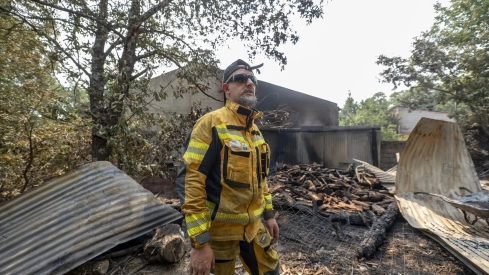
Wildfires this summer have brought flames to homes, vehicles, businesses, and agricultural operations in various parts of Spain. The large fires in Madrid, Ávila, and Toledo have already devastated some 77,000 hectares and forced the evacuation or confinement of more than 90,000 people, while emergency services continue to protect threatened population centers.
The first assessment carried out in the El Encinar del Alberche urbanization, in Villa del Prado, counted 43 homes destroyed and another 286 with damages of varying degrees. To this scenario are added the houses and cars incinerated by the Los Gallardos fire, in Almería, and the evacuations of homes and urbanizations during the advance of the Vall d'Uixó fire, in Castellón.
When authorities allow return, another part of the emergency begins. Those affected have to prove what was inside the home, how much it was worth, what can be recovered, and what expenses the fire has caused. The economic response will depend on the contracted policy, the insured capitals, and the aid approved by the different administrations.
Notify the insurance company even if you cannot yet enter
The first step is to contact the insurer or the mediator who processed the policy as soon as possible. Article 16 of the Insurance Contract Law establishes a maximum period of seven days from when the affected party becomes aware of the claim, although the contract may grant a longer period. Communication can be made even when it is still impossible to access the area.
The initial notice must record the date, place, and the first known consequences. The company will open a file and provide a claim number that should be kept throughout the process. If the fire has destroyed the documentation, the insurer can usually locate the policy through the personal data of the policyholder.
Exceeding the seven days does not automatically eliminate the right to collect. The law allows the insurer to claim damages caused by a late communication, unless it had already known about the claim through another channel. The practical recommendation remains to report immediately and then complete any missing information.
No one should enter an affected home while firefighters, police, Civil Guard, or municipal technicians maintain restricted access. A house that remains standing may have structural damage, deteriorated electrical installations, gas leaks, or still-hot materials. The inspection of goods begins when the authority confirms that it is safe to return.
Once inside, it is essential to photograph and record each room before moving anything. It is advisable to prepare a list of destroyed objects, those that could be saved, and an initial estimate of their value. The Insurance Contract Law sets five days from the communication of the claim to send this inventory in writing to the company.
Invoices are the clearest proof, although bank statements, warranties, manuals, family photographs, previous videos, purchase emails, or any document also serve to demonstrate that the goods were in the home. The description of the content itself included in the policy acts as a favorable presumption when it is impossible to provide better proof.
Damaged belongings must be kept until the expert's visit, provided that sanitary and safety conditions allow it. When it is necessary to remove food, wet furniture, flammable products, or dangerous elements, they must be photographed beforehand, note what is removed, and keep the proof of removal.
It is also advisable to keep hotel bills, provisional rent, travel expenses, meals, essential clothing, and urgent repairs. The company will later decide which expenses fit the policy, but without receipts, it will be much more difficult to include them in the claim.
What home insurance covers
Multi-risk home policies usually include direct damages caused by flames and smoke. Compensation is divided between the continent and the content, two concepts that determine what the insurer pays and how far the coverage extends.
The continent comprises the structure of the home and its fixed elements, including walls, roof, floors, windows, pipes, electrical installation, or built-in furniture. The content includes furniture, appliances, clothing, and the rest of the declared personal property. Each section has its own insured capital, and the company will compensate within those limits.
Many policies also include debris removal, the action of extinction services, document replacement, smoke cleaning, or temporary accommodation when the home becomes uninhabitable. These guarantees must appear in the particular conditions of the contract, along with the days covered and the applicable economic limits.
The insured value is decisive. If an old policy maintains a capital much lower than the current cost of reconstruction or replacement, the company may apply the proportional rule and reduce the compensation to the same extent. Some contracts expressly exclude this rule, so it will be necessary to review the wording of each policy before accepting a valuation.
Jewelry, cash, works of art, precious metals, and other objects of special value normally require a specific declaration. Legislation generally excludes these goods when there is no express agreement. Having photographed a valuable object helps to prove its existence, although coverage will depend on it being correctly included.
In a block of flats, two different insurances may be involved. The community policy covers common elements and the private insurance covers the home and its contents within the conditions contracted by each owner. Both claims must be communicated so that the adjusters can coordinate the valuation.
If the house has a mortgage, the loan remains in force even if the property has been destroyed. The bank may have rights over the compensation and must intervene when the money is used for reconstruction. The owner must inform both the insurer and the financial institution before deciding the destination of the amount received.
The company has 40 days from the receipt of the claim to pay the minimum amount it may owe according to the damages already known. The final compensation will arrive when the investigations and appraisal are completed, but this first deadline prevents keeping the entire payment paralyzed until the complete closure of the file.
What happens with the car, the business, and the field
The mandatory third-party insurance for a vehicle covers damages caused by the driver to other people, but not the destruction of the car itself by a forest fire. Compensation requires an all-risk policy or an extended third-party insurance that expressly includes fire. The amount will depend on the value contemplated in the contract and whether the vehicle is declared repairable or a total loss.
Businesses, offices, workshops, and industrial warehouses can claim damages caused by fire when they have business insurance that covers the property, machinery, furniture, or inventory. The cessation of activity can also be insured through a loss of profit guarantee.
This latter coverage usually requires direct material damage covered by the policy. An evacuation or confinement order that forces a establishment to close, but leaves the premises intact, will only entitle to compensation if the contract includes a specific guarantee for that situation.
In agricultural and livestock farms, agricultural insurance covers the risk of fire within the basic guarantee of insured productions. Agroseguro includes damages to crops, plantations, trees, vineyards, and covered livestock herds. The producer must report the claim and wait until it is safe to access the farm to carry out the assessment.
In a rented home, the owner's insurance usually covers the structure and the tenant's insurance, when it exists, protects their furniture and belongings. The landlord may also have contracted a guarantee for loss of rent. Each party must report their own damages and keep a copy of the rental contract.
The Urban Leases Law allows the tenant to suspend the contract or withdraw when conservation works ordered to repair the home make it uninhabitable. During the suspension, the contractual term stops and the obligation to pay rent is suspended until the works are completed.
Why the Consortium does not pay for fire damages
Forest fires are outside the list of extraordinary risks compensated by the Insurance Compensation Consortium. Material damages to homes, cars, or businesses correspond to private insurers when there is a policy that covers fire.
The Consortium intervenes in phenomena such as extraordinary floods, earthquakes, tsunamis, volcanic eruptions, tornadoes or certain high-intensity winds. In forest fires, its action is limited to the state insurance that protects people who collaborate in extinction tasks against injuries or deaths.
The existence of an investigation into the origin of the fire also does not oblige the insured party to wait for a responsible party to appear. The company must process the claim according to the policy and then can claim from the perpetrator the amounts it has paid. The law covers accidental fires, those caused by third parties and those derived from negligence, with the exception of fraud or gross negligence of the insured party itself.
Those who lack insurance may claim directly against the responsible party when identified and their participation is accredited. If they have civil liability insurance, the claim can also be directed against their company. The criminal investigation, public aid and the eventual civil claim will then follow different paths.
Public aid that can be requested
The Government has announced that this Tuesday it will bring to the Council of Ministers the declaration of areas seriously affected by a civil protection emergency, commonly known as a 'catastrophic zone'. The agreement must specify the municipalities included and the state measures available for homes, businesses, farms, workers and local administrations.
The declaration opens the door to tax benefits, labor measures, extraordinary aid and actions to rebuild infrastructure. The recognition of the zone also does not imply automatic compensation or guarantee full payment for everything lost. Each call will have its own requirements, amounts and deadlines.
While these measures are approved, the permanent state emergency aid regime contemplates up to 15,120 euros for the total destruction of the habitual residence. It also provides for aid for structural damage, less serious damage and the replacement of essential household goods. Its granting is subject to economic limits, family requirements and verification of indemnities received from insurance.
Requests for this regime must be submitted, in general, within one month from the day following the termination of the emergency. If an insurer's certificate or any document that cannot yet be obtained is missing, the affected party must register the request within the deadline and prove that they have already requested that documentation.
The Community of Madrid has announced temporary accommodation and aid for up to twelve months of rent for those who have lost their habitual residence, in addition to support for reconstruction. Ávila, Castilla-La Mancha, Andalusia, and the Valencian Community must specify their own measures for the areas affected by this summer's fires.
To access these calls, it is advisable to keep the certificate of registration, the property title or rental contract, evacuation communications, municipal reports, the claim number, and the insurer's resolutions. Public aid usually requires the applicant to prove what part of the damage has been covered and what remains pending.
When the insurer rejects coverage or presents an assessment that the affected party considers incorrect, a reasoned written response must be requested. The claim can then be directed to the company's customer service and, once that avenue is exhausted, to the Claims Service of the Directorate General of Insurance and Pension Funds.
The administrations will publish in the coming days the included municipalities, the forms, and the deadlines for extraordinary aid. The insurance file, inventory, photographs, invoices, and each written communication will serve both for the appraisal and for future applications.
Add ElConstitucional.es as a preferred Google source for free.
Stay informed about all the latest breaking news with the best information. Against disinformation, for democracy and social rights.
