
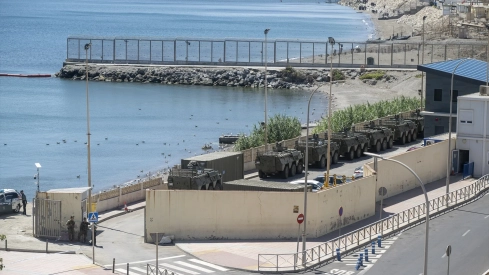
The migratory crisis that Ceuta is experiencing once again places us before one of those scenarios in which Law is subjected to its most difficult test. When tens of thousands of people gather at a border, when there are security problems, risk to human life, and enormous pressure on public services, it is understandable that the political debate becomes polarized. But precisely in exceptional situations is when it is most necessary to remember that a Rule of Law cannot choose which norms it complies with and which it momentarily suspends.
Spain has the right—and also the obligation—to protect its borders. But it must do so in accordance with the Constitution, the Immigration Law, European Union Law, and the international treaties to which it is a party.
And Morocco also has obligations.
This second statement is particularly important in the current crisis in Ceuta. Irregular immigration cannot be analyzed exclusively as a Spanish responsibility. Spain and Morocco have maintained a bilateral agreement since 1992 regarding the movement of people, transit, and the readmission of illegally entered foreigners, fully in force since 2012. That agreement expressly contemplates mechanisms for the readmission of nationals of third States who have illegally entered Spain from Moroccan territory, provided that the conditions set forth in the treaty itself are met, as stipulated in the BOE.
We are not, therefore, solely facing a question of good neighborliness or political collaboration. There is a bilateral legal framework that obliges both States.
Furthermore, Morocco is a party to the 1951 Geneva Convention on the Status of Refugees and has ratified, among other international human rights instruments, the Convention against Torture. International obligations regarding migration and the protection of people do not, therefore, end on the Spanish side of the border, if we refer to UN Treaties.
A border is not a zone without Law
Spain can prevent an irregular entry. What it cannot do is consider that the proximity of the border creates a space where legal guarantees disappear.
The Constitutional Court already established in its judgment 172/2020 that the so-called "rejection at the border" provided for Ceuta and Melilla is constitutional, but subject to important conditions. There must be individual consideration of the circumstances of the affected persons, possibility of judicial control, effective compliance with the international obligations assumed by Spain, and special attention to vulnerable persons. The Constitutional Court itself also recalls that when a person comes under the control of Spanish agents, they are subject to Spanish jurisdiction for these purposes.
This distinction is fundamental because for years we have colloquially used the expression "hot returns" to describe legally different situations.
Our legislation specifically speaks of rejection at the border. The tenth additional provision of the Organic Law on Foreigners allows for the rejection of foreigners detected at the border line of Ceuta or Melilla while attempting to overcome border containment elements to cross irregularly. But the law itself adds something that is sometimes forgotten: the rejection must be carried out respecting international human rights and international protection regulations to which Spain is a party, also reflected in the BOE.
Therefore, rejection at the border exists and is legal. What does not exist is an unlimited power of the Administration to automatically return anyone who reaches the Spanish border.
The sea changes the rules
This issue has acquired even greater relevance after the recent doctrine of the Supreme Court regarding those who try to reach Ceuta or Melilla by swimming.
The Supreme Court has delimited the scope of application of the tenth additional provision: the exceptional regime of rejection at the border cannot be extended without further ado to any attempt at irregular entry. In the examined case, related to a person intercepted at sea while trying to reach Ceuta by swimming, the Court concluded that this case could not be automatically equated to that of someone who physically tries to overcome the border containment elements provided by law.
The difference may seem excessively technical, but it has enormous practical consequences.
A person who scales a border fence and a person who is swimming in the sea do not present the same legal or material situation. In the second case, a principle even prior to the migratory debate appears: the protection of human life at sea.
Article 98 of the United Nations Convention on the Law of the Sea enshrines the duty to render assistance to persons in distress at sea and obliges coastal States to promote adequate search and rescue services.
To this is added the European Convention on Human Rights. Its Article 2 protects the right to life and its Article 3 prohibits inhuman or degrading treatment. When a person is under the jurisdiction or effective control of the Spanish authorities, these obligations do not disappear due to the fact that this person has attempted to enter our territory irregularly.
Put simply: first, life is saved, and then the administrative situation of that person is determined.
Rescuing someone does not automatically mean recognizing a right to remain in Spain. Nor does it convert an irregular entry into a regular one, nor does it prevent their subsequent return, repatriation, or expulsion when legally appropriate. It means something much more elemental: that migration control can never be exercised at the cost of a human life.
Rejection is not expulsion
It is also convenient to differentiate concepts that are often used interchangeably in public debate.
Border rejection, repatriation, and expulsion are not legally the same.
Border rejection constitutes a specific and exceptional regime applicable in Ceuta and Melilla under the circumstances delimited by the Immigration Law. Expulsion, on the contrary, is an administrative decision subject to a procedure, with corresponding guarantees and the possibility of appeal.
We cannot transform an exceptional figure conceived for a specific border situation into a universal procedure for immediate expulsion.
And there is also an insurmountable limit: the principle of non-refoulement. The Geneva Convention prohibits returning a refugee to the borders of a territory where their life or freedom may be threatened for certain reasons.
Similarly, Protocol No. 4 of the European Convention on Human Rights prohibits collective expulsions of foreigners
This forces us to flee from automatisms. Within a massive entry, there may be economic migrants, but also minors, victims of trafficking, vulnerable people, or potential applicants for international protection. The State needs to have mechanisms that allow it to detect these circumstances.
Morocco cannot be left out of the equation
The current crisis also presents a particularly delicate dimension.
Information known in recent days about the report from the National Immigration and Borders Center of the Police points to a possible permissiveness and even actions by certain Moroccan agents who would have guided migrants towards water access areas. These are elements that must be investigated and regarding which it would be irresponsible to anticipate conclusions about a possible responsibility of the Moroccan State, as published in 'El País'.
But if these circumstances were to be proven, the legal analysis would necessarily have to transcend Spanish immigration legislation.
The management of an international border requires loyal cooperation between the States that share it. Spain cannot indefinitely assume alone the human, economic, and security consequences derived from massive movements originating from the territory of a neighboring State.
The 1992 Hispano-Moroccan agreement precisely establishes cooperation and readmission mechanisms. And it contains a particularly significant provision: even transit for expulsion can be denied when the person is at risk of suffering ill-treatment in the destination State. That is, even the bilateral treaty itself recognizes that the effectiveness of migration control finds limits in the protection of fundamental rights. (BOE)
Security and rights are not incompatible concepts
Probably one of the errors in our political debate consists of presenting two apparently irreconcilable positions: either the border is defended or the rights of migrants are defended.
Legally, this opposition is false.
Spain has the right to control who enters its territory, combat human trafficking networks, demand that Morocco comply with its international commitments, and carry out returns or expulsions that correspond according to law.
But exactly the same State has the obligation to rescue those who are drowning, identify situations of vulnerability, allow access to international protection when appropriate, respect the principle of non-refoulement, and ensure that any administrative action can be subject to judicial review.
There is no contradiction.
The strength of a democracy is not measured solely by the height of its borders, but by its capacity to uphold legality precisely when those borders are under extraordinary pressure.
Ceuta needs security, resources, European cooperation, and a relationship with Morocco based on reciprocal obligations and not solely on diplomatic balances. But it also needs us not to forget something essential: behind the numbers, there are people.
The Spanish border can and must be protected, but it should never be protected by leaving the Law on the other side.
