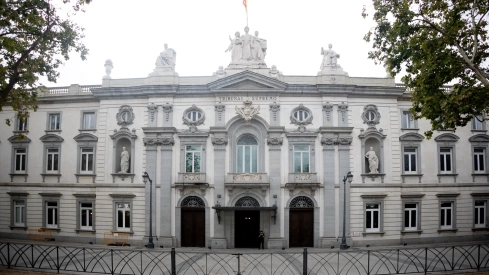
The Third Chamber of the Supreme Court announced yesterday its verdict on the appeal filed by the State Attorney's Office against the precautionary suspension of the right to vote for those naturalized under the 'grandchildren's law', ratifying the precautionary measures adopted in early September by the high court.
As was to be expected, this decision heightened the political atmosphere, in the midst of the pre-campaign for the general elections on November 29. But from a legal point of view, does the decision adopted by the Supreme Court make sense?
We must start from the premise that there is no single correct answer to the previous question. So much so that the administrative contentious chamber in charge of resolving this issue did not reach a unanimous conviction, with magistrate Alicia Millán issuing a dissenting opinion, disagreeing with her colleagues and understanding that the precautionary measures to suspend the vote should not have been adopted.
However, the majority of the chamber concluded that the general interest of preserving an electoral process with an unaltered census should prevail over the fundamental right to active suffrage of citizens who might be affected by said decision.
In this regard, it is worth remembering that the Ministry of Justice Instruction of 2022, which is being appealed, established an automatic grant of nationality for descendants of Spaniards who had left Spain between 07/18/1936 and 12/31/1956.
In this way, the appealed Instruction presumed that all persons who had left the national territory between those dates had done so for ideological or political reasons, exiling themselves abroad; without the need for their descendants to prove said circumstance.
According to the High Court, this presumption contravened the fundamental principles of our parliamentary democracy by potentially causing an illegal alteration of the census and allowing people who had not proven compliance with the legally established requirements to have the right to vote due to the automatic naturalization that resulted from that presumption.
Finally, they concluded that descendants who accredited compliance with the requirements before the consular registry officials could exercise their right to vote in the future elections on November 29, only limiting their access to those who were orphaned of proof, which a priori we can conclude aligns with the duty to ensure that general elections are held with all guarantees.