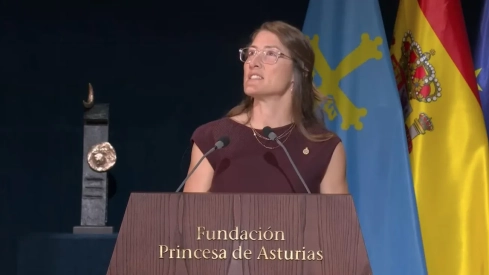
Christina Koch, Artemis II mission astronaut, received this Friday at the Campoamor Theater in Oviedo the Princess of Asturias Award for Concord 2026 and turned the ceremony into an explicit defense of human cooperation in the face of a "so disunited" world.
The NASA engineer has positioned the crewed journey around the Moon as an experience that, according to her account, has transcended political, economic, and cultural borders, and which the crew has summarized with a motto she repeated during her speech: "A mission of all and for all."
Artemis II, a mission designed to cross borders, not to raise them
Koch opened her speech by recalling her first visit to Spain, when she had just graduated from university and was working as a NASA engineer while pursuing the dream of becoming an astronaut. On that trip, she recounted, she read in a newspaper the news of the Columbia tragedy, whose crew had died.
"Our ambassadors of Earth" were, in her formulation, those crew members who had made "the supreme sacrifice." With that memory, the astronaut linked the global mourning for the mission with the idea that crewed space flights do not belong only to the country that launches the rocket.
Ten years later, she recounted, she received the call that changed her life to join a space mission. Since then, she said, she has understood that those who travel to space also carry a public responsibility: when they leave the planet, the world carries them in its hearts.
This approach, she emphasized in the presence of Spanish astronauts Pablo Álvarez Fernández and Sara García Alonso, has marked the definition of Artemis II's values. The motto has ended up incorporated into the mission's logo and the team's interactions, as she explained.
A message born 400,000 kilometers away, but directed to the usual street
The astronaut also recounted that, during the trip, she spoke via video call with her husband from about 400,000 kilometers away. He told her that, while the crew orbited the Moon, people were uniting on Earth regardless of their political ideas, their origin, their education, or their economic resources.
Koch, she recounted, became emotional and replied: "That's what we always wanted."
From there she moved on to her main thesis: there is no need to wait for another lunar mission to understand that fellow human beings are each person's crew. “Don't wait for the next mission to the Moon to realize that your fellow human beings are your crewmates,” she defended.
The astronaut called for a more active attitude “in every interaction, on every street” and maintained that fulfillment does not lie in receiving, but in giving. She closed her speech with a direct reference to Spain: she said that this recognition was the second gift the country had given her and that the first had been, simply, caring for other human beings.
“Trust, be grateful, show yourselves vulnerable,” she asked at the end of a speech focused on solidarity as a public value and on space exploration as a message of symbolic scope.