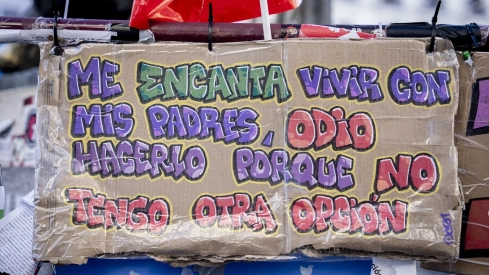
Finding stable employment, paying for housing, and ceasing to depend on family are concerns that permeate the unease of young people in vulnerable situations. 42.2% of respondents in the study 'Disconnection and Future: A Trapped Youth', by Ayuda en Acción, describe their mental health over the last twelve months as "fair". Their experiences show how job instability and difficulties in becoming independent accumulate and condition their expectations.
World Mental Health Day, celebrated this Saturday, October 10, allows us to look at these living conditions alongside access to psychological care. The research, conducted in 2025 and 2026 and published in July, combines a survey of 200 participants aged 16 to 30 from the Impulsa Empleo Joven program, five discussion groups, and interviews with experts. The results refer to this vulnerable youth served in seven autonomous communities and reflect their personal assessment of well-being.
The price of becoming independent
Among participants aged 25 to 30, 70% still live in the family home. Furthermore, 46% of all respondents believe they probably will not be able to emancipate themselves in the next two years. Job insecurity accompanies this outlook. Nearly three out of four state they have worked without a contract at some point, an experience that makes it difficult to have stable income to afford rent.
The difficulty transcends the young people in the program. The INE's Living Conditions Survey indicates that, in 2025, 44.3% of people aged 26 to 34 lived with their parents. Among those who still lived at home, 47.3% identified the main reason as not being able to afford to buy or rent a home. These are different age groups and samples, but both studies allow us to see the weight of the lack of resources in emancipation.
The Youth Council of Spain provides another measure of this barrier. In its balance published in May 2026, it places the average rent at 1,176 euros per month, equivalent to 98.7% of the average youth salary used by the organization. This is the cost of renting a home alone, which would leave practically all of that salary committed before paying for food, transport, or utilities.
The political scientist Pablo Simón warns in the Ayuda en Acción report that "young people face a practically inaccessible housing market" and links this barrier to intergenerational inequality. Marta Carretero, Head of Studies and research coordinator, explains in the presentation published by the entity that the impossibility of emancipation "delays the construction of one's own life project and generates a feeling of blockage".
Precariousness also weighs heavily
When asked about the reasons for the discomfort, the difficulty in finding stable employment appears in 30.2% of the responses and economic or family concerns in 15.6%. The discussion groups describe the wear and tear of chaining jobs and continuing to postpone leaving home. The authors speak of the "exhaustion of constantly restarting from scratch".
Asking for help also presents obstacles. Almost two out of three respondents believe that public mental health resources are difficult for most to access or that they are primarily accessible to those with more resources or information. This is their perception of access to these services. "You need a psychologist and you can't afford a psychologist," summarizes a testimony collected in the Malaga group.
Economic pressure also limits spaces for socializing. 48.2% say they don't have money for the leisure activities they would like to do and 22.6% admit to spending too much time alone or without company. The research links the loss of free meeting places with fewer opportunities to build bonds, participate in the neighborhood, and feel part of a community.
Ayuda en Acción proposes reinforcing accessible psychological care from educational centers and community spaces, recovering free meeting places, and recognizing leisure as a public policy for youth participation. It also proposes transport aid and symbolic economic compensation to facilitate the participation of vulnerable young people. "For youth participation to be truly inclusive, it is necessary to recognize that participating has costs," the study points out.
