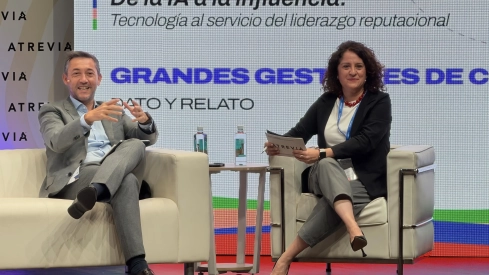
Javier Ruiz has revealed that he will make the leap to prime time afternoon in the new television scenario that La Séptima is preparing. The journalist announced this change during his intervention at the VI Ibero-American Congress of Marketing, Communication and Public Affairs of ATREVIA, held at CaixaForum Madrid, where he starred in a conversation focused on journalism, communication, disinformation and the new political scenario.
Ruiz has acknowledged that the change represents a significant transformation in his professional life. “I have always been a morning person. I say that I liked the news in the morning. I think this has just moved me to the night”, he explained, referring to the general elections on November 29. “Courtesy of your President of the Government, my life has just changed”, he added before confirming: “I assume that I am going to move to prime time as of now”.
The journalist linked this move to the new current affairs scenario and the election call, which, as he explained, forced the modification of La Séptima's initial plans. “Apparently an electoral channel is coming, because we didn't have this planned. And suddenly, well, we are going to be born as an election special”, he pointed out.
La Séptima bets on live and “truth and context” in the face of crises
During the conversation, Ruiz also advanced some of the keys to La Séptima's project. The journalist defended that the new television must bet on live information over closed and completely predictable content. “Solvency one, live two”, he summarized. In his opinion, the speed with which current events move means that informative content has an increasingly shorter life. “If you don't connect, you miss it. The product expires in two hours”, he explained.
Ruiz insisted that what may be valid first thing in the morning may have become outdated just a few minutes later. “What you were going to sell at nine in the morning, probably at nine and five is no longer valid”, he pointed out. For this reason, the project is planned with a clear commitment to real-time information and to television permanently connected with current events.
The conversation has also revolved around corporate communication and the management of reputation crises. Ruiz has argued that companies must provide the media with truthful information and context to correctly explain what happened. “Only the truth, not necessarily the whole truth, but only the truth and context. You get out with these two things: telling us what is really happening and telling us what importance it has, why,” he pointed out as his recipe for addressing a crisis from a journalistic point of view.
The journalist has also warned that lies eventually take their toll: “You cannot communicate by lying, absolutely sure of that too. We will catch you sooner or later, we will make you pay. Lies will catch up with you.” For Ruiz, context is fundamental because it allows putting data into perspective. He used a reputation crisis at Oxfam as an example to explain that a specific event does not always represent the global dimension of an organization. “When you have a problem in the supply chain, in production, whatever it is, you are the ones who have the context,” he explained to the communication professionals present at the congress.
Against noise and “junk journalism”
Another major issue addressed has been the proliferation of unverified information on social networks and digital media. Ruiz has defended the need to distinguish between journalism, opinion, communication, and simple noise. “A person with an account is not a journalist. And someone with a website is not a journalist,” he stated. In his opinion, journalistic work requires a prior process of knowledge, understanding, and verification before communicating.
“Journalists first know, then understand, then verify, and only then communicate,” he summarized. He also warned companies that not everything published in a digital medium should automatically become a crisis. In his view, it is necessary to learn to identify which information is relevant and which simply responds to noise.
In this regard, he criticized the practices of those who use alleged information to pressure companies or corporate executives. “That is not journalism. That is blackmail, that is mafia. Traditionally it has been crime and now it disguises itself as a pen,” he assured.
Distrust of information that confirms prejudices and from influencers
Asked about how to distinguish reliable information from disinformation, Ruiz has appealed to critical thinking. One of his main recommendations is to distrust information that seems to absolutely confirm all of the reader's prejudices.
“If it's too good to be true, it probably is,” he stated. The journalist explained that information that perfectly fits what one already thought also generates distrust in him. “When it agrees with us on everything, it usually leads me to distrust. When it offends us on everything, it also usually leads me to distrust,” he pointed out. His method also involves consulting journalistic sources and mastheads that have demonstrated their reliability over time.
Ruiz has also differentiated between communication and information when addressing the role of influencers. He noted that companies are increasingly resorting to these profiles, but warned that their communication capacity does not necessarily equate to journalistic work. “These people do extraordinary communication, but these people do neither journalism nor information,” he stated. In his opinion, there is a risk for brands when impact or attractiveness is prioritized over solvency: “Half the time they play with sexy and not with solvency.”
Ruiz, skeptical of early elections
The intervention also left room to analyze the new electoral scenario. Ruiz was skeptical of the early elections and considered it a move with still uncertain political effects. “I think it's a very short-term move,” he stated. In his analysis, he believes that the current context can mobilize the left, but maintains that “the left is unorganized” and that, in his opinion, there is not yet a consolidated scenario that allows for talk of a government majority.
Ruiz also raised the difficulties that the call for a possible general strike could generate, pointing out that, with an acting Executive and a dissolved Legislature, the question arises of what capacity for action the political power would have in the face of demands. The journalist clarified that this was his assessment at that moment and that he could modify it if circumstances changed: “If circumstances change, I change my mind, I have no problem.”
A new stage marked by current events
The VI Ibero-American Congress of Marketing, Communication and Public Affairs of ATREVIA has thus served as a stage for Javier Ruiz to announce one of the main novelties of his next professional stage: his arrival at the afternoon prime time.
The journalist himself has recognized that the change responds to a current events that has accelerated to the point of forcing a rethinking of television formats and schedules. His bet for La Séptima involves combining rigor, contrast and solvency with a television permanently connected to live broadcasting. "We are going to sell solvency and we are going to sell live broadcasting," he summarized.
And, above all, he made a confirmation that he had not made public until now during his speech: his departure from the morning to join the afternoon prime time.