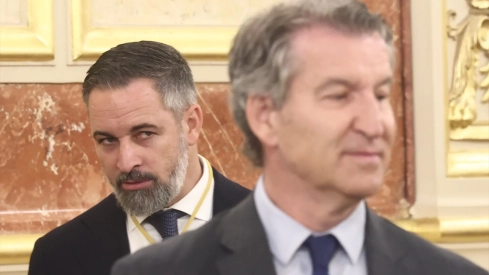
In Genoa, an agreement with the far-right Vox is considered necessary for Alberto Núñez Feijóo to reach Moncloa after the general elections on November 29. Sources from the national headquarters of the PP consulted by 'ElConstitucional.es' frankly describe this scenario. "It's lentils. We already know we're going to have to eat Vox. There's no other option," they affirm, referring to the need to agree with the far-right party.
The priority conveyed by these sources is to achieve a joint majority, beyond the distribution of deputies between both organizations. "The goal right now is to add up to a majority between the two. A deputy up, a deputy down, but that the bloc adds up," they explain. In their reasoning, they equate this strategy with that of the Prime Minister. "Sánchez does exactly the same with his bloc."
The content of the eventual understanding would be conditioned by the electoral result and Santiago Abascal's demands. "We will have to see how it turns out after the elections, and what they demand," they point out, before insisting that "the PP and Vox will have to agree." The diagnosis anticipates a willingness to negotiate, although the messages do not specify whether that support would translate into a government coalition or another parliamentary formula.
The majority and Abascal's weight
The polls allow us to understand this calculation. The average of DatosRTVE updated this Tuesday places the PP at 135 deputies and Vox at 65, a total of 200 seats, compared to the 176 that mark the absolute majority of Congress. This is an estimate from the surveys, subject to changes during the pre-campaign, which shows Feijóo far from his own majority and the far-right with considerable weight to negotiate its support.
The precedent of 2023 remains relevant. The PP obtained 137 seats and Vox, 33, insufficient to reach an absolute majority together. Feijóo later gathered 172 favorable votes in his first investiture vote, with the additional support of Coalición Canaria and UPN, against 178 opposed. Winning the elections allowed him to attempt the investiture, but not to gather the necessary support to govern.
The difference now reflected in the polls is both in the sum and in its composition. In the cited average, Vox would almost double its deputies from 2023 while the PP would lose two. A broader right-wing majority could therefore coexist with greater dependence of Feijóo on Abascal. The distribution between the two will determine the strength with which each party arrives at that negotiation, although the sources consulted today place the main objective on the bloc reaching the numbers.
The rapprochement also has a public expression in the Upper House. Feijóo confirmed this Tuesday, in an interview on Cope, that the PP is negotiating with Vox to seek a majority in the Senate, after the socialists' agreement with parties from the Broad Front. Among the proposed formulas is that Vox renounces presenting itself in some constituencies in exchange for representation by autonomous designation. This contact has a different object from the eventual investiture pact, but it shows that both parties are already exploring how to coordinate their forces ahead of 29N.
Génova minimizes Vox's influence
The consulted sources also defend that participation in governments reduces the radicalism of the formations they describe as "disruptive". In that comparison, they include both Podemos and Vox, whom they describe as "barking dogs that don't bite much" when they have had executive responsibilities. Asked about the dangerous measures that the far-right would have promoted in the autonomous communities shared with the PP, their answer is "nothing".
The autonomous agreements contain, however, concrete concessions to Vox's demands. The governance pacts reached this year in Extremadura, Aragon, Castilla y León, and Andalusia incorporate the so-called national priority in access to aid and protected housing, proposals for the return of unaccompanied foreign minors, and the replacement of historical memory norms with concord laws. Last October 7, furthermore, PP and Vox rejected in Castilla y León processing an update of the autonomous gender violence law to adapt it to the State Pact; the popular party justified its vote on the need to seek consensus among all forces.
In Genoa, they claim that "the center today is in the PP" and attribute to Sánchez the block politics with which they justify the understanding with Abascal. To do this, they retrieve the proposal that Feijóo presented in the July 2023 debate to facilitate the governance of the most voted list, which the socialist leader did not accept. "You cannot get into a boxing ring with your hands tied," they argue. The investiture system requires, in any case, the confidence of Congress, with an absolute majority in the first vote or a simple majority in the second.
That same reasoning extends to the tone of the pre-campaign. The sources blame the president for the polarization and present the harshness of his attacks as a response. "The only thing that has been done is to counterattack," they maintain. They also interpret the encampments and strikes as part of the political preparation of the left and acknowledge that within the PP, more aggressive profiles coexist with more institutional ones. "In all campaigns, you know that the forms become harsher," they add.
