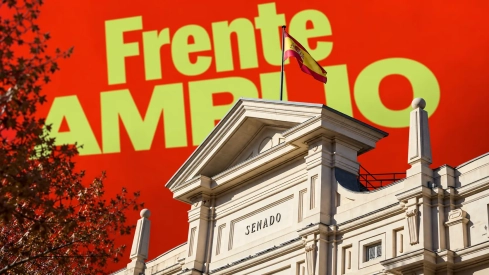
Frente Amplio has put names to its commitment to change the Senate majority on November 29. María Acín for Madrid, Óscar Urralburu for Córdoba and Isaura Navarro for València are among the references of a candidacy that combines parliamentary experience, municipal representatives and professionals from education, social services and the neighborhood movement.
The alliance with the PSOE, extended to more than forty constituencies, opens an opportunity for the alternative left to gain representation in a Chamber where the PP has exercised its absolute majority during the legislature. The agreement brings together Izquierda Unida, Movimiento Sumar, Más Madrid and allies such as Compromís or Chunta Aragonesista, with their own territorial formulas and some important exceptions.
The second position in many candidacies corresponds to Frente Amplio, although this order does not guarantee a seat. In peninsular provinces, four senators are elected and each citizen can mark up to three names. The election depends on the votes each candidate receives, regardless of their position on the ballot. The cooperation seeks for the progressive electorate to concentrate its support on the shared candidates.
Urralburu and Alzamora arrive after their time in Podemos
One of the most recognizable names is Óscar Urralburu, Organization Secretary of Movimiento Sumar and candidate for Córdoba. Before his current responsibility, he led Podemos in Murcia between 2015 and 2019 and was the parliamentary spokesperson for the party. His professional career began long before entering institutions. He has a degree in Fine Arts, a doctorate from the University of Murcia, and has worked as a secondary school teacher and university lecturer.
For Madrid, María Acín represents Más Madrid in the joint candidacy with the PSOE. Regional deputy and general secretary of her parliamentary group, she has a background in Environmental Sciences, Ecology, and public policy evaluation. Her activity in the Assembly has been especially linked to mobility and public transport.
In Barcelona, Laura Alzamora will be the Comuns candidate separately from the PSC. The councilwoman of L'Hospitalet is a psychologist, works in the third sector, and was secretary of Feminisms and LGTBI of Podem Catalunya. She has also been elected mayoral candidate for her city for the 2027 municipal elections. Her candidacy for the Senate remains after Comuns agreed to withdraw in Girona, Lleida, and Tarragona in exchange for the socialist commitment to promote an autonomous senator proposed by them.
Isaura Navarro will occupy the second position of the shared candidacy for València, between socialists Juan Antonio Sagredo and Jordi Mayor. The Compromís deputy brings experience in Congress, Les Corts, and the Consell, where she was autonomous secretary of Public Health and Minister of Agriculture. A lawyer by training, she has also worked in the legal services of CCOO. In Alicante, Compromís places Inmaculada Orozco, and in Castellón, the representation of Esquerra Unida corresponds to David Lluch.
Environmentalism will have another prominent name in Mar González Báez, federal co-spokesperson for Verdes Equo and candidate for Guadalajara. With a degree in History and linked to activism for housing, feminism, and public services, in 2023 she was number two for Sumar to Congress for Malaga. Now she aspires to the Upper House from a joint candidacy with the socialists.
Each territory specifies how to convert the alliance into seats
Andalusia reflects the municipal weight of IU in the coalition. María Jesús Amate, councilwoman of Huércal de Almería, will run for Almería; Violeta Márquez, councilwoman of Jerez, for Cádiz; and Mari Carmen Pérez, former mayor of Chauchina, for Granada. Social worker and councilwoman Mónica Rossi will be the representative for Huelva, and Laura Cerezuela, councilwoman of Linares, will be for Jaén.
Movimiento Sumar contributes Urralburu for Córdoba and Rosario Luque, head of Feminisms for the formation in Andalusia, for Malaga. Seville has a different distribution. Frente Amplio will not have its own titular candidate and will contribute Francisco Israel Fernández Varela as a substitute for the third aspirant on the list.
In Aragon, Ruth Pina, from CHA, will run for Zaragoza; Rubén Cabañas, from IU, for Huesca; and Ricardo Moreno, from CHA, for Teruel, within Senado de Progreso. Cabañas, former councilor in Monzón, is a draftsman in the metal sector and is linked to theater and cultural production. Moreno is the territorial vice-secretary of Chunta in the Teruel regions. The presence in Teruel is maintained despite the withdrawal of Frente Amplio from the candidacy for Congress in that province.
Galicia incorporates profiles from the social and university spheres. Rocío Núñez Rúa will run for A Coruña; Paula González Fernández, for Lugo; Millán Brea, for Ourense; and Paulo Carlos López, for Pontevedra, in alliance with the PSOE. Núñez is a social educator and civil servant in community social services; González is an economist and works in an agri-food cooperative. Brea is a social educator, doctor in Education Sciences and university professor, while López is a professor of Political Science at the University of Santiago and general secretary of Movemento Sumar Galicia.
In Castilla y León, Cristina Pindado for Ávila, Carlos Serrano for Burgos, Laura Fernández Bermejo for León, Eduardo Velázquez for Palencia and Yolanda Sánchez for Salamanca have been announced. The known representation is completed by Alberto López Villa in Segovia, Manuel Madrid Castro in Soria, Paco de la Rosa in Valladolid and Inmaculada Lucas in Zamora. Among them are IU leaders and municipal representatives, such as Lucas, a councilwoman from Zamora and provincial deputy, or De la Rosa, former councilman of Medina del Campo.
The dimension of the commitment in that community is understood with the results of 2023. The PP obtained twenty-seven senators and the PSOE nine, three and one respectively in each province. The shared candidacy tries to dispute that distribution by concentrating the progressive vote. The result will also depend on how much support the separate candidacies of PP and the far-right Vox retain, which have left Castilla y León out of their agreed withdrawals.
In Castilla-La Mancha, along with Mar González for Guadalajara, IU contributes Francisco Requena for Albacete, Pedro Mellado for Ciudad Real, Lorena Gallego for Cuenca and Isabel Álvarez for Toledo. Requena is a councilman in Madrigueras; Gallego was a councilwoman of Las Pedroñeras; Mellado coordinates IU in the community and Álvarez is responsible for the Women's area of the organization.
In the north, Antonia Luengo, a social worker, will represent IU for Asturias; Israel Ruiz Salmón, IU's Cantabrian coordinator, will do so for Cantabria; and Diego Mendiola, the Riojan coordinator, for La Rioja. In Navarra, the chosen candidate is Ane Sánchez Jiménez, a Primary school teacher and councilwoman for Contigo-Zurekin in Barañáin. In Murcia, IU-Verdes has designated its local coordinator and mayoral candidate, Liliana Mellado Miñano.
Euskadi incorporates a formula for sharing representation. Alba Gutiérrez, councilwoman for Amorebieta-Etxano for Ezker Anitza-IU, would occupy the first two years of a possible seat for Bizkaia, and would then give way to Sergitz Moreno, leader of Sumar Mugimendua. In Gipuzkoa, the candidate is Samira Raiss, a criminologist specializing in intervention in violence against women. In Álava, Frente Amplio does not provide main candidates and will support the candidacy agreed upon with the PSE-EE.
In Extremadura, former regional IU deputy Joaquín Macías is part of the joint candidacy for Badajoz. The agreement in Cáceres also contemplates a mid-legislature rotation for IU's representation if the seat is obtained. These commitments depend first on obtaining the seat and then on the agreed-upon reliefs taking place.
Balearic Islands has its own island coalitions. Francisco González Paredes, from Esquerra Unida, will be a candidate for Mallorca alongside socialist Catalina Cladera. A sociologist, professor at the Universitat de les Illes Balears and UNED, he was a councilman in Llucmajor. If he obtains the seat, the agreement foresees that he will occupy it during the first half of the legislature and that Rosa Cursach, from MÉS per Mallorca, will relieve him afterwards. In Eivissa, the unitary candidacy will feature Juanjo Ferrer, from EUIB.
Canarias follows a different path from the state pact with the PSOE, with the exception of La Gomera. Nueva Canarias, IU, Sumar and Podemos run under the confluence Unidad del Pueblo Canario. Among the candidates announced by Nueva Canarias are Rubén Reyes Gutiérrez for Fuerteventura and Fernando María Jiménez for Lanzarote.
Ceuta contributes one of the most unique additions. The independent Abdelah Abdelah Mustafa, promoted by Frente Amplio and linked to the neighborhood movement, replaces the socialist candidate José Miguel Romero in the shared candidacy. The PSOE has explained the replacement as a commitment to broaden support against the right and the far-right. Mustafa has accepted with a vindication of his work in the neighborhoods. "It is the time of the people," he affirmed.
