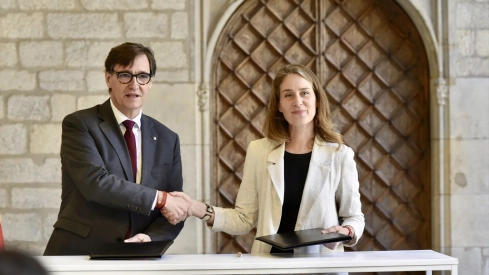
The PSC and Comuns have closed an agreement this Tuesday to concentrate the vote in the Senate in Girona, Lleida, and Tarragona in the face of the PP's pact with the far-right Vox. Ada Colau's party will withdraw its candidacies in the three provinces and will support the socialists, who have committed to promoting the designation of an autonomous senator at the proposal of the Comuns. In Barcelona, they will continue to compete.
The understanding came after days of blocked negotiations and hours after the PP announced its withdrawal in Girona and Tarragona to favor Vox. Both parties have justified it as a "democratic responsibility" to "block the path to the right and the extreme right". They have also denounced that Feijóo and Abascal intend to turn the Senate into an instrument of "democratic regression and control of state institutions".
The socialist spokesperson, Lluïsa Moret, has directly pointed to the PP for leaving these two provinces in the hands of a party that attacks Catalan self-government. "The PP has decided to make itself small in Catalonia", she stated. In her opinion, the agreement with Vox demanded a response from progressive forces.
The response has been possible between two parties that maintain significant differences on housing and that will compete for deputies to Congress throughout Catalonia. The pact allows collaboration without resolving the disputes that cross the Catalan left. ERC remains outside, the confrontation between the Comuns and the republicans remains open, and Barcelona retains its own electoral battle.
The PSC protects its seats and Comuns gains a path to the Senate
The 2023 results explain a good part of the negotiation. The PSC obtained twelve of the sixteen senators directly elected in Catalonia, three in each province. ERC obtained the fourth seat in Barcelona, Lleida, and Tarragona; Junts won it in Girona. The Comuns were left without direct election representation.
With this distribution as a starting point, the support of Comuns can help the socialists defend their seats in the new electoral scenario. The counterpart offers Colau's space a representation that resisted it at the polls in the last general elections. The agreed senator must be designated by the Parliament, through one of the positions corresponding to the PSC. Their name is not included in the announced agreement.
The electoral system forces any calculation to be refined. In each Catalan province, four senators are elected, and each citizen can mark up to three names, even from different parties. The PSC already won in 2023 the three seats their candidates aspired to. Concentrating the vote on them now can protect that position; automatically attributing the fourth ERC senator would be a mistaken conclusion.
The competition will be especially visible in Barcelona. There, the Comuns maintain a candidacy with which to dispute their own representation. In 2023, Laura Campos was about 68,000 votes behind the republican Joan Queralt, who obtained the fourth seat. This result explains the Comuns' interest in keeping open the possibility of entering the Senate for the province where they concentrate their greatest electoral strength.
The agreement revives a collaboration with precedents, although with a more reduced scope. PSC, ERC, and the predecessors of Comuns shared the Entesa Catalana de Progrés in the general elections of 2000, 2004, and 2008. In 2011, the alliance continued without the republicans. Now the cooperation is articulated through three withdrawals and a commitment to regional representation, while Barcelona is left out and ERC maintains its own candidacies.
Housing and Congress keep the dispute open
The electoral pact has come with an important negotiation still stalled between the Government of Salvador Illa and Comuns. The regulation of speculative housing purchases continues to confront both spaces. Last October 21, Jéssica Albiach warned that they would move forward with their proposal without an agreement with the socialists if they did not bring positions closer before the 30th. The Executive's alternative to respond to the objections of the Consell de Garanties Estatutàries had not convinced the Comuns.
This negotiation fully affects the campaign. Colau has placed housing among her main electoral arguments, and her space needs to demonstrate what it achieves by pressuring the socialists. Cooperating with the PSC against Vox and demanding changes in housing are two decisions that Comuns must defend before the same electorate. The Senate agreement specifies the first; the second is still awaiting results.
With ERC, differences have accumulated for years. In 2019, Colau retained the mayoralty of Barcelona despite Ernest Maragall having won in votes, thanks to the pact with the PSC and the support of three councilors from Manuel Valls' candidacy. In 2024, the rejection by the comunes of Pere Aragonès' budgets due to the Hard Rock project precipitated the early election. The rivalry between both formations is linked to decisions that changed governments and majorities, in addition to the competition for nearby voters.
The 29N pre-campaign has added another confrontation. Podemos has agreed to support ERC's candidacies in Catalonia, incorporate independents into their lists, and share events between Gabriel Rufián and Irene Montero. The collaboration has reinforced an alternative to Colau's Frente Amplio precisely in her main electoral territory. Aina Vidal even accused ERC of launching a "hostile takeover bid" against the comunes' space when attempts at a unitary candidacy failed.
The agreement with the PSC allows Comuns to offer a concrete result of cooperation after that failure. It also leaves ERC separately defending its Senate seats while competing with Colau for the Congress vote. The republicans and the comunes each obtained seven deputies in Catalonia in 2023, within the candidacies of ERC and Sumar. The dispute affects who will represent those voters and the weight each force will have in a future parliamentary majority.
Across Spain, a similar separation appears between both chambers. PSOE and Frente Amplio have agreed on Senate candidacies in more than forty constituencies, while for Congress they maintain their competition. Frente Amplio will run in all constituencies except Teruel, and Podemos will present its own lists in a large part of the country. Cooperation between these two spaces has been achieved in the Canary Islands, the Valencian Community, and the Balearic Islands.
In the Senate, withdrawals and specific positions can be negotiated to prevent the dispersion of votes from facilitating seats for the right-wing parties. In Congress, any resignation also affects the program, the parliamentary group, and the ability to negotiate a future Government. This distribution of power continues to separate the left-wing parties, even where they agree on warning of the risk of a PP and Vox Executive.
The battle for the Upper House also has institutional consequences. The Senate proposes four magistrates of the Constitutional Court by a three-fifths majority. Withdrawals and territorial agreements can influence whether a bloc reaches that threshold or needs to negotiate with other forces.
From ERC, the candidate for Congress Jordi Albert has responded to the electoral movements by claiming his own space. "If there is anyone lost with so much movement, let them know that in ERC there is a refuge place," he affirmed.
