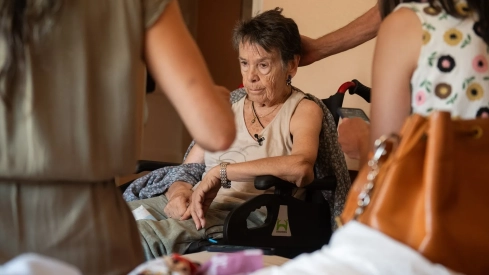
The United Nations special rapporteur on the right to adequate housing, Koldo Casla, strongly questioned this Thursday the eviction of Maricarmen and directly pointed to the judicial decision that allowed it to be executed. "The judge should have suspended it to avoid irreparable harm," he stated just 24 hours after the 87-year-old woman was expelled from the house where she had lived since 1956.
The reproach takes on special relevance because the Committee on Economic, Social and Cultural Rights of the United Nations had already requested a precautionary halt to the eviction. The measure aimed to give Spanish administrations time to find an adequate housing alternative before Maricarmen lost her home.
The suspension never arrived and the eviction was executed this Wednesday with a large police deployment. Maricarmen left the building on a stretcher and was transferred to Gregorio Marañón Hospital with a condition of exhaustion, after a morning marked by protests from hundreds of neighbors and activists.
Casla argued that complying with the Committee's request would have allowed Spain to "in good faith" fulfill its international human rights obligations. The rapporteur also warned that the case shows a deficiency in Spanish legislation, which currently does not guarantee an individualized analysis of the proportionality of each eviction.
"There is no way to understand how prioritizing the profitability of a real estate investment over the right to housing of an 87-year-old woman who receives a 1,300 euro pension and has lived in that house for 70 years can be justified," he denounced.
🏘️🇪🇸 Cuatro observaciones 24 horas después del desahucio de #Maricarmen. 1. Este caso pone de manifiesto que la legislación española actualmente no garantiza un análisis de proporcionalidad individualizado...
— Koldo Casla (@koldocasla.bsky.social) 2026-09-24T07:45:48.973Z
An alternative before the eviction
The rapporteur has demanded that any eviction capable of leaving a person on the street be halted until the corresponding city council or autonomous community offers a "viable and just" solution. "An eviction should not occur without a housing alternative," he insisted.
Maricarmen paid around 500 euros monthly for an old-rent dwelling and has a recognized disability of 50%. The property owner, the company Urbagestión, proposed a rent of 1,650 euros, an amount higher than her income, and rejected the different solutions proposed to avoid eviction.
The Ministry of Housing offered to buy the property or to compensate part of the rent. A writer also committed to covering the difference in rent, and the property owner received a request to postpone the eviction for one month for humanitarian reasons. None of these options were accepted.
Casla has also demanded that large landlords not be able to unilaterally change rental conditions as a preliminary step to expelling their tenants. His message about the balance between the real estate business and the right to housing has been emphatic. "If the investment is not profitable with a tenant inside, let them do business elsewhere," he wrote.
The rapporteur believes that what happened necessitates a review of Spanish procedural regulations so that judges can assess personal, economic, and social circumstances before authorizing an eviction. "Procedural legislation requires an amendment," he concluded.
The Ombudsman, Ángel Gabilondo, also demanded urgent measures this Thursday to prevent the evictions of vulnerable people. The institution described Maricarmen's case as "a symbolic reference of what should never happen" and demanded immediate solutions from the competent administrations.
Add ElConstitucional.es as a preferred Google source for free.
Stay informed about all the latest breaking news with the best information. Against disinformation, for democracy and social rights.
