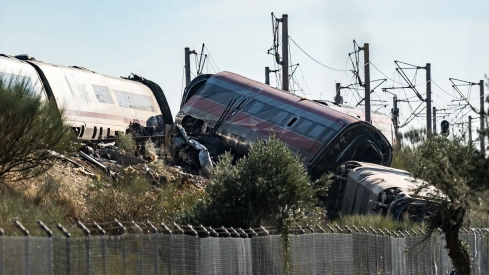
The railway accident that occurred in Urda (Toledo), between a Renfe AVE train and an Iryo convoy, has raised questions about the operation of high-speed safety systems in Spain. Although these mechanisms are designed to prevent collisions, there are still aspects that need to be clarified to understand what happened before the crash.
One of the main keys is the failure of the LZB system, which controls the circulation of trains on the high-speed line between Madrid and Seville. After this breakdown, Adif's control center had to manage traffic and give instructions to the affected trains.
According to the information published about the accident, the control center authorized the AVE to resume its journey at 8:36 a.m. However, the Iryo train was still stopped further ahead. Five minutes after the Iryo driver reported that she could not resume the journey, the collision occurred, around 8:53 a.m. The Government has pointed to a possible human error in the authorization to resume circulation. Nevertheless, this explanation still needs to be contrasted with the evidence and the result of the technical and judicial investigation.
The case raises an important question: if trains have automatic systems to control speed and brake when there is danger, why was the impact not avoided? To understand this, it is necessary to know how railway protection mechanisms work and what happens when the main system fails.
LZB, BSL, and ASFA: how train safety systems work
The Madrid-Seville high-speed line uses the LZB system, a German-origin technology that supervises the position and speed of trains. Its function is to keep circulation under control and prevent a convoy from entering a section of track occupied by another. To do this, the system continuously transmits information between the equipment installed on the track and the devices carried by the train. In this way, it can check if the convoy respects speed limits and circulation instructions. If it detects a dangerous situation, it can order a speed reduction or activate automatic braking.
However, when the LZB stops working, circulation must adapt to more restrictive conditions. At that moment, other safety procedures come into play, such as BSL and ASFA. BSL, acronym for Bloqueo de Señalización Lateral (Lateral Signaling Block), allows regulating train movements through signals located next to the tracks. When this system is used, drivers must respect the indications of these signals and the corresponding speed limits.
For its part, ASFA, whose name means Anuncio de Señales y Frenado Automático (Signal Announcement and Automatic Braking), serves to transmit information about railway signals to the train through devices or beacons installed on the track. If the driver does not respond correctly to certain warnings or does not respect the circulation conditions, the system can activate the brakes. The main difference is that LZB continuously supervises the train's progress, while ASFA acts based on the information it receives at specific points on the track and the planned speed controls.
Therefore, the failure of the main system should not imply that trains circulate without protection. The resumption of travel must comply with the rules corresponding to the alternative system and the infrastructure situation.
Adif's order and the unknowns about the railway accident
The investigation must clarify what instructions each train received, what systems were active, and why the collision was not avoided. According to the reconstruction, the LZB system stopped working around 8:30 a.m. Several trains were stopped, and Adif's control center had to manage circulation alternatively.
At 8:36 a.m., the center authorized the AVE to resume travel under the BSL. Subsequently, at 8:41 a.m. and 8:48 a.m., the Iryo driver reported that her train was still stopped and that she could not restart the LZB system. The AVE ended up hitting the Iryo from behind. The sequence of events focuses on the decisions made during those minutes, but it is still necessary to determine how the protection mechanisms worked and whether all safety procedures were followed.
One of the issues that must be clarified is whether the AVE's ASFA system correctly received information from the signals and whether it could activate braking under the conditions in which the train was operating. It will also be necessary to check what indications the signaling showed and if there was any specific authorization that allowed passing a stop signal. For the moment, it has not been officially confirmed that the ASFA failed or that there was a failure in all safety systems. Therefore, it cannot be stated that the collision was exclusively due to human error or a technical breakdown.
The recordings from the control center, the train logs, and the data from the signaling systems will be fundamental to reconstruct what happened. The objective is to determine if there were errors in the orders, technical failures, or a combination of factors. The accident once again highlights the importance of automatic protection systems in high-speed rail. These mechanisms are precisely designed to reduce the risk of a human error ending in tragedy. The investigation will have to determine why, in this case, the collision could not be avoided.
