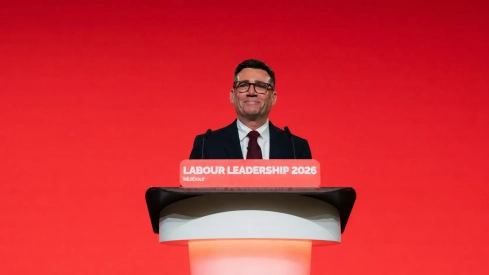
The British Prime Minister, Andy Burnham, has opened the door to studying a future return of the United Kingdom to the European Union. The Labour leader has included this possibility among the alternatives to redefine the relationship with Brussels, after stating that Brexit has caused "more harm than good". For now, he has not announced an application for accession or a timetable to return to the bloc.
Burnham elaborated on his approach this Wednesday on the BBC's 'Today' program, following the speech he delivered on Tuesday at the Labour conference in Liverpool. The Government will examine maintaining current agreements, moving closer to the customs union, returning to the single market, or "going all the way", an expression with which he has left open the reincorporation as a Member State.
Asked about his personal position, he acknowledged that he wishes to see that return. "I would like to see Britain rejoin in my lifetime," he stated, although he clarified that this desire does not imply doing so now. His proposal consists of studying the viability and the advantages and disadvantages of each option, and seeking a consensus on the relationship the country wants to maintain with Europe over the next decade.
British Prime Minister Andy Burnham said Britain should weigh options for its future EU relationship, including possibly rejoining the bloc, doubling down on his message that Brexit had 'done more harm than good' https://t.co/5oPi7Yp2GV pic.twitter.com/O6GCxNIj6P
— Reuters (@Reuters) September 30, 2026
The alternatives have different consequences. A customs union would facilitate trade in goods, through agreements on tariffs and customs rules, while participating in the single market would entail broader integration, linked to European standards and the free movement of goods, services, people, and capital. Rejoining the EU would also require negotiating a new accession.
The shift opens a debate on the red lines maintained by Keir Starmer, whom Burnham succeeded in July. The program with which Labour won the 2024 elections ruled out returning to the single market and the customs union, as well as restoring the free movement of people. The new prime minister has expanded the options he is willing to examine, but he still needs to specify what changes his government will advocate.
The Cost of Brexit
The review comes ten years after the June 2016 referendum. The United Kingdom formally left the EU on January 31, 2020, and exited the single market and the customs union at the end of that year. Since then, British companies face new administrative and commercial barriers in their exchanges with European partners, despite the agreement that allows tariff-free trade when its conditions are met.
The Office for Budget Responsibility (OBR), the independent British fiscal watchdog, estimates that Brexit will reduce long-term potential productivity by around 4% compared to a scenario of remaining in the EU. Its forecast also contemplates a volume of imports and exports approximately 15% lower than there would have been without the exit. These are estimates of the cumulative effect of trade barriers, not an already recorded annual drop.
Burnham linked this situation on Tuesday to the cost of living and the lack of economic direction, along with previous problems such as deindustrialization and austerity. The prime minister wants to review the relationship with what remains the country's main market, a decision that affects businesses, investment, and cooperation with European neighbors. "Everyone knows that things are not working as they should," he told Labour members.
Public opinion has also shifted towards greater rapprochement. A YouGov survey published this Wednesday, with fieldwork conducted on September 24 and 25, places support for rejoining the EU at 59%, compared to 32% opposition. The same question registered 51% support in January 2024.
Support is even higher when the option of strengthening ties without rejoining the bloc, the single market, or the customs union is considered. This option gathers 73% of respondents, compared to 15% who reject it. The responses correspond to different scenarios posed separately, so these percentages should not be added or interpreted as mutually exclusive options.
The conditions of a potential accession remain decisive. In another study published in June, YouGov found that support for rejoining decreased to 35% if the country lost its former exceptions, such as those that allowed it to remain outside the euro and Schengen; in that scenario, opposition reached 43%. This result belongs to an earlier survey and shows the weight that negotiation conditions could have.
Support and conditions
Burnham's opening has provoked the rejection of conservatives and Reform UK, Nigel Farage's far-right party. Conservative MP Alex Burghart has accused him of reopening Brexit wounds, while Richard Tice, Reform's number two, has spoken of "betrayal" and an attempt to return the country to Brussels "through the back door."
The Prime Minister intends to present the alternatives around the next UK-EU summit, scheduled for November, after the meeting planned for July was postponed following Starmer's departure. London and Brussels are holding talks on issues such as agri-food trade and youth mobility, which may advance before any decision on deeper integration.
Re-entry would require a formal application and negotiation with European institutions. Accession requires the unanimity of member states and the consent of the European Parliament, in addition to the ratification of the corresponding treaty. The special conditions that London enjoyed before Brexit would not be automatically recovered.
Emmanuel Macron has favorably received the possibility during his visit to Spain. The French president has said that it would be good news for Britons and Europeans, although he has warned that London could not choose only the advantages that interest it. "You cannot keep only what suits you," he said when referring to the rights and obligations of the relationship with the Union.
Pedro Sánchez has also backed a possible return. The Prime Minister has recalled that the departure was a loss for the British population and for the European project, and has expressed Spain's willingness to welcome the United Kingdom back. "Spain would applaud that decision and open its arms to a brotherly people," he stated.
